English
 Español
 Português
 Français
 Русский язык
 Italiano
 Deutsch
 Nederlands
 لعربية
 한국어
한국어 Japanese
 ภาษาไทย
 Türkçe
 Tiếng Việt
 Bahasa Indonesia
 Hindi
Hindi kazakh
 Uzbek
Uzbek Thai
Thai Farsi
Farsi
Qtenboard New Factory Upgrade | Production, QC OEM Customization Capacity
 2026-08-18
 675
675



2026-08-18
675
Buyers sourcing interactive flat panels and digital signage care about more than quoted unit prices and written specification sheets. Real‑world delivery speed, stable batch‑to‑batch performance and reliable quality control decide whether your project runs smoothly or runs into costly delays. Many suppliers publish impressive spec lists, yet their old‑style workshops struggle under large‑volume orders. Bottlenecks pop up in material handling, motherboard assembly and quality inspection. You face extended lead‑times, inconsistent unit performance and higher after‑support workload. Our newly‑completed Qtenboard manufacturing park addresses these common pain points from the ground up. Every zone, equipment set and workflow rule gets built for large‑volume commercial display production and OEM custom orders.
One of the biggest advantages of the new factory is its expanded layout. The new park is not only larger, but also divided in a much more structured and logical way. Material inbound, SMT lines, assembly lines, reliability testing rooms, and packaging zones are now physically separated but seamlessly connected.
Old factory layouts often place unrelated workstations close together. Raw materials cross paths with finished goods. Teams from different departments share narrow aisles. Staff spend significant working hours moving parts back and forth across buildings. Peak‑order seasons amplify these problems. Long material transfer times create waiting gaps on assembly lines. Minor holdups in one area spread and slow down the whole site.
This reduces unnecessary movement, prevents bottlenecks, and improves the speed of inter‑department communication. The workflow now feels smoother and more predictable, even during peak seasons. Raw components go straight from receiving storage toward SMT stations. Assembled motherboards flow directly into panel assembly workshops. Completed units move to reliability testing rooms without long‑distance transport. Passed goods transfer into dedicated packaging zones. Each production phase follows a natural physical sequence. You get shorter overall lead‑times, and scheduling forecasts become far more accurate for your bulk orders.
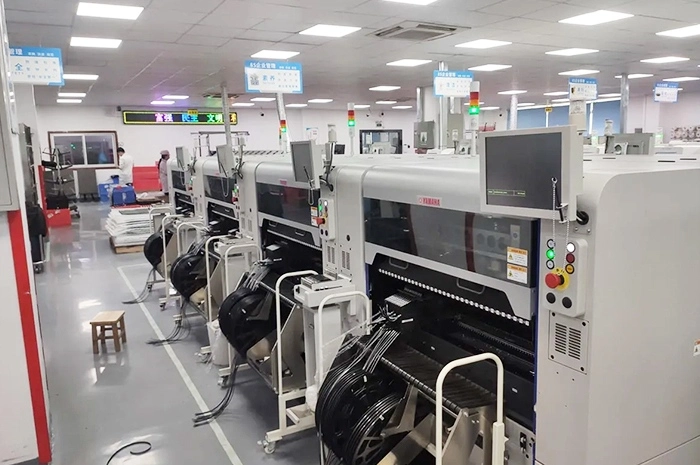
A major upgrade is the introduction of fully automated SMT (Surface Mount Technology) lines. These lines dramatically increase motherboard output while also improving precision.
For products like interactive whiteboards and digital signage, the motherboard is the heart of the device, and any delay here slows down the entire production chain. Older production sites rely heavily on manual component placement for certain board types. Human operators cannot match placement repeatability of automated machinery. Tiny resistors, chips and sensor connectors suffer offset placement. Small soldering defects appear on a percentage of finished boards. Those flaws may not show up during simple factory power‑on checks. They surface weeks later under real‑world store or classroom operating conditions.
With the automated SMT line, components are placed faster, more accurately, and with less manual intervention. Machine‑guided placement holds tight tolerances for every chip and passive part. Soldering temperature curves stay consistent board after board. Defect rates on fresh‑produced motherboards drop visibly. More qualified mainboards roll out per working shift. This is especially important for large‑volume OEM orders, where customers expect both quick turnaround and consistent performance across all units.
When you place big‑batch OEM orders, motherboard supply forms your main scheduling risk. If board output falls behind schedule, whole finished‑goods shipments get pushed back. Our upgraded SMT capacity removes that risk. We can ramp up motherboard output to match seasonal order spikes without sacrificing assembly precision. Every board feeds into later assembly steps with stable baseline quality.
The factory now operates under a strict three‑stage QC process, which covers incoming parts, mid‑assembly checks and pre‑shipment verification. Many manufacturers only run final‑unit testing. Hidden component defects or assembly mistakes can slip through and reach end‑users. Our multi‑layer QC catches issues long before product packing.
IQC (Incoming Quality Control) – All electronic components undergo parameter testing before entering production. Critical modules like touch controllers, display drivers, and WiFi boards must pass higher standards, as they directly impact user experience. We sample‑test every incoming batch. If measured parameters deviate from agreed‑on datasheet values, that whole component lot gets rejected. You avoid finished‑product failures caused by low‑grade supplied parts.
IPQC (In‑Process Quality Control) – During assembly, IPQC teams perform random checks to ensure cable routing, structural fixation, and touch responsiveness meet internal benchmarks. If something looks off, the team can immediately stop the line and address the issue. Inspectors sample units from active assembly stations, not only finished stacks. Loose wiring, misaligned fasteners or improperly seated connectors get fixed right away. Small assembly problems cannot accumulate into large‑batch quality events.
OQC (Outgoing Quality Control) – Before shipment, every unit is tested again to confirm stability and consistency. This includes checking firmware, ports, display brightness, and overall build quality. Operators cycle through each physical interface. They verify preset firmware versions match your project requirements. Screen brightness, colour output and touch response get validated one more time.
This systematic approach ensures that every stage of production contributes to stable quality rather than relying solely on final checks. Defect filtering happens step‑by‑step. Bad components get blocked at entry. Poor assembly gets corrected mid‑run. Final‑shipment verification confirms everything meets your specifications. This framework cuts failure risks for both standard stock products and custom‑built OEM hardware.
To make sure each interactive flat panel and digital signage unit can handle real‑world usage, the factory performs a 48‑hour high‑temperature aging test. Many factories skip long aging cycles to speed up delivery. Minor thermal‑related weaknesses will not show within short power‑on checks. Those weaknesses surface after weeks or months of customer‑site running.
During this process, the device runs continuously in a heated environment to simulate long‑term usage. After aging, engineers retest touch accuracy, display brightness, thermal management, system stability, speaker output, and wireless connectivity. Units that crash, lose touch calibration, overheat or suffer wireless drop‑outs during aging get pulled out from the shipment pool. They go through troubleshooting and rework before any re‑testing. Only repaired units that pass full aging cycles can move forward toward packing.
Only products that pass all these checks proceed to packaging. For international shipments, packaging is further reinforced based on transport distance and destination logistics conditions. This reduces damage during sea and land transport. Export‑bound goods face vibration, temperature swings and stacking pressure inside shipping containers. Our packaging team adjusts foam thickness, carton grade and inner support structures according to shipping route. You receive hardware with lower risk of transit‑caused physical damage.
To better support branding and customization needs, Qtenboard built an independent OEM customization area. This zone includes a UI customization printing area, a chassis silk‑screening area, and a boot‑animation programming station.
Before this dedicated zone existed, custom branding work shared floor space with mass‑stock assembly. Custom‑order handling slowed down standard product throughput, and vice‑versa. Custom firmware flashing, case silk‑screen work and wallpaper setup competed for operator resources. Lead‑times for OEM projects became unpredictable when large stock orders arrived.
OEM customers can provide brand logos, color themes, wallpapers, and design materials. Engineers integrate these into a unified system covering visual UI, boot‑up animations, and exterior branding. Because this line is separate from the main production line, overall throughput is unaffected, allowing simultaneous standard and customized orders. Your branded projects do not get delayed by big stock‑product runs. Operators assigned to the OEM zone focus only on custom‑request tasks. You get consistent execution for logo printing, boot‑logo programming and pre‑loaded brand‑themed UI settings.
This independent line also supports deeper OEM work beyond surface‑level branding. When your project needs minor firmware tweaks or special pre‑installed application settings, the OEM zone handles those configuration steps. All custom‑modified units go through the same IQC‑IPQC‑OQC and 48‑hour aging test flow as standard‑model hardware. Customization does not mean relaxed quality standards.
| Category | Upgrade Highlights | Direct Business Benefits For Buyers |
|---|---|---|
| Production Layout | Larger campus, clear physical zoning for inbound, SMT, assembly, testing, packaging | Smoother material flow, fewer workflow bottlenecks, more predictable lead‑times for bulk orders |
| SMT Capacity | Fully automated SMT production lines for mainboard assembly | Higher mainboard output, tighter placement precision, lower motherboard‑related defect rate |
| Quality Control | Three‑stage IQC‑IPQC‑OQC full‑process QC system | Defects get caught at multiple production stages, less bad hardware reaches finished‑goods status |
| Aging Test | Mandatory 48‑hour high‑temperature aging for every display unit | Screen out thermal‑related hidden faults before shipment, improve long‑term field reliability |
| OEM Customization | Physically separated OEM customization line, silk‑screen, UI and boot‑animation stations | Custom branding jobs run without disrupting mass‑stock production, stable OEM lead‑time performance |
| Export‑Oriented Packaging | Adjustable reinforced packaging matched to shipping route and destination | Lower physical damage risk for sea‑freight and long‑land‑route international shipments |
Eliminates motherboard supply bottlenecks that used to push back bulk‑order delivery dates during peak buying seasons.
Reduces batch‑to‑batch performance differences, a common headache for resellers handling repeat‑purchase OEM orders.
Separates custom‑OEM workflow from standard‑product assembly, so your branding requests do not wait behind large stock‑model runs.
Multi‑stage QC plus mandatory aging test cuts the volume of faulty units arriving at your receiving warehouse.
Route‑adapted export packaging lowers product damage claims and replacement costs for cross‑border projects.
Structured zone layout supports future order‑volume growth, so production capacity can expand together with your business demands.
Q1: How does the new factory improve production efficiency for my bulk orders?
A1: The factory layout is larger and better organized. Each production step is placed in a logical sequence, reducing unnecessary waiting time and boosting collaboration across teams. Automated SMT equipment lifts mainboard output capacity. Separated OEM zones prevent custom‑order work from interfering with standard‑product throughput. All these points make delivery timelines more predictable for large‑volume orders.
Q2: What quality testing procedures do interactive panels and digital signage complete before shipment?
A2: Products go through IQC for incoming components, IPQC random sampling during assembly, and OQC full‑unit inspection before packing. Every finished unit also completes a 48‑hour high‑temperature aging test that checks system stability, brightness, touch accuracy, thermal performance, speaker output and wireless connectivity.
Q3: Can OEM customers request branding and visual customization work inside this new factory?
A3: Yes. The factory has a dedicated customization line that handles UI themes, chassis silk‑screen printing, custom wallpapers, and startup animations. You supply your brand design files, and our operators finish branding work within this independent zone. Customized units still pass all standard quality checks and aging cycles.
Q4: How does the factory protect products during international sea or land shipping?
A4: Reinforced packaging materials and inner supporting structures are selected based on transportation method and destination distance. For long sea‑freight routes, we use thicker shock‑absorbing foam and heavy‑grade cartons. This setup lowers the risk of screen cracks and structural damage during transit.
Q5: Does every single unit go through the full 48‑hour aging test, or only sample units?
A5: Every finished interactive flat panel and digital signage unit runs the full 48‑hour high‑temperature aging procedure. We do not rely only on sampling. Units showing instability during aging get pulled aside for troubleshooting and rework. They cannot move into packaging until they pass the complete test cycle.
Q6: What happens if defects are found during IPQC in‑process inspection?
A6: The production line for that segment can stop right away. Technicians locate root causes, adjust assembly operations, and fix affected units. We do not keep producing while known assembly issues exist. This stops small‑scale assembly mistakes from spreading across a large batch of products.
Q7: Will OEM custom‑order lead‑times become longer because of extra branding steps?
A7: The independent OEM zone minimizes extra scheduling pressure. Custom branding tasks run parallel to main‑line assembly. As long as you supply finalized design files on time, branding work adds limited extra days to your overall project timeline.
Q8: Can I arrange factory visits to inspect the new production site and testing rooms?
A8: Yes. Qualified project partners can schedule on‑site factory tours. You may view material inbound zones, SMT lines, assembly workshops, aging‑test chambers and the OEM customization area. Remote virtual walk‑through options are also available for overseas buyers unable to travel.
Q9: How does automated SMT improve product quality besides lifting production volume?
A9: Automated machinery delivers higher component‑placement repeatability. Soldering parameters stay consistent across thousands of boards. Human‑caused placement and soldering mistakes drop sharply. This reduces hidden motherboard faults that would otherwise appear after products reach end‑user locations.
Q10: Are the three‑stage QC and aging‑test rules applied to both standard stock goods and OEM customized goods?
A10: Yes. Custom‑branded OEM units follow exactly the same quality control workflow. Customization steps do not create exceptions for testing standards. This keeps quality uniform no matter whether you order standard models or fully‑branded OEM hardware.


 Floor 6, Building A, No. 3, North District, Shangxue Science and Technology City, Xinxue Community, Bantian Street, Longgang District, Shenzhen City
 info@szqunmao.com
 +86 15920011166
 +86 15920011166