English
 Español
 Português
 Français
 Русский язык
 Italiano
 Deutsch
 Nederlands
 لعربية
 한국어
한국어 Japanese
 ภาษาไทย
 Türkçe
 Tiếng Việt
 Bahasa Indonesia
 Hindi
Hindi kazakh
 Uzbek
Uzbek Thai
Thai Farsi
Farsi
Interactive Panel OEM Manufacturing Control | Qtenboard Full‑Process OEM Service
 2026-08-18
 564
564



2026-08-18
564
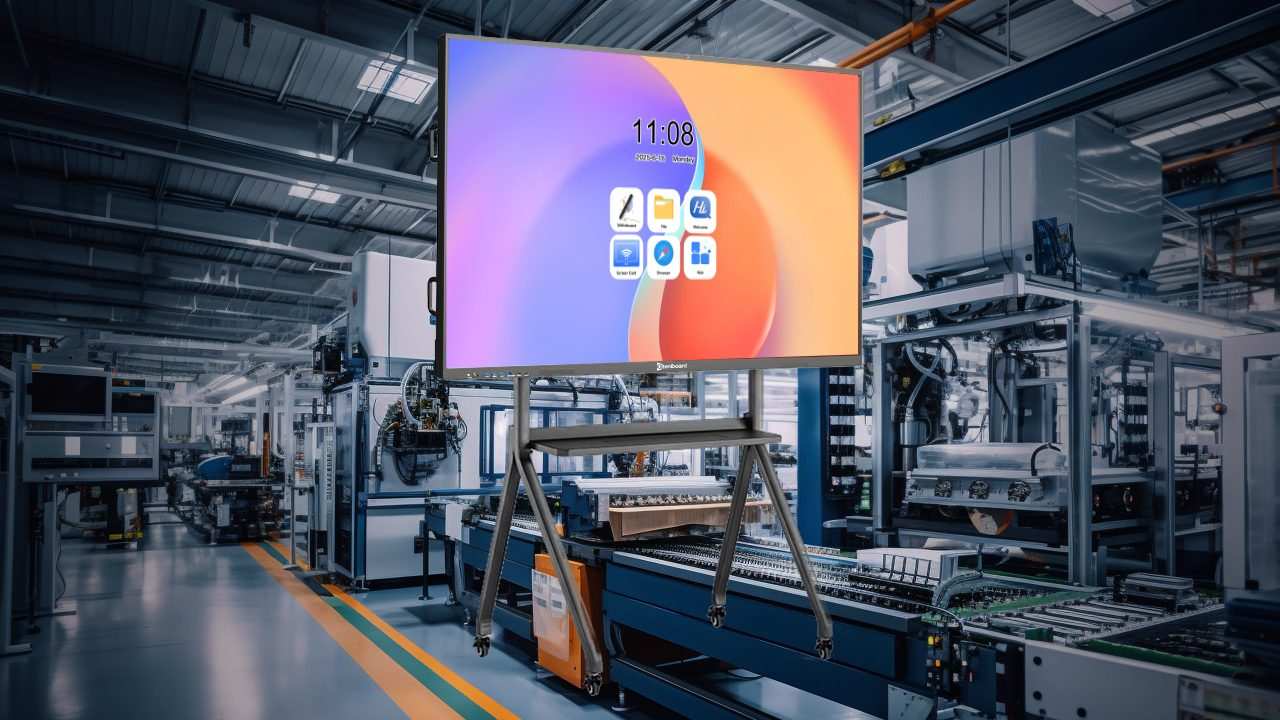
When it comes to interactive panel OEM cooperation, 63% of B2B electronic buyers (2025 survey) immediately think of changing logos or adjusting boot screens. They mistakenly believe that attaching their own brand to a generic interactive panel is equivalent to a “complete OEM cooperation”. Many purchasing teams set their expectations only on surface‑level brand tweaks. They move forward with orders, unaware of hidden risks built deep inside the production workflow. However, in the fiercely competitive interactive display industry, this perception is far from the truth. With more than ten years of experience in interactive panel manufacturing, we deeply understand the core of OEM cooperation. The real barrier is never superficial branding, but absolute control over the manufacturing process, helping partner brands achieve differentiated competition and get rid of the predicament of homogenization.
Many overseas distributors and edtech brands fall into this common trap. They compare product photos and specification sheets from multiple factories. Units look almost identical on paper. Price becomes the main decision factor. They place large‑volume orders under the assumption that all finished goods will perform consistently after branding work completes. This mindset creates costly mistakes that surface months after shipment.
On the market, interactive panels may seem identical in appearance, with the same screen size and similar bezel design, but there can be huge differences in core components (motherboards, touch systems, components). Most suppliers’ “OEM services” are only limited to appearance modifications, leaving partner brands unable to control product performance and eventually falling into a passive position. Just like the painful experience of a Southeast Asian edtech brand: after ordering 500 branded interactive panels, they were refused by the supplier when they needed to adjust the firmware to support local languages. Such factories can only provide superficial customization and cannot give brands real manufacturing voice.
This Southeast Asian case is not isolated. Multiple B2B customers share similar stories. Brands receive hardware printed with their logo, yet they hold zero authority over core software and hardware choices. When local market requirements shift, they cannot modify system language packs, disable unused applications, or adjust touch parameters for regional education software. They have to wait for the original manufacturer’s schedule. Their own product roadmap gets held hostage by third‑party production priorities. Your brand cannot respond quickly to market demands under such conditions.
The gap between superficial branding and real OEM lies in the presence or absence of manufacturing control. Superficial branding can only modify logos, packaging or boot screens, but cannot interfere with core configurations. Real OEM cooperation means that brands can fully control product design, component selection, production processes and firmware updates. As a source manufacturing enterprise, we break the industry misunderstanding of branding and provide full‑process manufacturing control, allowing partner brands to truly own their own Qtenboard products instead of simply replicating generic models.
You should draw a clear line between white‑label rebranding and genuine OEM work. White‑label rebranding takes existing mass‑produced hardware and applies cosmetic changes. All internal hardware and software stay fixed. Real OEM starts from your project requirements. Every major component, testing standard and system setting can align with your target market. This difference shapes your long‑term market performance and after‑sales workload.
Real OEM cooperation for Qtenboard is based on four uncompromising pillars of manufacturing control. First, design autonomy. Partner brands can independently choose motherboard specifications, touch systems and structural designs for Qtenboard. You can customize anti‑drop bezels for campus scenarios and slim bodies for office scenarios, accurately matching your own customer needs. If you target classroom deployment, you may pick reinforced frames, anti‑glare glass and longer‑running hardware configurations. For corporate office resale, slim housing, extra interface ports and lightweight structures make more business sense. You do not need to adapt your business to fit pre‑set standard hardware.
Second, process control. We allow partner brands to define welding standards, 48‑hour stress testing and touch response detection for Qtenboard production. You can audit the production line at any time to eliminate cut corners. Many white‑label factories skip extended aging tests to shorten production cycles. Defective units slip through and reach end‑users. With our OEM model, you set test thresholds. Every finished unit must pass your defined checkpoints before packing. You can arrange on‑site or remote production audits to confirm compliance with your requirements.
Third, batch consistency guarantee. By locking the bill of materials (BOM) for Qtenboard, we prevent arbitrary replacement of cheap components. Each batch of products will provide a test report to ensure that the deviation of brightness, touch sensitivity and heat dissipation performance is less than 1%. Uncontrolled BOM changes create the most damaging issues for B2B resellers. A factory may swap touch chips, power modules or thermal parts without notification to cut costs. Early batches work fine. Later shipments show noticeable performance drops. Locked‑BOM rules block this risk. Every component change needs formal confirmation from your side before implementation.
Fourth, system integrity control. Partner brands can review all firmware updates of Qtenboard, obtain complete technical documents, and independently control after‑sales services. Brand commitments run through the entire product life cycle. Many white‑label customers cannot get full firmware source‑related documents. They cannot carry out secondary development for local education platforms or office software. When software bugs appear, they fully depend on the original factory’s update rhythm. You avoid this bottleneck through our full‑control OEM framework.
Lack of manufacturing control will bring hidden costs and huge risks to partner brands. A European education distributor once encountered a dilemma. The first batch of 1,000 interactive panels performed well, but 20% of the second batch had touch calibration problems. It turned out that the factory had arbitrarily replaced cheap touch controllers without notification. This directly led to the recall and refund of 200 products, damaged brand reputation, and eventually lost school district orders. Partner brands choosing our Qtenboard OEM service can completely avoid such risks.
Recalls carry heavy financial losses. You cover shipping costs for returned goods. You process refunds to your own buyers. You allocate extra staff hours to handle complaint tickets. More harmful is reputational damage. Public‑sector education buyers keep long‑term vendor records. Bad product experiences can shut you out of large‑tender projects for multiple years. These indirect losses rarely appear in initial quotation comparisons, yet they dominate long‑term project profitability.
Based on our own factory, we have created a real OEM cooperation model for Qtenboard with prominent core advantages. Our own factory realizes full‑process production control without outsourcing links. Many interactive display suppliers outsource key assembly steps to third‑party workshops. They lose direct oversight over workmanship standards. Every production phase stays inside our facility under our management. Qtenboard uses modular design. You can flexibly customize touch sensors, interfaces or heat dissipation solutions without redesigning the entire machine. Modular architecture cuts custom development cycles and lowers your non‑recurring engineering fees. The component list of Qtenboard is traceable. All parts are reviewed and confirmed together with partner brands. We endow partner brands with firmware control rights for Qtenboard. You can customize firmware and review all updates to adapt to local language and software integration needs.
You gain practical market flexibility from these capabilities. If your market requires special local language input methods, you can adjust system firmware accordingly. When local education software needs specific hardware interface permissions, you can implement matching system configurations. You are not stuck waiting for a generic firmware release built for global mass markets.
Data is sufficient to prove the importance of manufacturing control: the annual failure rate of superficially branded OEM products reaches 72%, the batch defect rate is 15‑20%, and the customer retention rate is only 32%. The real OEM Qtenboard products we provide have an annual failure rate reduced to 18%, a batch defect rate of less than 5%, and a customer retention rate as high as 78%. Today, relying on full‑process manufacturing control capabilities, we help many partner brands achieve differentiated competition through Qtenboard, get rid of the predicament of branding, and become the preferred partner in the interactive panel OEM field.
These statistics reflect real‑world operating gaps. Lower failure rates shrink your after‑sales support workload. Smaller batch defect rates reduce replacement inventory pressure. Higher end‑customer retention translates into repeat purchase orders for your brand. The extra investment in genuine OEM pays back across the whole product lifecycle.
| Evaluation Dimension | Simple White‑Label Rebranding | Qtenboard Full‑Process OEM |
|---|---|---|
| Available custom items | Logo, boot‑up screen, outer packaging | Board selection, touch hardware, structure, glass, interfaces, firmware, test standards |
| BOM management | Factory changes components without notification | BOM locked, any component change needs partner confirmation |
| Production testing rules | Fixed factory default testing flow | You define aging time, touch test, stress‑test thresholds |
| Firmware authority | No modification access, wait for factory releases | Custom firmware, review all update versions, local language adaptation |
| Batch consistency report | No independent batch test data provided | Each shipment delivers batch‑wise performance test reports |
| Production audit permission | Not supported | Support on‑site or remote production‑line audit |
| Annual product failure rate | Up to 72% | 18% |
| Typical suitable buyer | Small trial order with zero special requirement | Edtech distributors, office‑solution brands, large‑volume tender‑oriented partners |
Design Autonomy: Select motherboard, touch module, glass type and structural housing. Build hardware matched for education classroom, corporate meeting or public display scenarios.
Process Control: Set welding standards, 48‑hour stress aging, touch‑response detection rules. Conduct production audits to prevent shortcuts during mass production.
Batch Consistency Guarantee: Lock complete BOM file. Every batch provides test reports. Keep brightness, touch sensitivity and heat‑dissipation deviation below 1%.
System Integrity Control: Review every firmware iteration. Get complete technical documentation. Manage your own after‑sales logic for your branded interactive panels.
Unannounced component replacement leads to inconsistent performance across different production batches.
No permission to adjust firmware for local language, regional education software or special interface requirements.
You cannot set your own product testing standards, bad units pass factory inspection and reach end‑buyers.
No formal batch test reports, hard to trace root causes when quality complaints appear.
Your after‑sales response speed is limited by the original factory’s technical support schedule.
Large‑tender project requirements cannot be satisfied because you cannot provide BOM and production‑control proof documents.
Q1: What is the difference between white‑label rebranding and real Qtenboard OEM?
A1: White‑label rebranding only changes logo, boot screen and packaging based on existing standard hardware. You hold no control over internal components or firmware. Real Qtenboard OEM lets you decide core hardware selection, testing standards, locked‑BOM rules and firmware adjustments. You obtain genuine ownership of your product solution.
Q2: Must I redesign everything if I choose Qtenboard OEM?
A2: No. Our modular framework allows partial modification. You can keep standard housing while swapping touch modules or motherboards. You pick which parts to adjust, and reuse proven mature modules to cut engineering cost and shorten lead‑time.
Q3: What does BOM locking mean for my project?
A3: BOM locking freezes the full component list of your interactive panel. No chip, touch sensor, power unit or thermal part can be swapped out without your written confirmation. This stops hidden cost‑cutting component substitutions and keeps performance identical across every production batch.
Q4: Can I get firmware modification rights for local language and local software integration?
A4: Yes. Within our OEM scope, you can carry out language adaptation, pre‑install designated applications, and review every firmware update release. You do not fully depend on our default system build for global markets.
Q5: Am I allowed to audit your production line for my OEM order?
A5: Yes. On‑site factory visits or remote streaming audits are available for formal OEM projects. You can check assembly workflow, aging‑test stations and quality‑check procedures for your product batches.
Q6: What documents will I receive with each production batch?
A6: Each shipment delivers batch‑level test reports covering brightness, touch response, heat dissipation and power‑consumption data. OEM partners also get full BOM files and relevant technical documentation for after‑sales support work.
Q7: Is Qtenboard OEM suitable for small‑volume initial orders?
A7: OEM projects have minimum order thresholds for full hardware customization. If your quantity is low at the beginning, you can start with partial custom items such as firmware adjustment and logo branding. You expand deeper manufacturing control as your order volume grows.
Q8: How does manufacturing‑control OEM reduce my long‑term business risk?
A8: Locked‑BOM rules prevent unexpected hardware changes. Independent batch testing lowers defect rates. Firmware control lets you respond fast to local‑market demands. These points cut recall probability, reduce after‑sales tickets and protect your brand reputation for education and corporate tender projects.
Q9: If I select Qtenboard OEM, will I handle all firmware development work by myself?
A9: No. Our technical team completes base firmware development. You get review authority for every change request. You tell us your requirements for language, pre‑loaded software and system restrictions. Our engineers implement these adjustments for your branded interactive panels.
Q10: What scenarios benefit most from full‑control OEM service?
A10: Partners targeting education tenders, corporate office solution resellers, regional distributors with special local‑software requirements, and brands pursuing differentiated product positioning gain the most value. Pure resellers with zero special technical requirements may fit simple white‑label rebranding workflows.


 Floor 6, Building A, No. 3, North District, Shangxue Science and Technology City, Xinxue Community, Bantian Street, Longgang District, Shenzhen City
 info@szqunmao.com
 +86 15920011166
 +86 15920011166