English
 Español
 Português
 Français
 Русский язык
 Italiano
 Deutsch
 Nederlands
 لعربية
 한국어
한국어 Japanese
 ภาษาไทย
 Türkçe
 Tiếng Việt
 Bahasa Indonesia
 Hindi
Hindi kazakh
 Uzbek
Uzbek Thai
Thai Farsi
Farsi
Why Modern Commercial Interactive Displays Demand Better Hardware
 2026-07-28
 578
578



2026-07-28
578
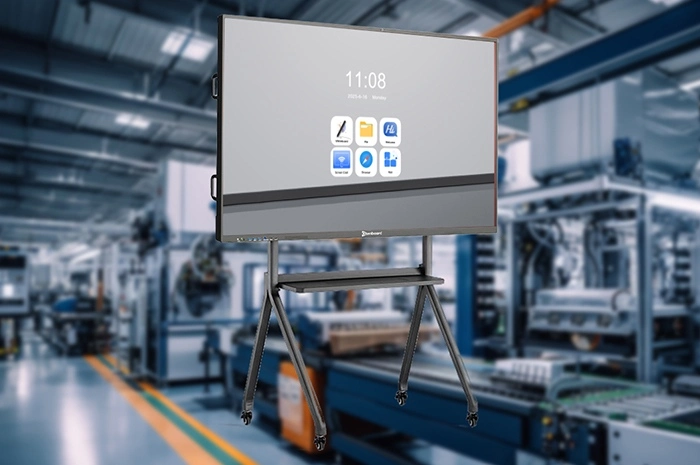
In commercial and educational environments, an interactive whiteboard is no longer a simple presentation tool. It has become a core communication device, used for teaching, corporate training, remote collaboration, data sharing and organizational decision-making.
As end-user expectations continuously rise, so do the rigorous demands placed on the internal hardware of a commercial interactive display. Classroom teachers, enterprise meeting participants and IT administrators expect instant touch response, smooth continuous writing, high-fidelity clear visuals, and stable all-day performance—regardless of how long the device has been running or how many applications, video streams and peripheral devices are active simultaneously.
Unlike ordinary consumer-grade tablets and monitors, commercial interactive whiteboards face intensive long-cycle usage. They operate for extended hours, frequently running 8–12 hours every single workday, and are shared by dozens of different users each week. This realistic application environment makes underlying hardware architecture far more critical than superficial outward appearances and basic marketing features.
For brands like Qtenboard, hardware architecture is not merely an isolated technical choice—it directly shapes daily user experience, long-term operational reliability, and overall equipment lifecycle value, and superior hardware architecture is the foundation of daily usability and lasting user satisfaction.
At the core of a professional interactive flat panel hardware platform lies the main processor. The RK3576 plays a decisive role in balancing peak computing performance, power efficiency, and long-running system stability.
Instead of blindly pursuing short-term peak benchmark performance alone, the RK3576 chipset is architected to handle multiple concurrent real-world tasks at the same time, which perfectly matches interactive whiteboard operating scenarios. A typical interactive whiteboard may need to render high-resolution teaching courseware, process multi-point touch handwriting input, allocate system memory resources, decode multi-channel video content, and maintain data communication with external cameras, microphones and laptops all at once without congestion.
This balanced multi-task performance is essential for a commercial interactive display, where sudden system interruptions or visible operation delays can completely disrupt classroom lessons or important corporate meetings. With optimized RK3576 scheduling architecture, system response remains consistent and predictable, even during continuous all-day extended use.
For frontline end users including teachers and meeting moderators, this translates into seamless, uninterrupted human-computer interaction. For school and enterprise IT operation teams, it means fewer performance-related failures and maintenance tickets over the device’s full lifecycle.
The visual and interactive experience directly defines how users perceive the overall quality of an interactive whiteboard.
High-resolution 4K displays have gradually become standard configuration in modern commercial and educational environments. However, advanced panel specifications cannot deliver real value without matching powerful underlying hardware architecture. Smooth 4K video playback, precise image color rendering, stable high frame rate output and seamless picture switching all heavily rely on the capability of the main control platform. Insufficient processing capacity will lead to frame drops, color distortion and delayed screen output, wasting the potential of high-quality LCD panels.
Touch interaction is equally critical for daily usage. Freehand writing, screen annotation, document dragging and content navigation must deliver natural, zero-latency feedback. Any perceptible lag between physical touch input and on-screen cursor response quickly breaks user concentration and confidence during teaching and meetings.
By deeply optimizing the coordination mechanism between display output pipelines and multi-touch data processing modules, RK3576-powered Qtenboard interactive whiteboards deliver far more fluid and predictable interactive experience. The stable touch response supports continuous teaching annotation and group collaborative discussion without unnecessary distraction, and natural low-latency interaction boosts teaching and meeting efficiency significantly.
A professional commercial touchscreen whiteboard must achieve seamless integration within already built classroom and office IT environments.
In K12 classrooms, university lecture halls and enterprise meeting rooms, interactive displays frequently connect with Windows/Mac laptops, conference cameras, array microphones, external active audio systems, USB storage drives and wireless casting adapters. The hardware platform architecture determines how reliably these peripheral connections function, especially under the condition that multiple interfaces work simultaneously without resource conflict.
Complete interface protocol support ensures quick, smooth switching between different signal input sources. Teachers and meeting presenters can fully concentrate on content delivery instead of wasting time debugging connection failures and configuration problems. For project system integrators deploying smart classrooms and conference systems, this outstanding compatibility reduces on-site deployment complexity and long-term customer after-sales support costs.
True peripheral compatibility is not simply reserved physical port slots—it depends on how the entire interactive display hardware platform uniformly manages external data communication, signal decoding and power allocation.
In continuous commercial operation scenarios, long-term running stability often carries greater importance than raw instantaneous computing performance.
An education interactive whiteboard may stay powered on for many hours every school day. A meeting room interactive display can run continuously through back-to-back multi-shift conferences. Under both working modes, random system crashes, progressive frame rate slowdowns and automatic restarts are completely unacceptable and will cause serious disruption to formal activities.
Scientifically optimized hardware architecture realizes effective thermal management, consistent performance output, and predictable stable system behavior over multiple years. When properly integrated, tuned and equipped with reasonable heat dissipation design, the RK3576 platform supports long-duration continuous operation without obvious performance degradation or frequent forced restarts.
This inherent operational reliability directly affects the equipment total cost of ownership (TCO), making underlying hardware architecture a critical factor during institutional procurement and purchasing decisions.
In diversified educational environments, an interactive whiteboard needs to adapt to multiple flexible teaching styles. During one single class, teachers frequently switch between freehand writing, high-definition multimedia courseware playback, embedded interactive exercises and online remote classroom connection.
Sustained smooth system performance helps maintain coherent lesson rhythm and improves student engagement in class. Clear display visuals and responsive touch interaction make digital teaching resources more accessible and improve overall classroom teaching effectiveness.
In corporate meeting rooms, commercial interactive displays serve as central digital collaboration hubs. Team members conduct brainstorming, annotate project documents in real time, share market data and exchange creative ideas simultaneously. Consistent hardware stability ensures meetings stay focused and productive without technical interruptions.
Across both education and enterprise office scenarios, the underlying hardware architecture determines whether the interactive display facilitates efficient communication or becomes an annoying source of technical friction—multi-scenario adaptability maximizes the return of hardware investment.
Purchasing a commercial interactive display represents a long-term capital investment for schools, government organizations and enterprises. Institutional buyers expect 5–8 years of stable reliable service, rather than merely excellent performance within the initial few months after delivery.
A forward-looking scalable hardware platform such as RK3576 enables interactive whiteboards to support continuous future software OTA updates and expanding new functional use cases. This kind of system adaptability effectively prevents premature equipment obsolescence and extends the effective service lifespan of interactive panels.
For institutional buyers, this platform characteristic translates into better long-term return on investment. For daily end users, it guarantees a consistent smooth operating experience year after year.
Heading into 2026, optimized underlying hardware architecture will occupy an increasingly important position in interactive flat panel product research and development.
Several influential industry trends are already emerging in the smart display sector:
Deeper hardware and software system integration: Interactive whiteboards will adopt more tightly coupled all-in-one hardware & software platforms instead of relying on fragmented independent functional plug-ins.
Higher energy efficiency, not only higher hardware specifications: Low power consumption and intelligent thermal control will become core evaluation indicators for large-scale commercial equipment deployment.
AI-assisted natural human-computer interaction: Main hardware platforms will gradually support built-in intelligent capabilities including voice recognition, gesture control, automatic scene adjustment and equipment usage data analytics.
Higher long-term lifecycle support expectations: Global institutional purchasers demand main control platforms designed for multi-year system update paths and extended technical support cycles.
Within this evolving future industry landscape, selecting a mature, extensible hardware architecture today will determine whether an interactive display can remain functionally competitive several years later—future-ready hardware avoids frequent equipment replacement and reduces overall total cost of ownership.
| Comparison Dimension | Qtenboard Interactive Panel with RK3576 Platform | Low-End Entry-Level Main Control Chips |
|---|---|---|
| Multi-Task Concurrent Processing | Smooth simultaneous running of writing, video decoding, casting and peripheral connection; no obvious resource congestion | Easy to lag when multiple applications run together; frequent frame drop during multi-source signal switching |
| Touch Writing Latency | Ultra-low delay optimized for education annotation; stable continuous multi-point writing | Noticeable handwriting lag; broken lines during fast continuous writing |
| Long-Running Thermal Stability | Balanced power consumption architecture; performance will not sharply decline after 8-hour continuous operation | Severe heat accumulation; automatic frequency reduction leads to system slowdown after long use |
| 4K Video & Image Rendering | Hardware accelerated decoding; stable high frame rate 4K media playback | Rely heavily on software decoding; stuttering appears when playing high-bitrate 4K files |
| Peripheral & Interface Compatibility | Complete protocol support for casting, camera, audio and USB devices; low conflict probability | Simplified peripheral driver support; occasional connection identification failures |
| Long-Term Software Upgrade Potential | Sufficient performance margin to support 3–5 years continuous system function iteration | Limited computing surplus; difficult to carry new feature updates after 2–3 years |
Q1: What core advantages does the RK3576 chip bring compared with older generation solutions for interactive whiteboards?
A1: RK3576 upgrades multi-task scheduling efficiency, strengthens hardware media decoding ability, optimizes touch data processing pipelines and achieves better power & thermal balance. It solves common pain points such as handwriting lag, video stutter and system slowdown after all-day operation widely seen on older chip platforms.
Q2: Can RK3576 interactive panels support long-time continuous operation in schools from morning classes to after-school activities?
A2: Yes. After Qtenboard’s systematic firmware optimization and matched heat dissipation design, RK3576 equipment can sustain stable operation over 8–12 hours daily, suitable for full-day continuous usage requirements of K12 classrooms, universities and training institutions.
Q3: Does the RK3576 platform support wireless screen casting from Windows, Mac, iOS and Android devices at the same time?
A3: Fully supported. The platform reserves sufficient bandwidth resources for multi-device casting connection. Multiple users can cast content alternately or simultaneously without serious delay and disconnection failures.
Q4: Are RK3576-based interactive flat panels capable of running third-party education LMS software and meeting collaboration applications smoothly?
A4: Yes. Rich computing memory surplus ensures compatibility with mainstream classroom management software, online teaching platforms and enterprise conference collaboration programs. Qtenboard completes targeted software adaptation testing before factory delivery.
Q5: Will the RK3576 hardware platform still support system OTA upgrades in the next 3–5 years?
A5: The chip architecture reserves sufficient performance headroom. Qtenboard will continue pushing iterative system updates including function expansion, compatibility optimization and security patches for RK3576 model products within the long-term support cycle.
Q6: For system integrators, can Qtenboard provide customized system firmware based on the RK3576 platform for branded OEM projects?
A6: OEM customized development service is available. We support customized boot logo, system UI, pre-installed application software, function module switch and localized language adaptation for bulk order partners adopting the RK3576 hardware scheme.
A commercial interactive display is only as powerful and reliable as the underlying hardware architecture built inside it.
From daily system response performance, real-time touch interaction quality, multi-device compatibility to long-running stability and multi-year service lifecycle value, every user experience detail of an interactive whiteboard is fundamentally determined by the main control hardware platform. By prioritizing balanced, commercial-grade reliable hardware solutions built around RK3576, Qtenboard develops interactive flat panels oriented toward real classroom and meeting room practical demands, instead of merely pursuing attractive marketing specifications on product datasheets.


 Floor 6, Building A, No. 3, North District, Shangxue Science and Technology City, Xinxue Community, Bantian Street, Longgang District, Shenzhen City
 info@szqunmao.com
 +86 15920011166
 +86 15920011166