English
 Español
 Português
 Français
 Русский язык
 Italiano
 Deutsch
 Nederlands
 لعربية
 한국어
 Japanese
 ภาษาไทย
 Türkçe
 Tiếng Việt
 Bahasa Indonesia
 Hindi
 kazakh
 Uzbek
 Thai
 Farsi





Whether a brief calls it a smart chalkboard, an electronic blackboard or an all-in-one intelligent blackboard, the buyer is asking for the same thing: a front-of-room display that lets a teacher write, show, collaborate, save and share a lesson without chalk or printed handouts. This guide is written for school districts, training providers, importers and AV integrators who need to specify one, approve a pilot batch and then repeat it across classrooms. It uses the Qtenboard 75" 4K UHD All-in-One Interactive Blackboard (QM-75HY, T982.81) as the working configuration, and walks through the decisions that turn a teaching requirement into an orderable, repeatable specification.
1. Who This Guide Is For
Four roles normally shape a classroom display order. The school or district procurement team defines what a teacher must be able to do during a lesson. The AV integrator owns the wall, the network and the commissioning. The importer and tender agent assembles the paperwork and the delivery schedule. The factory project manager turns all of it into one approved specification sheet. When those four agree on the same document, classroom 1 and classroom 200 behave identically; when they do not, the differences show up during installation rather than in the quotation.
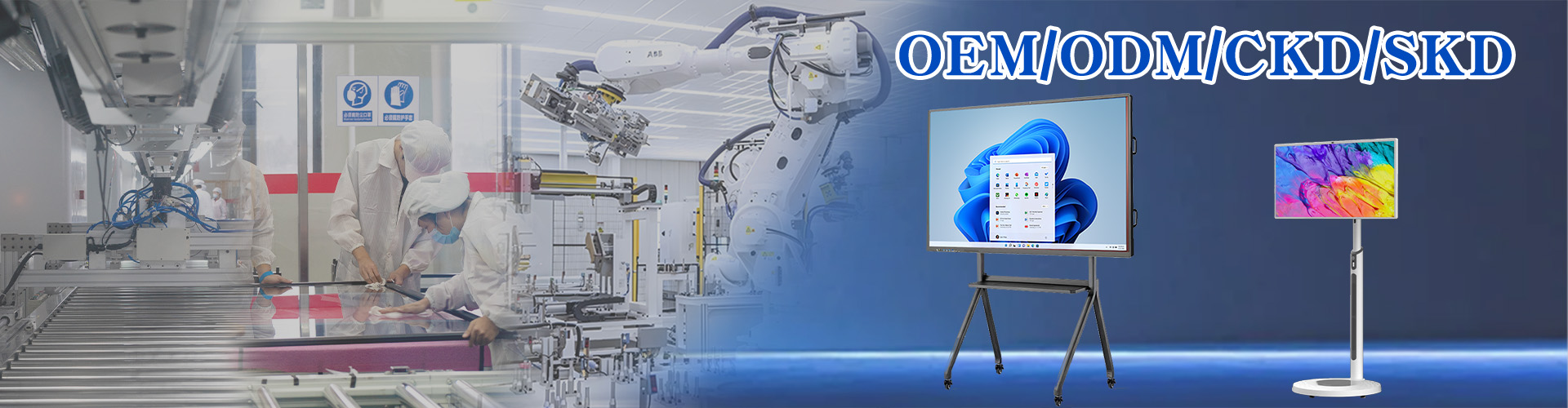
Qunmao Display Technology Co., Ltd. was established in 2009 with a production base in Shenzhen covering 230,000 square metres, integrating production, sales, software development and service for LCD and central control equipment. As an OEM & ODM solution provider, it exports more than 85% of output to over 50 countries and regions, including India, Morocco, Russia, Indonesia, the USA, South Africa, Southeast Asia and Pakistan. Qtenboard intelligent blackboards sit alongside interactive flat panels, smart conference panels, educational tablets, smart advertising displays and digital signage in the main product range — enough breadth that the first job is always to name the exact configuration for the programme.
2. Where a 75" Interactive Blackboard Earns Its Place
The 75-inch format is sized for a full classroom: wide enough for equations, diagrams and a video window side by side, and bright enough to stay readable from the back row. Typical deployments include primary and secondary classrooms, university lecture rooms, vocational and training centres, online teaching and hybrid classrooms, tutoring and examination-preparation centres, corporate training rooms, and teaching or briefing spaces in hospitals and offices.
What these have in common is a lesson that is created, delivered and saved on the same surface. A smart interactive blackboard combines the familiar front-of-room board with digital technology — a touch screen, teaching software and internet access — so a teacher can write and draw, bring in multimedia, run group work, and keep a record of what was taught. That record is the quiet commercial value: notes and annotations can be saved and shared with students who were absent, and a lesson can be reused across classes or schools without rebuilding it.
3. Define the Teaching Workflow Before Choosing Hardware
Start from what happens during a period, not from the diagonal. Five common teaching jobs lead to five different emphasis areas:
| Teaching job | What the board must do | What to confirm in the specification |
|---|---|---|
| Explain a new concept to the whole class | Open a teaching app, write and draw on a virtual whiteboard, pause a video and annotate over it | Touch writing, 4K text legibility, low response time, anti-glare surface |
| Bring in multimedia | Play videos and images, use interactive simulations, cast from a teacher device | Wireless projection, split-screen zones, supported media formats |
| Run group problem-solving | Let students move objects, write equations and change graphs, then review each group's solution | Multi-user interaction, stable touch response, on-screen review |
| Assess and adapt | Quiz students, track progress, give instant feedback, adjust pace and content | Teaching software scope, quiz tools, per-class account structure |
| Record and share | Save all notes and annotations and share them with absent students or another classroom | File format, storage location, account ownership, export policy |
One boundary is worth stating early. A board that retains a physical chalk-writing surface is a different form factor and a different purchase line, and a non-interactive information display is the right tool for corridor announcements and lobby wayfinding. The all-in-one intelligent blackboard is chosen when the teacher needs to write, show, collaborate and save on one digital surface. Fixing that split at the start keeps the bill of materials clean.
4. Choose the Board Form
Three forms solve three different briefs:
| Form | Best fit | What it changes in the order |
|---|---|---|
| All-in-one intelligent blackboard — the configuration used here | Digital-first teaching with touch writing, multimedia, collaboration and saved lessons | Single landscape panel, Android build, teaching software, wall or mobile-stand mounting |
| Board with a physical chalk-writing surface | Schools that must keep real chalk writing alongside a screen | Different enclosure, dimensions and installation drawing; its own purchase line |
| Non-interactive information display | One-way announcements, timetables and wayfinding in public areas | No touch or teaching software; a signage playback specification instead |
For this programme, agree the mounting method early: a fixed wall bracket at a defined height, or a mobile stand for rooms that share the unit. Confirm wall substrate, bracket load rating, ventilation clearance, power and network positions, and the narrowest doorway and lift on the delivery route. A 75-inch glass panel is a two-person lift, and those site facts belong in the RFQ rather than in a discovery call after the order.
5. 4K Display Performance and Why Each Line Matters
The table below is the reference configuration for the Qtenboard intelligent blackboard. It is the document the quotation, the pilot approval and the incoming inspection should all point to.
| Item | Specification | What it delivers |
|---|---|---|
| Brand / Model / Version | Qtenboard / QM-75HY / T982.81 | A single, repeatable part number for every classroom and every reorder |
| Display | 75 inch UHD Intelligent Blackboard | A front-of-room canvas sized for a full class |
| Resolution | 3840 × 2160 (4K UHD) | Sharp equations, small annotations and diagrams from the back row |
| Pixel pitch | 0.4296 × 0.4296 mm | Fine detail at close and mid viewing distances |
| Viewing area | 1650.2 × 928.3 mm (H × V) | Wide landscape space for a whiteboard zone beside a video window |
| Panel | BOE A+ grade LCD panel | Consistent quality and colour across a district-wide fleet |
| Glass | Anti-glare glass with zero gap bonding process | Less reflection from windows and ceiling lights, and a natural writing feel with minimal parallax |
| Brightness | 400 cd/m² (typ.) | Readable in a lit classroom without washing out colour |
| Colour depth | 16.7M (8-bit) | Accurate diagrams, maps and subject imagery |
| Response time | 6 ms (typ.) | Smooth video playback and immediate writing feedback |
| LCD life | 60,000 hrs (typ.) | A long service horizon for a multi-year school contract |
| Operating system | Android 14.0 | A current platform for teaching apps, whiteboard tools and wireless projection |
| Light sensor | Automatic brightness adjustment to the environment | All-day viewing comfort, eye protection and lower power use as daylight changes |
| Collaboration functions | Split screen, wireless screen transmission, multi-screen interaction, wireless projection | Teacher and student content side by side without rewiring the room |
A few programme-specific items are best agreed at RFQ stage rather than assumed: the exact OS build and licence scope, RAM and storage, touch point count and sensing technology, stylus and pen accessories, speaker and camera configuration, and export packing dimensions. Recording them on the approved specification sheet is what keeps classroom 200 identical to classroom 1 — and what makes a reorder a one-line email.
6. Touch Writing, Annotation and Lesson Capture
Four capabilities define the product. Touchscreen writing lets users write, draw and edit content directly on the screen. Multimedia integration brings videos, images and other digital resources into the lesson. Collaboration tools let students work together on projects and teachers share lessons across different classrooms or schools. Recording and saving keeps the lesson for future reference or for students who were absent.
Turn those into acceptance items: pen, finger and eraser behaviour, stroke response at the panel edges, colour and line-width options, how a paused video is annotated, where saved notes are stored, which file format is used, and who owns the account. Then run them on the pilot unit with a real lesson rather than a single demonstration stroke. "The board supports writing" is a capability; "the teacher can save and share a full annotated lesson" is the acceptance criterion.
7. Split Screen, Wireless Projection and Multi-Screen Interaction
The intelligent blackboard supports split screen, wireless screen transmission, multi-screen interaction and wireless projection. In a classroom that means a worked equation can stay visible while a video plays beside it, a teacher can cast from a laptop without cable changes, and a student device can be brought onto the board for a group review. For a district, it also means one lesson layout can be approved once and reused in every room.
Put the layout into the specification: zone ratios, which sources can appear in each zone, supported casting protocols from teacher and student devices, behaviour when a device disconnects, and whether the board keeps playing local content if the network drops. Approve whiteboard and video layouts in the wide 16:9 landscape of the 1650.2 × 928.3 mm viewing area, not in a tall poster format.
8. Classroom Writing and Pointing Tools
Digital writing is only part of a teacher's toolkit. Many schools also order a dedicated physical instrument for board work, presentations and pointing at content from a distance, so that the screen stays clean and the teacher can move around the room while explaining. A dual-tip magnetic whiteboard pen (QMIR06) is a common accessory line for this purpose, with a 4.2 mm fine tip and a 10 mm broader tip in one body and a built-in magnet for storage on a board frame.
Where accessories are included in the same programme, list them as their own purchase lines with their own model numbers and quantities. Confirm pen and stylus behaviour on the pilot unit — edge accuracy, palm rejection, calibration stability and simultaneous writers — rather than assuming a single set of settings covers every classroom. Keeping accessories as separate lines also makes replacement orders simple when a pen is lost or worn.
9. The Worked Maths Lesson and Seven Teaching Outcomes
A useful way to specify the board is to write down a lesson that must run end to end. In a maths class, the teacher opens a teaching app, works on a virtual whiteboard, shows step-by-step instructions, pauses a video to explain a point, and saves all notes and annotations. The class is then split into groups; students move objects, write equations and change graphs on the board while the teacher walks around helping; each group's solution is reviewed on screen and discussed. That single scenario tests writing, multimedia, casting, group interaction, saving and review in one pass.
The seven stated advantages of an interactive smart blackboard can be turned into procurement criteria in the same way:
Increased engagement — interactive tools that hold attention and motivate participation.
Improved learning outcomes — hands-on, dynamic work that supports retention.
Enhanced collaboration — joint projects, presentations and instant teacher feedback.
Access to multimedia resources — videos, images and interactive simulations in one lesson.
Personalised learning — adjustable pace and content for different needs and learning styles.
Real-time assessment — quizzes, progress tracking and immediate feedback during class.
Eco-friendly operation — no chalk and less paper waste, reducing consumable spend across a school year.
List every app, file format and interface language by name. Outcomes describe why the purchase is made; the named software image and content formats describe what is actually delivered.
10. System, Software and Network Architecture
The board runs Android 14.0 and is intended to host teaching software, whiteboard tools, multimedia resources and wireless projection on the same unit. That openness is what allows one hardware configuration to serve maths, languages, science and staff training without a separate player in each room.
For a district roll-out, put the software scope into the specification: exact OS build, pre-installed teaching and whiteboard applications, third-party installation policy, interface language, boot screen, RAM and storage, network join and guest-casting policy, CMS or device-management compatibility, administrator accounts, timed power, and how saved lessons are stored and shared. Confirm whether Windows-based teaching software is required at RFQ stage — that is a configuration decision, not something to assume from a form-factor description. List every application by name so the delivered image matches the school's content workflow.
11. Branding and OEM / ODM for District Roll-Outs
OEM and ODM service is available for volume programmes, and it is most valuable when it is applied once and then frozen. The configurable surface typically covers:
Brand and identity — logo, nameplate, boot screen and startup animation, UI language, carton artwork and manual language.
Software — a standard image, pre-installed teaching apps, whiteboard defaults, zone layout and lesson-saving policy.
Configuration — OS build, RAM and storage, mounting method, and the declared touch and accessory options.
Packaging and documentation — manual language, warranty card and per-site carton marking for multi-school deliveries.
Supply logo artwork as production files and state the target volume in the RFQ, since custom imaging and finishes normally tie to a minimum quantity. Factory visits are welcome at any time before order release, which is a practical way for a district or distributor to approve the assembly line, the aging test and the export packing in one trip. Keep the customisation bounded: branding, software and declared options are flexible, while the panel, glass stack and environmental class belong on the fixed specification sheet.
12. Building the RFQ
A complete enquiry removes two or three quotation rounds. Send all of the following in one message:
Configuration — Qtenboard QM-75HY, version T982.81, 75" 4K UHD all-in-one intelligent blackboard, Android 14.0.
Teaching workflow — whole-class explanation, multimedia, group work, assessment, recording and sharing.
Mounting — wall bracket or mobile stand, with wall substrate, bracket rating, service clearance and doorway dimensions.
Touch and writing — required point count, sensing technology, stylus and pen accessories, simultaneous writers.
System — OS build, RAM / storage, named teaching apps, third-party installation policy, UI language and boot screen.
Collaboration — split-screen zones, wireless projection protocols, multi-screen interaction, lesson-saving format.
Quantity and sites — units per classroom, number of rooms and schools, and whether the order mixes sizes or forms.
Branding and packaging — logo, boot screen, nameplate, carton artwork, manual language and per-site marking.
Site facts — wall dimensions, power outlet, network position, ambient light, doorway and lift clearance.
Destination — country / port, mains voltage and plug type, preferred Incoterm, currency and payment terms.
Documentation — certificate set, warranty scope and spare-parts requirement for the tender.
Timing — required delivery date and whether a pilot unit is needed before the production run.
Enquiries are answered within 12 hours by email, product and price questions within 24 hours, and 7*24 online service is available. Monthly stock of 3,000–5,000 units is a supply-capability statement; confirm the actual date and minimum quantity for the specific customisation in writing when the quotation is issued.
13. Pilot Approval and the Golden Sample
For a custom software image, custom branding or multi-classroom order, approve one fully assembled pilot unit before the production run — panel, glass, mounting, touch configuration and teaching software together, not as five separate approvals. Run the worked maths lesson from Section 9 on it: open the teaching app, write and annotate, pause a video, split the screen, cast from a teacher laptop, save and share the notes, run a two-group activity with simultaneous writers, and review each group's solution.
Add checks for 4K text legibility from the back row, anti-glare behaviour under the room's real window light, light-sensor response, edge touch accuracy, wireless projection stability, the Android 14.0 build and pre-installed apps, boot screen and logo, bracket fit, service access, and export carton artwork. The signed unit becomes the golden sample referenced by the QC checklist and by every later batch. If a programme mixes this board with a chalk-surface form or a different size, approve each as its own sample and its own purchase line. One named person on the buyer side should sign the approval — that single discipline prevents most specification drift between pilot and production.
14. Production, Quality Control and Supply Capacity
Products are strictly tested by QC before delivery, and the company also sells its own brand in China's domestic market, so quality control is a factory-level routine rather than a project extra. The company adheres to ISO 9001 standards, owns a production factory with a complete supply chain, and maintains 3,000–5,000 units in stock every month. Materials meet applicable standards, and competitive factory pricing is paired with superior quality across the range.
For custom batches, the approved specification sheet is the only reference: no panel substitution, no OS downgrade, no change to the glass stack or the declared touch configuration without written confirmation. Request the QC checklist and device serial list together with the shipment documents rather than after the container arrives. Where a project requires third-party inspection or a factory assessment, state it in the RFQ so it is built into the schedule rather than added at dispatch.
15. Certification and Tender Documentation
For government, education and healthcare tenders, the paperwork is part of the product. The company has been engaged in the business display industry for more than ten years, maintains independent product R&D institutions, and holds a certificate set covering 3C certification, energy-saving certificate, test report, national high-tech enterprise certificate, CNAS quality certification, CE, FCC, RoHS, ISO 9001 quality management, ISO environmental management and the product implementation standard certificate. It is also a designated brand in the domestic government procurement list and holds invention patents, utility model patents, design patents, intellectual property rights and copyrights.
Request current certificates for the exact configuration ordered: certificate numbers, validity dates and the legal entity name should match the proforma invoice, otherwise a tender submission can be rejected on paperwork alone. Where the tender names a specific OS build, touch configuration or board form, the certificate set and the specification sheet should describe the same machine. Confirm warranty duration, spare-parts scope and the language of the teacher manual before the purchase order is issued.
16. Packaging, Installation, Training and After-Sales
A 75-inch landscape glass panel ships as a display plus a bracket or stand, often in more than one carton or a wooden crate. Confirm export carton dimensions, foam protection, whether a stand ships assembled or flat-packed, the wooden-frame option for less-than-container loads, and any drop-test or humidity requirements for long routes. Freight is calculated from packing size and gross weight, not from the 75-inch diagonal. Keep the packing list, commercial invoice, certificate pack and mounting guide as one document set, with every carton labelled to the same serial number.
Commissioning follows a fixed sequence: unbox inspection against the QC checklist, bracket assembly on a load-bearing wall or stand assembly on a level floor, orientation check against the purchase order, power-on test, network join, wireless projection from a real teacher laptop, split-screen and whiteboard test, recording and saving test, light-sensor check, and administrator handover. Teacher training is a deliverable, not a courtesy — record the final device list, serial numbers, OS build, touch configuration, mounting method and admin credentials in the asset register before the integrator leaves.
Questions receive a reply within 24 hours with solutions provided immediately; quick email response is within 12 hours, and 7*24 online service is available. For expansion, standardise on one model, one version, one OS build, one software image and one golden sample. Then a second phase in another school is a quantity change, not a new project.
17. Indicative Project Timeline
| Stage | Owner | Output document |
|---|---|---|
| 1. Teaching workflow | School / integrator | Lesson scenarios, recording and sharing requirements |
| 2. Model & version lock | Both parties | QM-75HY / T982.81 / Android 14.0 / 3840 × 2160 in writing |
| 3. Specification lock | Both parties | Signed sheet with glass, touch, OS, software, mounting and branding lines |
| 4. RFQ & quotation | Qunmao | Quotation with Incoterm, MOQ, certificate set and lead time |
| 5. Pilot approval | Both parties | Golden sample with a full worked lesson run on it |
| 6. Production / QC | Qunmao | QC checklist and device serial list |
| 7. Documentation | Qunmao | Certificate pack, invoice and packing list |
| 8. Freight & receiving | Forwarder / buyer | Signed receiving report per school |
| 9. Commissioning & teacher training | Integrator | Teacher sign-off and asset register entry |
| 10. After-sales & repeat orders | Both parties | 24-hour support record, standardised reorder specification |
Lead times vary with customisation scope, quantity and destination. What belongs in the contract is the sequence and the acceptance document for each stage, not a generic number of days.
18. Frequently Asked Questions
Q. What is a smart interactive blackboard, and are "smart chalkboard" and "electronic blackboard" the same thing?
A. Yes. All three names describe the same category: an advanced educational tool that combines the familiar front-of-room board with digital technology — a touch screen, teaching software and internet access — for a more interactive and collaborative lesson. The working configuration here is the Qtenboard QM-75HY 75" 4K UHD all-in-one intelligent blackboard, version T982.81.
Q. Does it still use chalk?
A. No. The board is designed for digital touch writing, drawing and editing. One of its stated advantages is that it eliminates the need for chalk and reduces paper waste, which lowers consumable spend across a school year. A brief that requires a physical chalk-writing surface is a different board form and a separate purchase line.
Q. What are the key display specifications?
A. 75-inch UHD, 3840 × 2160 resolution, 0.4296 × 0.4296 mm pixel pitch, a 1650.2 × 928.3 mm viewing area, a BOE A+ grade panel with anti-glare glass and zero gap bonding, 400 cd/m² brightness, 16.7M (8-bit) colour, 6 ms response time, 60,000-hour LCD life and Android 14.0. A light sensor adjusts brightness to the environment to protect eyes and save power.
Q. Can teachers write on it and save the lesson?
A. Yes. Users can write, draw and edit content on the touch screen, and lessons can be recorded for future reference or shared with students who were absent. All notes and annotations from a worked lesson can be saved and shared. Confirm the file format, storage location and account ownership in the specification sheet.
Q. Does it support split screen and wireless projection?
A. Yes. The board supports split screen, wireless screen transmission, multi-screen interaction and wireless projection, so a whiteboard zone and a video window can run side by side and a teacher or student device can be brought onto the screen. Approve zone ratios, casting protocols and landscape content layouts before production.
Q. Can students work on it in groups?
A. Yes. Collaboration tools let students work together on projects and teachers share lessons across classrooms or schools. In a worked maths lesson, groups move objects, write equations and change graphs on the board, and the teacher reviews each group's solution on screen. State the required number of simultaneous writers and test it on the pilot unit with a real group activity.
Q. Which operating system and software does it run?
A. Android 14.0, with teaching apps, whiteboard tools, multimedia resources and wireless projection on the same unit. Confirm the exact OS build, pre-installed applications, third-party installation policy, RAM, storage, interface language, boot screen, administrator accounts and lesson-saving policy on the approved sheet. If a tender requires Windows-based teaching software, request it as a configuration decision at RFQ stage.
Q. Is it only for classrooms?
A. No. Alongside classrooms, these displays are widely used in hospitals, offices and other training and briefing environments, as well as online teaching rooms. The same writing, multimedia, collaboration and lesson-saving functions apply wherever a group needs to work through content together.
Q. What can OEM / ODM customise, and what is the supply capacity?
A. OEM / ODM covers logo, nameplate, boot screen, UI language, carton artwork, manual language, a standard software image, pre-installed teaching apps, whiteboard defaults, OS build, RAM / storage, mounting method and declared accessory options. Monthly stock is 3,000–5,000 units, products are strictly QC-tested before delivery, and the factory operates under ISO 9001 with a complete in-house supply chain. Include the target volume in the RFQ so custom imaging and finishes can be scheduled.
Q. What after-sales support applies to a multi-school roll-out?
A. Questions receive a reply within 24 hours with solutions provided immediately, quick email response is within 12 hours, and 7*24 online service is available. Certificate papers, warranty scope and spare parts are confirmed before the purchase order. Standardise on one model, one version, one OS build, one software image and one golden sample, then reuse the approved specification sheet as the reorder reference so classroom 200 is identical to classroom 1.
19. Start Your Project
Send the teaching workflow, the model and version, the OS and software requirements, the mounting method, the quantity and the destination in one message, and the process above starts with a specification that can be quoted, sampled and repeated. For classroom teaching, online lessons, training rooms and collaborative group work, the Qtenboard QM-75HY 75" 4K UHD intelligent blackboard is the reference configuration; where a physical chalk surface, a non-interactive information display or a different size is required, the same project team will quote the matching unit from the range. One approved specification sheet is what turns a single pilot classroom into a district-wide roll-out.