English
 Español
 Português
 Français
 Русский язык
 Italiano
 Deutsch
 Nederlands
 لعربية
 한국어
 Japanese
 ภาษาไทย
 Türkçe
 Tiếng Việt
 Bahasa Indonesia
 Hindi
 kazakh
 Uzbek
 Thai
 Farsi





A 49-inch floor display is one of the most practical sizes in a commercial signage programme: tall enough to read across a lobby, compact enough for an aisle end, a lift lobby or a reception desk. Whether a brief calls it a vertical advertising machine, a 49-inch freestanding digital display or an indoor digital signage kiosk, the buyer is asking for the same thing — a reliable 4K screen that plays the right content, in the right orientation, at every site. This guide is written for retail chains, hospitality groups, importers and AV integrators who need to specify one, approve a pilot batch and then repeat it across locations. It uses the 49" 4K vertical Android digital signage kiosk (QM-4916GL) as the working configuration, and walks through the decisions that turn a display requirement into an orderable, repeatable specification.
1. Who This Guide Is For
Four roles normally shape a signage order. The brand, retailer or hospitality operator defines what a visitor should see and how often the content changes. The AV integrator owns the mounting position, power, network and commissioning. The importer and tender agent assembles the paperwork and the delivery schedule. The factory project manager turns all of it into one approved specification sheet. When those four agree on the same document, site 1 and site 200 behave identically; when they do not, the differences show up during installation rather than in the quotation.
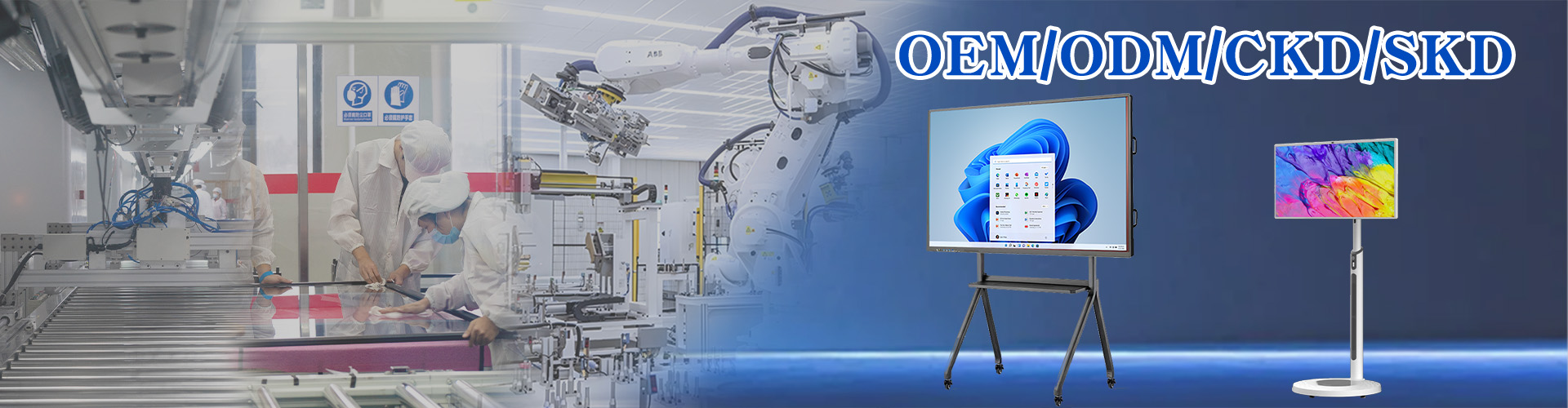
Qunmao Display Technology Co., Ltd. was established in 2009 with a production base in Shenzhen covering 230,000 square metres, integrating production, sales, software development and service for LCD and central control equipment. As an OEM & ODM solution provider, it exports more than 85% of output to over 50 countries and regions, including India, Morocco, Russia, Indonesia, the USA, South Africa, Southeast Asia and Pakistan. Advertising players, digital signage, smart advertising displays, interactive flat panels, smart blackboards, conference panels and LCD video walls all sit in the main product range — enough breadth that the first job is always to name the exact configuration for the programme.
2. Where a 49" Indoor Kiosk Earns Its Place
The 49-inch portrait format fits where a wall screen would be too small and a 75-inch totem would dominate the space. Typical deployments include shopping mall and supermarket aisle-end campaigns, airport and transport information points, bank and government service halls, hotel lobbies and lift waiting areas, exhibition halls and showrooms, hospital and clinic notice points, corporate reception directories, restaurant and catering promotions, and office and public-space advertising.
These are indoor, mains-powered, high-traffic environments. Digital signage is an electronic display used to show advertising content, information or messages to viewers, and an advertising video player plays digital video content for that purpose — either as a standalone device or integrated into the display itself. Both are tools businesses use to attract and engage customers, promote products and services, and build brand awareness. The commercial value is not the screen alone; it is that one approved playlist can be published to every location without reprinting a poster.
3. Define the Content Job Before Choosing Hardware
Start from what the screen has to do during a trading day. Four common jobs lead to four different emphasis areas:
| Content job | What the unit must do | What to confirm in the specification |
|---|---|---|
| Run a campaign loop | Play video, posters and subtitles on a schedule | 4K decoding, split-screen zones, playlist scheduling, local fallback |
| Show wayfinding and information | Hold a tall directory column, opening hours and service notices | Portrait layout, 4K text legibility, 89 / 89 / 89 / 89 off-angle readability |
| Support a promotion at a counter | Combine a price panel, a video and a QR handoff in one view | Zone ratios, media formats, brightness under retail lighting |
| Let a visitor interact | Product lookup, catalogue browsing, touch navigation | Intelligent touch option, point count, sensing technology, stylus behaviour |
One boundary is worth stating early. If the brief calls for a transaction, a printed receipt or a card reader, that belongs to a self-service payment ordering terminal with its own peripheral set. A digital signage kiosk is the right choice when the job is to show, inform and promote. Fixing that split at the start keeps the bill of materials clean and avoids paying for interfaces the project will never use.
4. Choose the Size and Form From the Series
The signage family is organised into two resolution series, each with a defined size ladder and a set of installation styles. Choosing the ladder first makes the model code meaningful:
| Series | Available sizes (inch) | Available styles |
|---|---|---|
| 972 Series 4K — the configuration used here | 49 / 50 / 55 / 65 / 75 / 85 | Wall-mounted, vertical stand, double screen, water brand, full screen |
| 352 Series 2K | 32 / 43 / 49 / 50 / 55 | Wall-mounted, vertical stand, double screen, water brand, full screen |
A 49-inch unit therefore exists in both 2K and 4K, and the 4K ladder continues upward for sites that need a larger canvas. Where a flagship store, a main atrium or a long-distance viewing position calls for more presence, the 75" 4K branded kiosk digital signage display (QM-7516GL) is the natural step up within the same 4K series. Keep one size per purchase line so the content layout, enclosure drawing and installation method stay consistent; where several sizes are required, approve each as its own sample and its own order line.
Every style in the range supports horizontal and vertical screen wall hanging to meet different scenarios, so orientation is a layout decision rather than a change of product family. Confirm the chosen style, orientation and base footprint on the drawing before production.
5. Display Performance and Why Each Line Matters
The table below is the reference configuration for the 49-inch 4K kiosk. It is the document the quotation, the pilot approval and the incoming inspection should all point to.
| Item | Specification | What it delivers |
|---|---|---|
| Brand / Model | Qunmao / QM-4916GL | A single, repeatable part number for every site and every reorder |
| Display | 49 inch 4K media player digital signage, vertical indoor advertising machine | A tall indoor canvas sized for aisles, lobbies and service halls |
| Resolution | 3840 × 2160 (4K UHD) | Sharp prices, small notices, QR codes and product detail from a walking distance |
| Media support | 4K video and image decoding and playback | One high-resolution asset library can serve the whole fleet |
| Active display area | 604 × 1073.8 mm (H × V), 16:9 panel in portrait | Full-height posters, directory columns and scrolling information |
| Panel | IPS HD LCD with LED backlight | Gorgeous colour, no colour difference, no distortion, a delicate and true picture |
| Viewing angle | 89 / 89 / 89 / 89 | Readable from side approaches in malls, halls and lift lobbies |
| Brightness | ≥300 cd/m² | Comfortable under indoor retail, hotel and public-space lighting |
| Refresh rate | 60 Hz | Smooth campaign video and animated transitions |
| Colour | 16.7M (8-bit) | Consistent brand colours across every screen in the chain |
| Operating system | Android 13.0 with pre-installed front-end presentation software | A ready-to-run playback platform with room for project applications |
| Structure | Industrial all-in-one frame, super thin, unique cooling technology | Easy installation and convenient maintenance in a public space |
A few programme-specific items are best agreed at RFQ stage rather than assumed: the exact OS build, RAM and storage, network module, speaker configuration, the intelligent touch option, whole-unit dimensions beyond the active area, and export packing size and gross weight. Recording them on the approved specification sheet is what keeps site 200 identical to site 1 — and what makes a reorder a one-line email.
6. Orientation, Mounting and Site Preparation
The 604 × 1073.8 mm active area is a 16:9 panel installed in portrait, so content should be designed portrait-first: a full-height campaign zone, a tall directory or price column, a scrolling ticker for notices, and a QR handoff within comfortable reach. Horizontal and vertical screen wall hanging are both supported, which means a landscape video wall or a portrait directory can be planned from the same product family.
Approve the layout in the same review as the hardware. On the physical side, confirm the chosen style (wall-mounted, vertical stand, double screen, water brand or full screen), wall substrate or floor condition, bracket or base footprint, anti-tip stability, ventilation clearance for the cooling design, power outlet and network position, service access behind the frame, and the narrowest doorway and lift on the delivery route. A portrait unit that cannot be brought through a standard door is a logistics decision, not a display decision.
7. Android 13.0, Split Screen and Playback Modes
The kiosk runs Android 13.0 with pre-installed front-end presentation software and a quad-core processor, with WiFi and wired connectivity for content delivery. Intelligent split-screen playback lets video, pictures and posters run synchronously in separate zones, with fine adjustment in each area — useful when a screen must promote a campaign and carry practical information at the same time.
Two operating modes are available. A standalone version suits a single site where an operator updates content locally from a drive; a network version suits a chain that publishes centrally and needs every location to change on the same schedule. Put the choice into the specification, then confirm supported media formats, playlist scheduling, zone ratios, timed power on/off, administrator accounts, playback logs and behaviour when the network drops. List every file format and language by name so the delivered image matches the operator's content workflow.
8. Standalone or Networked: Planning the Fleet
For a single lobby, a standalone unit is simple to own: no backend, no accounts, and content can be swapped on site. For twenty or two hundred locations, the network version earns its place because one approved playlist is published once and appears everywhere, with no travel and no version drift between stores. Many programmes mix both: networked units in flagship sites and standalone units in temporary or low-connectivity positions.
Decide before the RFQ, because it changes the software image, the administrator structure, the network requirements at each site and the training material. Where a chain expects to expand, agree a standard device-naming and asset-register scheme at pilot stage so a second phase is a quantity change rather than a new integration project.
9. Picture and Sound Quality in a Public Space
Three features matter most in a busy indoor environment. A dynamic colour engine and intelligent motion compensation keep video clean and natural when content includes fast movement. An excellent sound system with rich stereo and environmental effects adds presence where audio is part of the campaign. And the IPS HD LCD panel holds colour and detail off-axis, which is what 89 / 89 / 89 / 89 viewing angles are for in practice — a visitor walking past, not standing directly in front.
Confirm speaker output, whether audio is enabled by default, ambient noise at each position, and any local rules on sound in hospitals, banks or government buildings. Approve a sample campaign on the pilot unit under the site's real lighting rather than in a showroom, so brightness, colour and motion are judged in the conditions the screen will actually work in.
10. Adding Visitor Interaction
Where the brief calls for product lookup, catalogue browsing or touch navigation, an intelligent touch control option can be configured on the same family. State the required touch points, sensing technology, stylus behaviour, glass treatment and simultaneous users at RFQ stage, and test them on the pilot unit with a real two-hand gesture. Confirming the touch configuration and the content layout together prevents a screen that works for playback but hesitates when a visitor navigates.
Keep interaction proportional to the job. A campaign loop in a lift lobby needs no touch at all; a product finder in a showroom does. Separating those two lines in the purchase order keeps pricing transparent and spare parts simple.
11. Branding and OEM / ODM for Chain Roll-Outs
OEM and ODM service is available for volume programmes, and it is most valuable when it is applied once and then frozen. The configurable surface typically covers:
Brand and identity — logo, nameplate, boot screen and startup animation, UI language, carton artwork and manual language.
Software — a standard image, pre-installed presentation software, home-screen layout, zone ratios and playlist defaults.
Configuration — OS build, RAM / storage, network module, standalone or network version, and the declared touch option.
Structure and packaging — the chosen style, frame finish, export carton, foam protection and per-site carton marking.
Supply logo artwork as production files and state the target volume in the RFQ, since custom imaging, finishes and software builds normally tie to a minimum quantity. Factory visits are welcome at any time before order release, which is a practical way for a distributor to approve the assembly line, the aging test and the export packing in one trip. Keep the customisation bounded: branding, software and declared options are flexible, while the panel, orientation and environmental class belong on the fixed specification sheet.
12. Building the RFQ
A complete enquiry removes two or three quotation rounds. Send all of the following in one message:
Configuration — QM-4916GL, 49" 4K vertical Android digital signage kiosk, 972 Series 4K.
Style and orientation — wall-mounted or vertical stand, portrait or landscape, with the enclosure drawing.
Environment — indoor retail, hospitality, transport, finance, government or public-space use.
Display — 3840 × 2160, ≥300 cd/m², 60 Hz, 16.7M colour, 89 / 89 / 89 / 89, 4K decoding.
System — Android 13.0 build, RAM / storage, pre-installed software, third-party application policy, UI language, boot screen.
Playback — standalone or network version, split-screen zones, supported media formats, scheduling, timed power, playback logs.
Network — WiFi and wired, CMS or remote publishing compatibility, administrator accounts, offline fallback.
Touch — required points, sensing technology, stylus and simultaneous users, if applicable.
Audio — speaker output and whether sound is enabled in the campaign.
Quantity and sites — units per location, number of delivery addresses, and whether any site needs a different size.
Branding and packaging — logo, boot screen, nameplate, carton artwork, manual language and per-site marking.
Site facts — wall or floor condition, power outlet, network position, service clearance, doorway and lift dimensions.
Destination — country / port, mains voltage and plug type, preferred Incoterm, currency and payment terms.
Documentation — certificate set, warranty scope and spare-parts requirement for the tender.
Timing — required delivery date and whether a pilot unit is needed before the production run.
Enquiries are answered within 12 hours by email, product and price questions within 24 hours, and 7*24 online service is available. Monthly stock of 3,000–5,000 units is a supply-capability statement; confirm the actual date and minimum quantity for the specific customisation in writing when the quotation is issued.
13. Pilot Approval and the Golden Sample
For a custom software image, custom branding or multi-site order, approve one fully assembled pilot unit before the production run — panel, enclosure, orientation, OS build and content together, not as five separate approvals. Run the real campaign on it: play a 4K video, a poster loop and a split-screen layout, publish a playlist remotely, power-cycle on a timer, disconnect the network and confirm local fallback, check 4K text legibility from the intended viewing distance, and judge brightness and off-angle colour under the site's real lighting.
Add checks for the boot screen and logo, zone ratios, audio behaviour, cooling clearance, service access behind the frame, and export carton artwork. Where the programme includes a 75-inch step-up model or a landscape position, approve each as its own sample and its own purchase line. The signed unit becomes the golden sample referenced by the QC checklist and by every later batch. One named person on the buyer side should sign the approval — that single discipline prevents most specification drift between pilot and production.
14. Production, Quality Control and Supply Capacity
Products are strictly tested by QC before delivery, and the company also sells its own brand in China's domestic market, so quality control is a factory-level routine rather than a project extra. The company adheres to ISO 9001 standards, owns a production factory with a complete supply chain, and maintains 3,000–5,000 units in stock every month. Materials meet applicable standards, and competitive factory pricing is paired with superior quality across the range.
For custom batches, the approved specification sheet is the only reference: no panel substitution, no OS or software image change, no style or orientation change without written confirmation. Request the QC checklist and device serial list together with the shipment documents rather than after the container arrives. Where a project requires third-party inspection or a factory assessment, state it in the RFQ so it is built into the schedule rather than added at dispatch.
15. Certification and Tender Documentation
For government, finance, transport and healthcare projects, the paperwork is part of the product. The company has been engaged in the business display industry for more than ten years, maintains independent product R&D institutions, and holds a certificate set covering 3C certification, energy-saving certificate, test report, national high-tech enterprise certificate, CNAS quality certification, CE, FCC, RoHS, ISO 9001 quality management, ISO environmental management and the product implementation standard certificate. It is also a designated brand in the domestic government procurement list and holds invention patents, utility model patents, design patents, intellectual property rights and copyrights.
Request current certificates for the exact configuration ordered: certificate numbers, validity dates and the legal entity name should match the proforma invoice, otherwise a tender submission can be rejected on paperwork alone. Confirm warranty duration, spare-parts scope and the language of the user manual before the purchase order is issued.
16. Packaging, Installation, Training and After-Sales
A 49-inch kiosk normally ships as a display plus a bracket or stand, often in more than one carton or a wooden crate for less-than-container loads. Confirm export carton dimensions, foam protection, whether a stand ships assembled or flat-packed, the wooden-frame option, and any drop-test or humidity requirements for long routes. Freight is calculated from packing size and gross weight, not from the screen diagonal. Keep the packing list, commercial invoice, certificate pack and mounting guide as one document set, with every carton labelled to the same serial number.
Commissioning follows a fixed sequence: unbox inspection against the QC checklist, bracket or stand assembly, orientation check against the purchase order, power-on, OS and licence verification, network join, 4K playback and split-screen test, remote playlist publishing, timed power check, audio check, and administrator handover. Content-editor training is a deliverable, not a courtesy — record the final device list, serial numbers, OS build, playback mode, mounting method and admin credentials in the asset register before the integrator leaves.
Questions receive a reply within 24 hours with solutions provided immediately; quick email response is within 12 hours, and 7*24 online service is available. For expansion, standardise on one model, one OS build, one software image, one playback mode and one golden sample. Then a second phase in another city is a quantity change, not a new project.
17. Indicative Project Timeline
| Stage | Owner | Output document |
|---|---|---|
| 1. Content job & environment | Operator / integrator | Indoor campaign, information or interaction role |
| 2. Series, size & style lock | Both parties | 972 Series 4K, 49", style and orientation in writing |
| 3. Specification lock | Both parties | Signed sheet with display, OS, playback, network and branding lines |
| 4. RFQ & quotation | Qunmao | Quotation with Incoterm, MOQ, certificate set and lead time |
| 5. Pilot approval | Both parties | Golden sample with a real campaign and offline fallback test |
| 6. Production / QC | Qunmao | QC checklist and device serial list |
| 7. Documentation | Qunmao | Certificate pack, invoice and packing list |
| 8. Freight & receiving | Forwarder / buyer | Signed receiving report per site |
| 9. Commissioning & training | Integrator | Staff sign-off and asset register entry |
| 10. After-sales & repeat orders | Both parties | 24-hour support record, standardised reorder specification |
Lead times vary with customisation scope, quantity and destination. What belongs in the contract is the sequence and the acceptance document for each stage, not a generic number of days.
18. Frequently Asked Questions
Q. Are "vertical advertising machine", "49-inch freestanding digital display" and "digital signage kiosk" different products?
A. No. They are three buyer names for the same class: an indoor commercial display that plays advertising content, information or messages in a public space. The working configuration here is the Qunmao QM-4916GL, a 49-inch 4K vertical Android digital signage kiosk. Fix the series, style, orientation and software image, and the phrase resolves into one orderable specification.
Q. Is it a true 4K screen, and can we publish our 4K assets to it?
A. Yes. The panel is 3840 × 2160 UHD, and the unit supports 4K video and image decoding and playback. A single high-resolution asset library can therefore serve the whole fleet, with sharp prices, QR codes, notices and product detail from a walking distance.
Q. Does it ship in portrait or landscape?
A. The working configuration is portrait, with a 604 × 1073.8 mm active area — a 16:9 panel installed vertically. Horizontal and vertical screen wall hanging are both supported across the range, so a landscape video position can be planned from the same family. Approve content layouts in the chosen orientation and confirm the base footprint, service clearance and doorway dimensions.
Q. Which sizes, series and styles are available?
A. The 972 Series 4K covers 49 / 50 / 55 / 65 / 75 / 85 inch, and the 352 Series 2K covers 32 / 43 / 49 / 50 / 55 inch. Both offer wall-mounted, vertical stand, double screen, water brand and full screen styles. A 49-inch unit exists in both series, so state the resolution on the purchase order. Keep one size per order line so content layouts and installation drawings remain consistent.
Q. Which operating system and playback modes does it run?
A. Android 13.0 with pre-installed front-end presentation software, a quad-core processor, and WiFi and wired connectivity. Intelligent split-screen playback runs video, pictures and posters synchronously in separately adjustable zones. Choose a standalone version for local updates or a network version for central publishing across a chain.
Q. What happens if the network drops at a site?
A. Confirm local fallback and scheduled playlist behaviour in the specification sheet, then test it on the pilot unit by disconnecting the network during a campaign loop. For networked fleets, also agree administrator accounts, timed power on/off, playback logs and remote publishing compatibility before production.
Q. Can visitors interact with the screen?
A. An intelligent touch control option can be configured for product lookup, catalogue browsing or touch navigation. State the required touch points, sensing technology, stylus behaviour and simultaneous users at RFQ stage, and test them on the pilot unit with a real two-hand gesture. A campaign loop in a lift lobby needs no touch at all — keep the two jobs on separate order lines.
Q. Is it suitable for outdoor or direct-sun positions?
A. The QM-4916GL is an indoor advertising machine with a ≥300 cd/m² brightness rating for retail, hotel, transport and public-space lighting. For a street-facing or direct-sun position, request the dedicated outdoor high-brightness product line with its own enclosure and thermal specification. State the environment in the RFQ so the correct line is quoted.
Q. What can OEM / ODM customise, and what is the supply capacity?
A. OEM / ODM covers logo, nameplate, boot screen, UI language, carton artwork, manual language, a standard software image, pre-installed presentation software, zone ratios, playlist defaults, OS build, RAM / storage, network module, playback mode, touch option, frame finish and packaging. Monthly stock is 3,000–5,000 units, products are strictly QC-tested before delivery, and the factory operates under ISO 9001 with a complete in-house supply chain. Include the target volume in the RFQ.
Q. What after-sales support applies to a multi-site roll-out?
A. Questions receive a reply within 24 hours with solutions provided immediately, quick email response is within 12 hours, and 7*24 online service is available. Certificate papers, warranty scope and spare parts are confirmed before the purchase order. Standardise on one model, one OS build, one software image, one playback mode and one golden sample, then reuse the approved specification sheet as the reorder reference so site 200 is identical to site 1.
19. Start Your Project
Send the content job, the series, size, style and orientation, the OS and playback requirements, the quantity and the destination in one message, and the process above starts with a specification that can be quoted, sampled and repeated. For indoor campaign playback, wayfinding and information display, the QM-4916GL 49" 4K indoor vertical digital signage kiosk is the reference configuration; where a larger canvas, a landscape position or a self-service transaction workflow is required, the same project team will quote the matching unit from the range. One approved specification sheet is what turns a single pilot site into a chain-wide roll-out.