English
 Español
 Português
 Français
 Русский язык
 Italiano
 Deutsch
 Nederlands
 لعربية
 한국어
 Japanese
 ภาษาไทย
 Türkçe
 Tiếng Việt
 Bahasa Indonesia
 Hindi
 kazakh
 Uzbek
 Thai
 Farsi

Why Same-Size Interactive Panels Differ 3x in Price: A/B/C Grade Breakdown
 2026-11-25
 33




2026-11-25
33
A distributor in Tashkent receives two quotes for a 65-inch interactive flat panel. The specifications sheet looks nearly identical — 4K resolution, 20-point touch, Android system. The price difference is close to three times. Before treating the lower quote as a bargain, it is worth understanding what the panel grade difference actually represents: which layer of the product was changed to reach that price, and what that change means for a school deployment in Uzbekistan three years from now.
Buyers naturally compare the specifications that appear on a quote sheet: screen size, resolution, touch points, Android version, and perhaps the brand of the panel. These visible parameters are necessary, but they describe only the surface of an interactive flat panel. A complete unit is an integration of several supply chains — the LCD panel itself, the touch module, the cover glass, the motherboard and power board, the bonding process, the mechanical housing, and the warranty and spare-parts system behind the product.
A downgrade at any one of these layers can bring the unit price down. The critical question is not whether a cheap interactive panel exists — it does, and it has legitimate use cases — but which layer was compromised and whether that compromise aligns with the project's lifespan and operating intensity. The three-tier framework below is a practical way to organize that question.
Before the table, one important clarification: A/B/C is an industry shorthand, not a unified international standard. No international standards body publishes a binding definition of "A-grade interactive panel" or "C-grade interactive panel." Different suppliers may use the same letters to describe entirely different configurations. The practical implication for buyers in Uzbekistan and Central Asia is straightforward: ask the supplier to write down, in the quotation or a contract annex, exactly what their grade means — panel brand and model, whether the panel is new, the dead-pixel acceptance policy, the bonding method, the motherboard configuration, and the warranty coverage by component.
| Tier | Typical positioning | Panel | Bonding | Warranty structure | Reasonable use case |
|---|---|---|---|---|---|
| A — premium / project grade | High-frequency teaching, government school projects, long-lifecycle deployments | Branded panel with a documented dead-pixel policy; stronger batch consistency | Optical or zero-gap bonding is common at this tier | Component-level coverage; clearer spare-parts channel | 3–5+ year deployments where downtime carries real cost |
| B — standard commercial | General classrooms, meeting rooms, routine replacement | Mainstream panel; moderate dead-pixel standard | Some models use zero-gap; others use air-gap | Whole-unit warranty is common; component coverage must be confirmed | Standard teaching and office use with moderate intensity |
| C — low-cost / short-cycle | Short-term rental, exhibition, low-frequency use | Panel origin often less transparent; higher risk of brightness uniformity and dead-pixel issues | Air-gap is more common | Shorter warranty or stricter conditions; spare parts dependent on the supplier | One-off events or low-intensity use where replacement cost is acceptable |
The point of this table is not to label one tier as "good" and another as "bad." A cheap interactive panel can be a rational choice for a short rental fleet or a temporary exhibition. The risk appears when a buyer uses short-cycle logic to select equipment for a multi-year school deployment: the savings on the unit price are then transferred into future maintenance, downtime, and replacement logistics — a shift that is difficult to reverse once the contract is signed.
The tier labels in the market are useful for orientation, but procurement decisions need to be anchored in components that can be inspected and written into a contract. The four dimensions below are where the panel grade difference becomes concrete.
The brand name printed on a panel is less informative than the acceptance standard behind it. Ask the supplier to state, in writing, how many bright and dark sub-pixels are permitted, whether defects in the central viewing area are treated differently, and whether the policy applies to the sample unit, the mass-production batch, or both. For Uzbekistan's dusty and high-temperature summers, long-term brightness uniformity and thermal design also deserve attention: a panel that passes a one-hour demo may show uneven aging after a full academic year of daily use.
The motherboard determines whether the panel remains usable as software evolves. Confirm the exact CPU and GPU model, the RAM and storage configuration, and whether the "RAM" figure on the quote refers to installed memory or usable memory after system overhead. For deployments in Uzbekistan, Russian and Uzbek interface support, as well as compatibility with locally used teaching platforms, should be tested on the actual unit rather than assumed from an Android version number. Firmware update frequency is another signal: a supplier that cannot describe an update path is unlikely to provide one after delivery.
Bonding affects glare, the perceived distance between the pen tip and the writing line, and dust ingress over time. Air-gap construction is not automatically unacceptable, but in bright classrooms with direct sunlight and fine dust, the visual and maintenance differences become noticeable. Zero-gap bonding is commonly associated with mid-to-high-tier configurations, but the label alone is not a guarantee: the process still needs to be verified on a sample unit, especially at the edges of the glass where bubbles and separation tend to appear first.
"Three-year warranty" without a breakdown by component is an incomplete promise. Confirm separately how long the panel, touch module, motherboard, and power board are covered; who supplies the spare part; who pays cross-border freight; and whether the remedy is a replacement unit or a replacement component. For a project in Uzbekistan, the freight responsibility clause often matters more than the nominal warranty length, because a "covered" repair that requires the buyer to ship a 65-inch unit back to China at their own cost is functionally a limited warranty.
The purchase price is only the first number in the total cost of ownership. Once a low-cost unit fails in the field, three categories of cost tend to appear — and none of them are visible on the original quotation.
A unit that needs repair or replacement must travel. For Uzbekistan, this may mean cross-border freight, customs formalities, and waiting time. If the original shipment's origin documents were incomplete, a replacement shipment can also face additional customs scrutiny. Uzbekistan applies a 15% import duty to certain display and projection equipment under the current tariff schedule, while LCD modules and touch panels may fall under different rates; the exact treatment depends on the HS code and the form in which the goods are declared[reference:0]. A "cheap" first shipment that creates a complicated second shipment is not cheap in total.
For a school, a failed panel in a classroom is not an abstract inconvenience — it interrupts scheduled lessons. For a distributor or system integrator, a delayed delivery can affect payment milestones and future tender eligibility. Public procurement timelines in Uzbekistan are often tied to the academic calendar and budget cycles; a delivery window that closes before the start of the school year leaves little room for a replacement cycle[reference:1]. Downtime cost is therefore highest precisely in the projects where low-cost equipment is most tempting.
Power boards, touch modules, and styluses are small-ticket items individually. But when they can only be sourced from the original supplier at supplier-set prices, and when each failure triggers a separate international shipment, the cumulative maintenance cost over three years can narrow or erase the initial price advantage. A useful exercise is to request a spare-parts price list at the quotation stage and compare not just the unit price but the three-year consumable and repair envelope. Any illustrative figures used in this comparison should be clearly labeled as assumptions, not as verified market data.
Total cost of ownership framing: compare the landed unit price, the probability of failure within the project period, the cost of one replacement cycle (freight + customs + downtime), and the availability of locally stocked spare parts. A cheap interactive panel that fails once in year two can cost more than a B-tier unit that runs without interruption.
Illustrative procurement scenario — Uzbekistan
A public school modernization project in Uzbekistan plans to equip 50 classrooms with interactive panels. The tender requires DDP delivery, a local service partner, and installation and warranty support[reference:2]. Two quotations arrive: one at a low C-tier price, one at roughly 2.5 times that price with a documented panel grade, zero-gap bonding, and a component-level warranty matrix. The budget committee's first instinct is to favor the lower quote.
Applying the tier logic changes the comparison. The low quote does not specify the dead-pixel policy or the warranty coverage for the touch module. The delivery window is tied to the start of the academic year, which leaves no buffer for a replacement cycle. The tender requires a local service center, and the low-cost supplier has not identified one. The higher quote includes a spare-parts list and a named local partner. The relevant comparison is no longer "unit price versus unit price" but "landed cost with a defined failure path versus landed cost with an undefined failure path."
This scenario is illustrative and does not represent a specific named contract. Its purpose is to show how the panel grade difference interacts with tender requirements: the grade matters not in isolation, but in relation to the delivery timeline, the service obligations, and the consequences of downtime.
The most reliable selection rule is to choose the tier after defining the project lifespan and operating intensity — not before. A unit selected for a two-week exhibition and a unit selected for a five-year school deployment are solving different problems, and the same low price can be appropriate in one context and risky in the other.
| Project scenario | Suggested starting tier | What to verify before ordering |
|---|---|---|
| Short-term rental, exhibition, temporary use | C tier may be considered | Return policy, cosmetic condition, basic function test |
| Standard classroom or office, moderate daily use | B tier as baseline | Component warranty breakdown, batch consistency, language support |
| High-frequency school or government project, 3–5+ years | A tier preferred; B tier only with verified warranty and spare-parts access | Panel supply stability, local service partner, DDP delivery capacity |
| Large-volume tender with fixed delivery window | Decide between A and B based on warranty and spare-parts clauses, not brand name alone | Production capacity, certification documents, in-country support commitment |
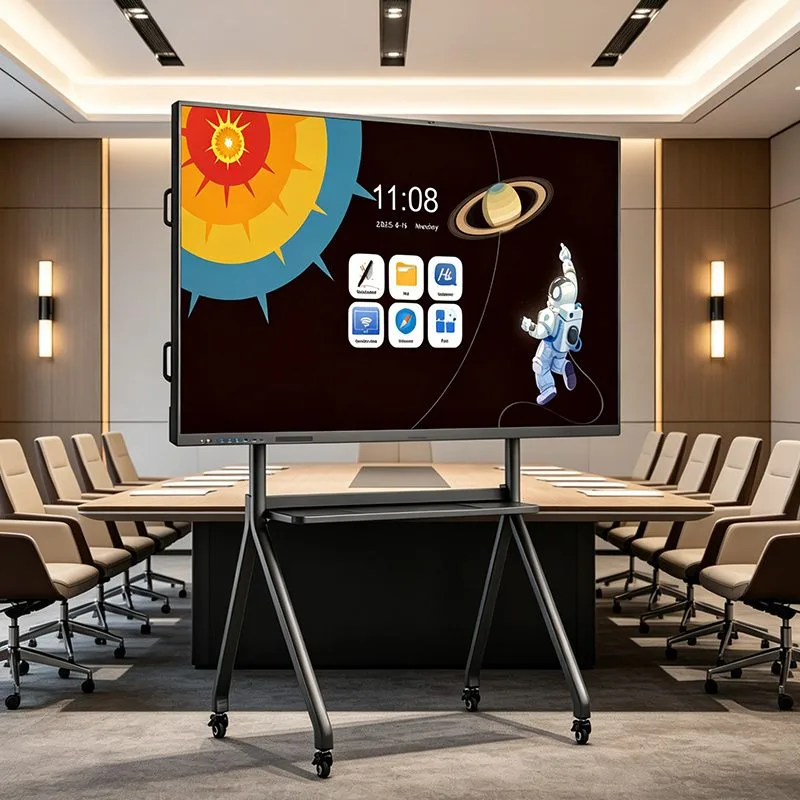
For a standard classroom or meeting-room deployment where zero-gap bonding and a verifiable configuration are part of the requirement, a reference configuration such as the Qtenboard 105-inch smart digital whiteboard can serve as a comparison point against other quotations — not because a larger size is always necessary, but because a published configuration gives the buyer a concrete baseline to hold other suppliers against.
Two practical points deserve attention when matching a tier to a project in Uzbekistan. First, tender timelines are often compressed around the academic calendar and budget cycle; a supplier that cannot confirm a production and shipping window before the deadline introduces schedule risk regardless of grade. Second, the availability of a local service partner or spare-parts stock changes the effective warranty of any tier. A high-tier unit without local support can perform worse, operationally, than a mid-tier unit with a named service partner in Tashkent or Samarkand. These are questions to put to the supplier and, where possible, to a local freight forwarder or customs broker before the quotation is finalized.
A pre-shipment inspection is the buyer's last practical opportunity to catch a grade mismatch before the goods leave the factory. The five checks below are organized around the dimensions discussed above, and they should be applied to both the supplier's sample unit and units drawn randomly from the mass-production batch. The gap between the sample and the batch is often more informative than the absolute quality of either.
Check brightness uniformity across a white field, count bright and dark sub-pixels against the agreed standard, look for mura or uneven aging, and confirm that the central viewing area meets the stricter zone requirement if one was specified. AQL sampling is a recognized method for converting "acceptable quality" into a countable inspection plan; common display inspection plans use AQL 0.65 for major defects and AQL 1.5 for minor cosmetic defects, applied across defined viewing zones[reference:3][reference:4]. The exact plan should be agreed in writing before inspection.
Test multi-point accuracy, writing latency, edge response, and palm rejection. If the panels are intended for lower-grade classrooms, test the actual stylus or finger-writing experience rather than relying on a touch-point count on the specification sheet. A 20-point touch specification does not by itself guarantee that the touch module will maintain accuracy after months of use.
Verify boot time, Wi-Fi and Bluetooth stability, HDMI/USB/LAN port function, screen casting, and language package switching for Russian and Uzbek. Open the system information screen and compare the reported CPU, RAM, and storage against the quotation. If local teaching software is part of the deployment, test it on the inspection unit rather than assuming compatibility from the operating system version.
Inspect the bonding layer for bubbles or dust ingress, check frame gaps and mounting-point load ratings, confirm power protection features, and review the packaging for shock and moisture protection. For Uzbekistan, where goods may travel by road or rail through Central Asia, packaging quality and transport insurance should be confirmed at the same time as the product inspection. Confirm that the power cable and plug configuration match Uzbekistan's 220V/50Hz supply and Type C/F sockets[reference:5].
Record serial numbers from the sampled batch, collect the QC report and firmware version for each sampled unit, and confirm that the warranty document identifies the covered components and the responsible service party. If the shipment requires certificates or origin documents for customs, verify that the document set is complete before the goods leave the factory. A technically acceptable unit with incomplete customs documentation can still create a delay at the border that erases its price advantage.
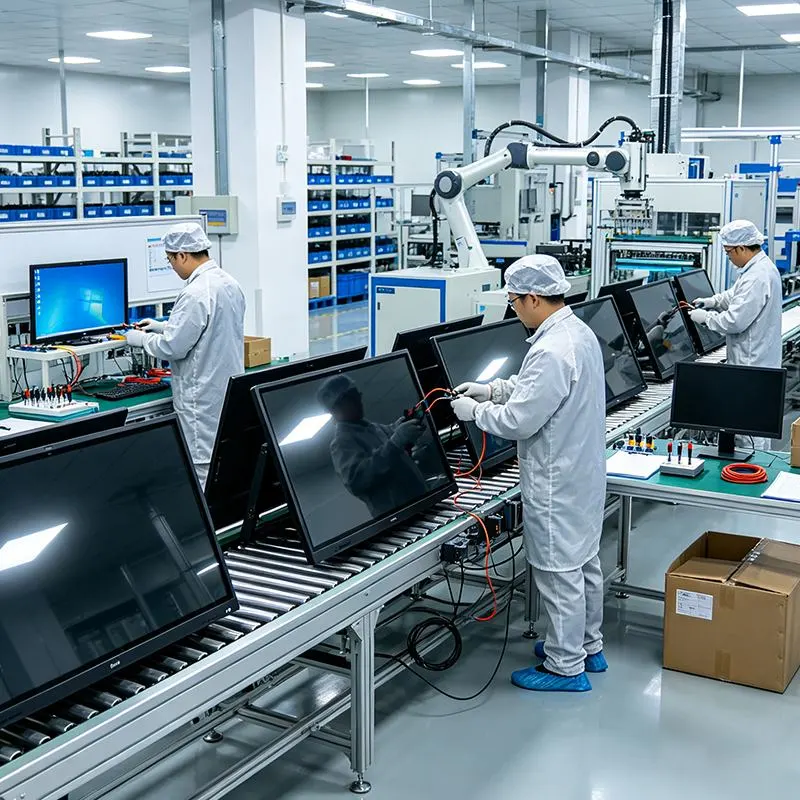
Shenzhen Qunmao Display Technology has been manufacturing commercial displays since 2005, with a production base of approximately 330,000 square meters and automated SMT and burn-in testing lines[reference:6]. For buyers evaluating interactive panels for Uzbekistan or the broader Central Asian market, the following capabilities are relevant to the tier and inspection questions discussed above.
Qunmao operates as a source factory rather than an assembly-only supplier, with in-house tooling development for structural components and control over the production chain from mold development to finished unit[reference:7]. Products are certified to CE, FCC, and RoHS standards, and the factory holds ISO 9001 certification[reference:8]. Documented aging tests, ESD protection, and a stated defect-rate target of below 0.5% are part of the manufacturing quality framework[reference:10]. These documents are the kind of evidence a buyer needs when asking a supplier to substantiate a grade claim.
Qunmao's product pages publish configuration details — panel sizes from 65 to 110 inches, 4K UHD industrial LCD panels, AG anti-glare and AF anti-fingerprint tempered glass, and Windows/Android dual-system support — that allow a buyer to compare quotes against a defined baseline rather than a generic description[reference:11]. OEM/ODM support covers hardware interfaces, mounting, branding, and software configuration, which is relevant for distributors and system integrators assembling a tender response[reference:12]. For a buyer in Uzbekistan, this means the supplier can be asked to document the exact configuration that corresponds to the tier being quoted, rather than relying on an undefined letter grade.
Qunmao's standard framework includes a one-year free warranty with lifetime technical support, and component charging after the warranty period[reference:13]. For project-based buyers, the more relevant question is how this framework can be adapted to the tender requirements — specifically, whether component-level coverage, spare-parts lists, and local service arrangements can be negotiated into the contract. These are the points to clarify at the quotation stage, because a warranty term that is not written into the contract is difficult to enforce after delivery.
The following questions can be copied directly into an email or a request for quotation. They are designed to convert the panel grade difference from a marketing label into a set of verifiable commitments.
What is the exact panel brand and model, and is the panel new or from another source?
What is the written dead-pixel acceptance policy, including the rule for the central viewing area?
Which bonding process is used — air-gap, zero-gap, or optical bonding — and can it be verified on a sample?
What are the exact CPU, GPU, RAM, and storage configurations, and is the RAM figure installed or usable?
Does the unit support Russian and Uzbek language interfaces, and which locally used teaching software has been tested?
What is the warranty coverage by component (panel, touch, motherboard, power board)?
Who supplies spare parts, who pays cross-border freight for a warranty repair, and what is the remedy (repair or replace)?
Which certifications and customs documents can be provided for the destination market?
What inspection report and QC documentation accompany the shipment, and can AQL sampling be applied?
Is there a local service partner or spare-parts arrangement in Uzbekistan, or a remote diagnostic process?
Not automatically. If the project lifespan is short and downtime is tolerable, a well-documented B-tier configuration may deliver better value than paying a premium for an A-tier label. The grade label is less important than the written specification behind it: panel brand and model, dead-pixel policy, bonding method, motherboard configuration, and component warranty.
A cheap interactive panel can be acceptable when the use case is genuinely short-term or low-intensity — rental fleets, exhibitions, temporary installations — and when the buyer has priced in the possibility of replacement rather than repair. It becomes risky when the same logic is applied to a multi-year school deployment where downtime and replacement logistics carry real cost.
Ask for a written definition and attach it to the quotation or contract. A verifiable claim identifies the panel brand and model, states the dead-pixel policy, names the bonding process, specifies the motherboard configuration, and breaks down warranty coverage by component. A verbal assurance that a product is "A-grade" is not an acceptance criterion. Where possible, inspect both the sample unit and a random draw from the production batch.
For a school or public-sector deployment, the warranty structure and the availability of local spare parts often matter more than any single hardware parameter. A mid-tier unit with a named service partner and a component-level warranty can be operationally more reliable than a higher-tier unit without a defined failure path. After warranty, the panel's dead-pixel policy and the motherboard's language and software compatibility are the two specifications most likely to affect daily use.
A threefold price difference between same-size interactive panels is not a pricing accident. It usually reflects real differences in the panel, the motherboard, the bonding process, and the warranty structure. The productive way to approach the comparison is to define the project lifespan and operating intensity first, then use the tier framework to ask which layer of the product has been changed — and to require the supplier to document that layer in writing. A cheap interactive panel is not inherently a mistake; selecting one for a project that needs a long-lifecycle configuration is. The checklist and inspection points above are intended to make that distinction verifiable before the purchase order is issued.
View Interactive Whiteboard Reference Configuration Contact Us for Specification Comparison
Notes for buyers: Tariff rates, HS classification, and customs procedures referenced in this article are indicative and subject to change; confirm the applicable rate and document requirements with a licensed customs broker before finalizing a quotation. Inspection AQL values are examples of commonly used display-industry plans and should be agreed in writing between buyer and supplier. Any cost comparison used in procurement should be based on verified quotations or clearly labeled assumptions.


 Floor 6, Building A, No. 3, North District, Shangxue Science and Technology City, Xinxue Community, Bantian Street, Longgang District, Shenzhen City
 info@szqunmao.com
 +86 13148726043
 +86 13148726043