English
 Español
 Português
 Français
 Русский язык
 Italiano
 Deutsch
 Nederlands
 لعربية
 한국어
 Japanese
 ภาษาไทย
 Türkçe
 Tiếng Việt
 Bahasa Indonesia
 Hindi
 kazakh
 Uzbek
 Thai
 Farsi






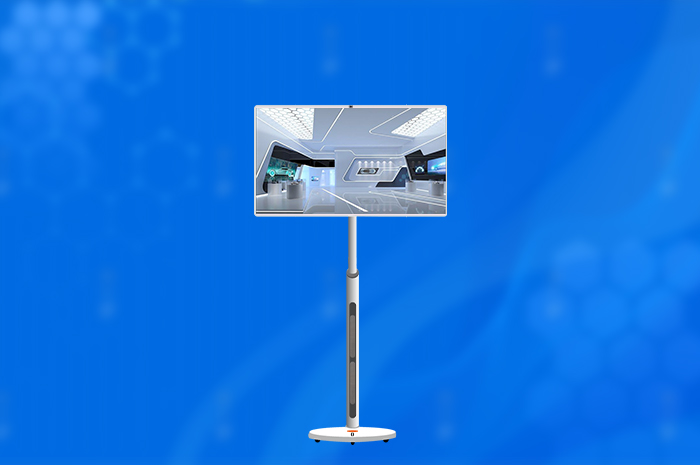
A 32-inch touch kiosk is one of the most flexible units in a commercial display programme: small enough for an aisle or a reception desk, large enough for wayfinding, product lookup, campaign playback and queue information. What often begins as a broad request for a kiosk display screen becomes a precise, repeatable specification once the form factor, touch route and software scope are agreed. This guide is written for buyers who need to specify one, order a pilot batch and then repeat it across sites. It uses the 32" vertical capacitive touch kiosk (QM-C32XJ-PL) as the working configuration, and walks through the decisions that turn a category phrase into an orderable, repeatable specification.
1. Who This Guide Is For
Four roles normally shape a kiosk order. The retail, hospitality or public-space operator defines what a visitor should be able to do at the screen. The systems integrator owns the floor position, network drop, software and commissioning. The importer or tender agent assembles the paperwork and the delivery schedule. The factory project manager turns all of it into one approved specification sheet. When those four agree on the same document, a pilot unit and unit 200 behave identically; when they do not, the differences show up at installation rather than in the quotation.
Qunmao Display Technology Co., Ltd. was established in 2009 with a production base in Shenzhen covering 230,000 square metres, integrating production, sales, software development and service for LCD and central control equipment. As an OEM & ODM solution provider, it exports more than 85% of output to over 50 countries and regions, including India, Morocco, Russia, Indonesia, the USA, South Africa, Southeast Asia and Pakistan. The kiosk range covers touch screen kiosks, information inquiry kiosks, interactive kiosks, self-service kiosks, self-ordering kiosks, self-payment kiosks and queue kiosks — enough breadth that the first job is always to name the exact configuration.
2. Where a 32" Indoor Information Kiosk Earns Its Place
The 32-inch format fits where a full-height totem would dominate the space and a tablet would be too small to read while walking. Typical deployments include supermarket aisle lookups and promotional playback, hotel lobby directories and concierge information, bank and government service halls, hospital and clinic wayfinding, transport information points, exhibition hall product catalogues, corporate reception directories, restaurant and catering information, and campus or enterprise notice points. All are indoor, mains-powered, high-traffic environments where a visitor stands for a short time, reads, taps and moves on.
In each of these, the kiosk replaces printed signs and staffed questions with one updatable screen. That is the business case: content changes without reprinting, opening hours and service information stay consistent across sites, and a chain can push a campaign to every location from one backend. The screen is not the value on its own — the ability to keep it current is.
3. Define the Visitor's Job Before Choosing Hardware
Start from the action, not from the diagonal. Four common jobs lead to four different specifications:
| Visitor job | What the unit must do | What that implies |
|---|---|---|
| Find a place or a service | Wayfinding maps, floor directories, searchable lists, on-screen keyboard | Reliable multi-touch, portrait layout, fast touch response |
| Look up products or information | Catalogue browsing, images, video, QR handoff to a phone | Split-screen zones, scheduled content, remote publishing |
| Watch a campaign | Looped video, posters, subtitles, timed playlists | Media decoding, local fallback when the network drops |
| Join a queue or check in | Ticket or queue number, service routing | Integration with the operator's client software and peripherals |
One boundary is worth stating early. If the brief includes taking payment, printing a receipt, scanning a QR payment code or accepting a card, that is a dedicated self-service payment ordering terminal, with its own peripheral set and its own quotation. An information kiosk is the right choice precisely when no transaction hardware is needed — specifying it clearly keeps the bill of materials clean and avoids paying for interfaces the project will never use.
4. Choose the Form Factor From the Available Range
The kiosk family is organised by mounting style and touch route, with a defined size ladder for each. Choosing the ladder first makes the model code meaningful:
| Form factor | Available sizes (inch) | Typical placement |
|---|---|---|
| Vertical capacitive touch kiosk — the configuration used here | 32 / 43 / 49 / 55 / 65 | Floor-standing aisle, lobby and reception positions with finger or stylus input |
| Vertical infrared touch kiosk | 32 / 43 / 49 / 50 / 55 / 65 / 75 / 85 | High-traffic indoor positions, larger formats, glove or object input |
| Wall-mount infrared touch kiosk | 32 / 43 / 49 / 50 / 55 / 65 / 75 / 85 / 98 | Where floor space is limited or a fixed height is required |
| Wall-mount capacitive touch kiosk | 10.1 / 13.3 / 15.6 / 18.5 / 21.5 / 23.6 / 27 / 32 / 43 / 49 / 50 / 55 / 65 | Compact counters, door-side panels and space-constrained service points |
Where the interaction happens seated or across a counter, a sloped enclosure is often more comfortable than a tall upright one. The K-type infrared inquiry terminal (QM-C32XJ-BG) is the 32-inch alternative in that family, and it uses infrared sensing rather than capacitive. Selecting between the upright and sloped forms at this stage fixes the enclosure drawing, the viewing height, the base footprint and the installation method for every downstream document.
5. Choose the Touch Route for the Environment
Two sensing technologies serve this family, and the choice is environmental as much as financial. Capacitive G+G — a high-channel glass-on-glass solution — gives smooth writing, precise touch and strong anti-interference. It suits clean indoor retail, hospitality and office environments, supports multi-user gestures, and keeps a flush glass surface that is easy to wipe down. Infrared sensing works with a finger, gloved hand or any opaque object, is tolerant of dust and chalk in the air, and scales comfortably to the larger sizes in the vertical and wall-mount ladders.
For a supermarket or hotel lobby with bare-hand interaction, capacitive is the natural fit. For a workshop, a dusty transit hall or a site where staff wear gloves, infrared earns its place. Agree the route before the RFQ: it determines the glass stack, the bezel, the calibration procedure and the cleaning instructions in the user manual. Do not leave it as an open line to be settled after the order.
6. What 20-Point Capacitive Touch Enables
The working configuration supports 20 simultaneous touch points on a capacitive G+G surface. In practice that means more than one visitor can use the screen at once, a teacher or staff member can annotate beside a guest, and gestures such as pinch, rotate and two-handed drag behave predictably across the full glass area. For wayfinding, two people can compare routes side by side; for a product catalogue, one can hold a filter while another scrolls a list.
When writing the acceptance criteria, specify the behaviours rather than the number alone: touch accuracy at the panel edges, response after cleaning, palm rejection while writing, stylus compatibility, calibration stability after a power cycle, and recovery from an interrupted touch. Then test them on the pilot unit with real two-hand interaction. A kiosk that works perfectly with one finger and hesitates with two will be noticed immediately by visitors.
7. Display Specification and Why Each Line Matters
The table below is the reference configuration for a 32-inch vertical capacitive kiosk. It is the document the quotation, the pilot approval and the incoming inspection should all point to.
| Item | Specification | What it delivers |
|---|---|---|
| Model | QM-C32XJ-PL | A single, repeatable part number for every site and every reorder |
| Screen | 32 inch, vertical floor-standing, all-in-one slim frame | A small footprint with a readable full-height display |
| Panel | IPS HD LCD, LED backlight | Consistent colour and wide off-axis readability |
| Native resolution | 1920 × 1080 Full HD | Sharp text, maps and product images at close viewing distance |
| Media decoding | 4K video and image decoding and playback | One 4K master asset library can serve the whole fleet; files play back downscaled to the FHD panel without transcoding |
| Active display area | 393.5 × 698 mm (H × V), 16:9 panel in portrait | Tall wayfinding columns, full-height posters and scrolling information |
| Viewing angle | 89 / 89 / 89 / 89 | Readable from side approaches in aisles and lobbies |
| Brightness | ≥300 cd/m² | Comfortable under indoor retail, hotel and hall lighting |
| Refresh rate | 60 Hz | Smooth campaign video and animated transitions |
| Touch | 20-point capacitive, high-channel G+G | Multi-user interaction, smooth writing, strong anti-interference |
| System | Intelligent Windows operating system; third-party client software can be installed | Runs the operator's own inquiry, queue or catalogue application |
| Connectivity | WiFi, with wired network support in the project configuration | Remote content publishing and fleet status |
| Construction | All-in-one frame, super-thin, easy installation and maintenance | Fast service access behind a floor-standing unit |
A few project-specific items are best confirmed at RFQ stage rather than assumed: the exact OS build and licence ownership, RAM and storage, glass thickness and surface treatment, touch accuracy tolerance, the network module standard, whole-unit weight and export packing dimensions. Recording them on the approved specification sheet is what keeps site 200 identical to site 1 — and what makes a reorder a one-line email.
8. Plan Content and Layout for a Portrait Screen
The 393.5 × 698 mm active area is a 16:9 panel installed in portrait, so the content design should be portrait-first: a tall map or directory column, a full-height campaign zone, a scrolling ticker for opening hours or service notices, and a persistent navigation strip within thumb reach. Split-screen playback allows video, images and posters to run together with fine adjustment in each zone, which is useful when the kiosk must inform and promote at the same time.
Approve the layout in the same review as the hardware. Confirm which content is published locally and which is pushed remotely, what happens when the network drops, how playlists are scheduled, and who holds the administrator account. On the physical side, confirm base footprint, anti-tip stability, floor flatness, power outlet position, network drop, service clearance behind the frame, and the narrowest doorway and lift on the delivery route. A portrait unit that cannot be brought through a standard door is a logistics problem, not a display problem.
9. System, Software and Network Architecture
An information kiosk is a software delivery point. The Windows-based intelligent operating system supports installation of third-party client software, so the operator's wayfinding application, catalogue browser, queue client or digital signage player can run on the same unit. That flexibility is the reason to choose this class over a closed media player.
Put the software scope into the specification: exact OS build and licence, RAM and storage, pre-installed applications and installation policy, interface language, boot screen, WiFi module and standard, wired port, CMS or remote publishing compatibility, split-screen and playlist behaviour, timed power on/off, administrator accounts, playback logs and behaviour during a network outage. List every application, file format and language by name. "Third-party software can be installed" is a capability; the acceptance criterion is that the named application runs, publishes and recovers correctly on the delivered unit.
10. Branding and OEM / ODM for Chain Roll-Outs
OEM and ODM service is available for volume programmes, and it is most valuable when it is applied once and then frozen. The configurable surface typically covers:
Brand and identity — logo, nameplate, boot screen and startup animation, UI language, carton artwork and manual language.
Software — a standard image, pre-installed client applications, home-screen layout, zone layout and playlist defaults.
Configuration — OS build, RAM and storage, network module, glass treatment and the declared 20-point capacitive touch.
Structure — vertical stand finish, base footprint and service access within the same form factor.
Supply logo artwork as production files and state the target volume in the RFQ, since custom imaging, finishes and software builds normally tie to a minimum quantity. Factory visits are welcome at any time before order release, which is a practical way for a distributor to approve the assembly line, the aging test and the export packing in one trip. Keep the customisation bounded: branding, software and declared options are flexible, while the panel, touch route and environmental class belong on the fixed specification sheet.
11. Building the RFQ
A complete enquiry removes two or three quotation rounds. Send all of the following in one message:
Configuration — QM-C32XJ-PL, 32-inch vertical floor-standing capacitive kiosk.
Environment — indoor information / advertising role; no direct sun, rain or payment peripherals.
Orientation and mounting — portrait floor-standing, with base footprint and anti-tip confirmation.
Display — 1920 × 1080 FHD with 4K media decoding; ≥300 cd/m²; split-screen zones.
Touch — 20-point G+G capacitive, plus accuracy, glass, stylus and glove requirements.
System — exact OS build and licence, RAM / storage, named applications, UI language and boot screen.
Network — WiFi and wired, CMS, remote publishing, timed power and playback logs.
Quantity and sites — units per location, total volume, number of delivery addresses, and whether any site needs a different size or form factor.
Branding and packaging — logo, nameplate, carton artwork, manual language and per-site marking.
Site facts — floor condition, doorway and lift dimensions, power and network positions, service clearance.
Destination — country / port, mains voltage and plug type, preferred Incoterm, currency and payment terms.
Documentation — certificate set, warranty scope and spare-parts requirement for the tender.
Timing — required delivery date and whether a pilot unit is needed before the production run.
Enquiries are answered within 12 hours by email, product and price questions within 24 hours, and 7*24 online service is available. Monthly stock of 3,000–5,000 units is a supply-capability statement; confirm the actual date and minimum quantity for the specific customisation in writing when the quotation is issued.
12. Pilot Approval and the Golden Sample
For a custom software image, custom finish or multi-site order, approve one fully assembled pilot unit before the production run — panel, stand, touch glass, OS build and content together, not as five separate approvals. Run the real visitor journey on it: play a 4K source file and confirm clean downscaled playback on the FHD panel, open the wayfinding interface, test 20-point response with two hands and a stylus, join WiFi and wired network, push content remotely, run a scheduled playlist and split-screen layout, power-cycle on a timer, and move the assembled unit through the narrowest doorway on site.
Add checks for brightness under the site's real lighting, off-angle readability, colour consistency, boot screen and logo, base stability, service access behind the frame, and export carton artwork. The signed unit becomes the golden sample referenced by the QC checklist and by every later batch. If a programme mixes the upright capacitive unit with a sloped or wall-mounted form, approve each as its own sample and its own purchase line. One named person on the buyer side should sign the approval — that single discipline prevents most specification drift between pilot and production.
13. Production, Quality Control and Supply Capacity
Products are strictly tested by QC before delivery, and the company also sells its own brand in China's domestic market, so quality control is a factory-level routine rather than a project extra. The company adheres to ISO 9001 standards and owns a production factory with a complete supply chain; monthly stock of 3,000–5,000 units supports both standard configurations and repeat orders.
For custom batches, the approved specification sheet is the only reference: no panel substitution, no touch-route change, no OS or enclosure change without written confirmation. Request the QC checklist and device serial list together with the shipment documents rather than after the container arrives. Where a project requires third-party inspection or a factory assessment, state it in the RFQ so it is built into the schedule rather than added at dispatch.
14. Certification and Tender Documentation
For government, education, finance and healthcare projects, the paperwork is part of the product. The company has been engaged in the business display industry for more than ten years, maintains independent R&D institutions, and holds a certificate set covering 3C certification, energy-saving certificate, test report, national high-tech enterprise certificate, CNAS quality certification, CE, FCC, RoHS, ISO 9001 quality management, ISO environmental management and the product implementation standard certificate. It is also a designated brand in the domestic government procurement list and holds invention patents, utility model patents, design patents, intellectual property rights and copyrights.
Request current certificates for the exact configuration ordered: certificate numbers, validity dates and the legal entity name should match the proforma invoice, otherwise a tender submission can be rejected on paperwork alone. Confirm warranty duration, spare-parts scope and the language of the user manual before the purchase order is issued.
15. Packaging, Delivery and On-Site Commissioning
A 32-inch vertical kiosk normally ships as a screen and a base, often in more than one carton or a wooden crate for less-than-container loads. Confirm export carton dimensions, foam protection, whether the stand ships assembled or flat-packed, the wooden-frame option, and any drop-test or humidity requirements for long routes. Freight is calculated from packing size and gross weight, not from the screen diagonal. Keep the packing list, commercial invoice, certificate pack and assembly guide as one document set, with every carton labelled to the same serial number.
Commissioning follows a fixed sequence: unbox inspection against the QC checklist, base assembly on a level load-bearing floor, portrait and anti-tip check, power-on, OS and licence verification, network join, touch calibration, 4K-file playback on the FHD panel, split-screen and scheduled-playlist test, remote content push, and administrator handover. Confirm floor flatness, doorway clearance, cable routing to the nearest outlet and a safe position in the pedestrian flow. Record the final device list, serial numbers, model code, OS build, touch configuration and admin credentials in the asset register before the integrator leaves.
16. Training, After-Sales and Fleet Expansion
Operator training is a deliverable, not a courtesy: content editors need to publish a campaign, store staff need to clean the glass without affecting calibration, and IT needs to rejoin a unit to the network after a replacement. Capture those three procedures in a short handover document in the agreed language.
Questions receive a reply within 24 hours with solutions provided immediately; quick email response is within 12 hours, and 7*24 online service is available. For expansion, standardise on one model code, one OS build, one software image, one touch configuration and one golden sample. Then a second phase in another city is a quantity change, not a new project — and the approved specification sheet becomes the reorder reference.
17. Indicative Project Timeline
| Stage | Owner | Output document |
|---|---|---|
| 1. Visitor job & environment | Operator / integrator | Indoor information or advertising role, no transaction hardware |
| 2. Form factor & touch route | Both parties | Upright capacitive, sloped or wall-mounted, confirmed in writing |
| 3. Specification lock | Both parties | Signed sheet with display, decoding, touch, OS, network and branding lines |
| 4. RFQ & quotation | Qunmao | Quotation with Incoterm, MOQ, certificate set and lead time |
| 5. Pilot approval | Both parties | Golden sample with real content and two-hand touch test |
| 6. Production / QC | Qunmao | QC checklist and device serial list |
| 7. Documentation | Qunmao | Certificate pack, invoice and packing list |
| 8. Freight & receiving | Forwarder / buyer | Signed receiving report per site |
| 9. Commissioning & training | Integrator | Staff sign-off and asset register entry |
| 10. After-sales & repeat orders | Both parties | 24-hour support record, standardised reorder specification |
Lead times vary with customisation scope, quantity and destination. What belongs in the contract is the sequence and the acceptance document for each stage, not a generic number of days.
18. Frequently Asked Questions
Q. What does "kiosk display screen" actually refer to, and where should a buyer start?
A. It is a category phrase covering many forms and sizes, not a single part number. A practical starting point for indoor information and advertising work is the 32-inch vertical capacitive configuration, QM-C32XJ-PL. From there, confirm the form factor, touch route, OS build and quantity, and the phrase resolves into one orderable specification.
Q. Is the screen 4K, and can we reuse our 4K campaign files?
A. The panel is 1920 × 1080 Full HD, and the unit supports 4K video and image decoding and playback. That means a 4K master asset can be published to the fleet without transcoding and plays back downscaled to the native FHD panel. It is a useful combination for chains that produce one high-resolution asset library for several screen types.
Q. Capacitive or infrared — how do we choose?
A. Capacitive G+G gives smooth writing, precise touch and strong anti-interference on a flush glass surface, and suits clean indoor retail, hotel and office environments with bare-hand use. Infrared tolerates gloves, dust and opaque objects and scales to the larger sizes in the vertical and wall-mount ranges. Choose by environment first; the decision affects glass, bezel, calibration and cleaning instructions.
Q. How many people can use the screen at once?
A. The working configuration supports 20 simultaneous touch points. Two visitors can compare wayfinding routes side by side, or one can hold a filter while another scrolls a catalogue. Specify edge accuracy, palm rejection, stylus behaviour, calibration stability and recovery from an interrupted touch, then verify them with a real two-hand test on the pilot unit.
Q. Does it ship in portrait or landscape?
A. Portrait, with a 393.5 × 698 mm active area — a 16:9 panel installed vertically. That supports tall directory columns, full-height posters and scrolling information. Approve content layouts in portrait, and confirm base footprint, anti-tip stability, service clearance and doorway dimensions. For a fixed landscape position, the wall-mounted range is the appropriate form.
Q. Which sizes are available if some sites need a different format?
A. Vertical capacitive units are offered in 32 / 43 / 49 / 55 / 65 inch; vertical infrared in 32 / 43 / 49 / 50 / 55 / 65 / 75 / 85 inch; wall-mount infrared up to 98 inch; wall-mount capacitive from 10.1 up to 65 inch. Keep one size and one form factor per purchase line so the content layout, enclosure drawing and installation method remain consistent.
Q. What operating system and software does it run?
A. An intelligent Windows operating system with support for installing third-party client software, so the operator's wayfinding, catalogue, queue or signage application can run on the unit. Confirm the exact OS build, licence ownership, RAM, storage, named applications, UI language, CMS compatibility, remote publishing, timed power, administrator accounts and playback logs in the specification sheet.
Q. Can it take payments, print receipts or scan QR payment codes?
A. No. This is an indoor information and advertising kiosk. Projects requiring receipt printing, QR payment scanning, card acceptance or a POS position belong to a dedicated self-service payment ordering terminal, quoted with its own peripheral set. Stating that boundary at RFQ stage keeps the bill of materials accurate.
Q. What can be customised, and what is the supply capacity?
A. OEM / ODM service covers logo, nameplate, boot screen, UI language, carton artwork, manual language, a standard software image, pre-installed applications, OS build, RAM / storage, network module, glass treatment and stand finish. Monthly stock is 3,000–5,000 units, products are strictly QC-tested before delivery, and the factory operates under ISO 9001 with a complete in-house supply chain. Include target volume in the RFQ so custom imaging and finishes can be scheduled.
Q. What after-sales support applies to a multi-site roll-out?
A. Questions receive a reply within 24 hours with solutions provided immediately, quick email response is within 12 hours, and 7*24 online service is available. Certificate papers, warranty scope and spare parts are confirmed before the purchase order. For expansion, standardise on one model, one OS image, one touch configuration and one golden sample, then reuse the approved specification sheet as the reorder reference.
19. Start Your Project
Send the visitor job, the form factor, the touch route, the OS and software requirements, the quantity and the destination in one message, and the process above starts with a specification that can be quoted, sampled and repeated. For indoor wayfinding, information lookup and advertising playback, the QM-C32XJ-PL 32" capacitive touch information kiosk is the reference configuration; where a sloped counter, a wall-mounted position, a different size or a transaction workflow is required, the same project team will quote the matching unit from the kiosk range. One approved specification sheet is what turns a single pilot into a fleet.