English
 Español
 Português
 Français
 Русский язык
 Italiano
 Deutsch
 Nederlands
 لعربية
 한국어
 Japanese
 ภาษาไทย
 Türkçe
 Tiếng Việt
 Bahasa Indonesia
 Hindi
 kazakh
 Uzbek
 Thai
 Farsi






Most rooms in a school, an office or a training estate are not large halls — they are standard rooms where a group of people gather around one shared screen. Whether a brief calls it a 65inch freestanding interactive flat panel, a 65inch black freestanding interactive flat panel, or a 65inch white freestanding interactive flat panel, the buyer is asking for the same platform: a 65-inch 4K touch display, a mounting method, a frame finish, and a software image that behaves identically in every standard room. This guide is written for school districts, corporate workplace teams, training chains, importers and AV integrators who need to specify one, approve a pilot batch and then repeat it across an estate. It uses the 65" 4K interactive flat panel for education and business as the working configuration, and walks through the decisions that turn one well-defined room into a repeatable standard.
1. Who This Guide Is For
Four roles normally shape a standard-room display order. The school, university or corporate workplace team defines what a teacher, presenter or team must be able to do during a session. The AV integrator owns the wall or floor position, the delivery route, power, network and commissioning. The importer and tender agent assembles the paperwork and the shipping schedule. The factory project manager turns all of it into one approved specification sheet. When those four agree on the same document, room 1 and room 200 behave identically; when they do not, the differences show up during installation rather than in the quotation.
Qunmao Display Technology Co., Ltd. was established in 2009 with a production base in Shenzhen covering 230,000 square metres, integrating production, sales, software development and service for LCD and central control equipment. As an OEM & ODM solution provider, it exports more than 85% of output to over 50 countries and regions, including India, Morocco, Russia, Indonesia, the USA, South Africa, Southeast Asia and Pakistan. Interactive flat panels sit alongside interactive whiteboards, smart blackboards, conference panels, educational tablets, digital signage, advertising displays and LCD video walls in the main product range — enough breadth that the first job is always to name the exact configuration for the programme.
2. Where a 65" Interactive Flat Panel Earns Its Place
The 65-inch format is the reference size of a modern estate: large enough for a full standard class or a team meeting, compact enough to pass through a normal doorway and fit a standard wall without structural work. Typical deployments include primary and secondary classrooms, university seminar and tutorial rooms, vocational and corporate training rooms, standard meeting and team rooms, huddle-to-standard collaboration spaces, briefing rooms in hospitals and public buildings, and showroom or exhibition demonstration points where the group stands close to the screen.
What these have in common is a shared surface at a comfortable distance. One panel replaces a projector, a screen, a whiteboard, a speaker set and a separate casting receiver: a teacher writes and annotates, plays a 4K video, casts from a laptop, runs a split-screen comparison, and saves the session for people who were not in the room. For a multi-building programme, the commercial value is that one approved hardware and software image can be rolled out to every standard room without re-specifying each one — and that a larger hall is handled as a deliberate upgrade rather than an exception.
3. Define the Session Before Choosing Hardware
Start from what happens in the room, not from the diagonal. Four common jobs lead to four different emphasis areas:
| Session | What the panel must do | What to confirm in the specification |
|---|---|---|
| Teach a standard class | Write on a whiteboard, annotate over a paused video, keep small text and equations readable from the back row | 4K legibility, anti-glare glass, touch writing, low writing latency |
| Run a team meeting | Cast from several laptops, hold an agenda beside a video window, share notes afterwards | Wireless projection, split-screen zones, casting protocols, session export |
| Collaborate in small groups | Let several people write or move objects at once, then review each result on screen | Multi-user touch, simultaneous writers, stylus behaviour at the panel edges |
| Repeat training across sites | Run the same content in many rooms, be managed centrally, power on by schedule | Standard software image, device management, timed power, remote publishing |
One boundary is worth stating early. If the brief calls for a real chalk-writing surface alongside the screen, that is a smart blackboard form with its own enclosure drawing; if it calls for a vertical advertising loop in a lobby, that is a digital signage kiosk. An interactive flat panel is chosen when people need to write, cast, collaborate and save on one shared screen. Fixing that split at the start keeps the bill of materials clean.
4. Choose the Size and the Platform From the Range
The interactive flat panel range spans 55 to 110 inches, so the 65-inch working configuration sits inside a ladder that can be standardised across one estate. Choosing the ladder first makes the model code and the room drawing meaningful:
| Size band | Best fit | What it changes in the order |
|---|---|---|
| 55 inch | Small tutoring rooms, one-to-one training, compact huddle spaces | Shortest viewing distance, lightest handling, smallest wall footprint |
| 65 inch — the configuration used here | Standard classrooms, seminar rooms, team and training rooms, standard meeting rooms | The reference room: a balanced viewing distance, a standard wall footprint and two-person handling |
| 75 inch | Larger classrooms, lecture rooms, boardrooms, training suites | Longer viewing distance, larger wall footprint, a new route survey |
| 86 – 110 inch | Lecture halls, teaching theatres, flagship boardrooms | Structural wall check, crate freight, additional handling equipment |
Where a programme wants a single named classroom SKU rather than a platform page, the 65" education interactive flat panel configuration can be quoted as its own order line, with its OS build and touch configuration frozen on the same sheet. Keep one size and one form per purchase line so the content layout, wall drawing and commissioning checklist stay consistent. For programmes that mix a standard-room size with a large-hall size, agree a common specification language at the start: one glass stack, one software image, one remote-management approach and one branding package. That is what allows a 65-inch standard room and an 86-inch hall to be ordered, commissioned and supported as one project.
5. Display Performance and Why Each Line Matters
The table below is the platform reference for a 65-inch interactive flat panel. It is the document the quotation, the pilot approval and the incoming inspection should all point to. The approved specification sheet carries the exact values for the selected version.
| Item | Platform reference | What it delivers |
|---|---|---|
| Display | 65 inch 4K interactive flat panel, landscape all-in-one frame | A shared front-of-room canvas sized for a standard class or team meeting |
| Resolution | 3840 × 2160 (4K UHD) | Sharp equations, small annotations, spreadsheets and diagrams from the back row |
| Media support | 4K video and image decoding and playback | One high-resolution asset library can serve the whole estate |
| Panel | BOE A+ grade LCD panel | Consistent quality and colour across every room in the roll-out |
| Glass | Anti-glare glass with zero gap bonding process | Less reflection from windows and ceiling lights, and a natural writing feel with minimal parallax |
| Brightness | Indoor brightness class, value confirmed per version on the approved sheet | Readable in a lit classroom or meeting room without washing out colour |
| Colour | 16.7M (8-bit) true colour | Accurate diagrams, maps, brand colours and subject imagery |
| Viewing angle | Wide off-axis viewing | Readable from side seats and standing positions around a table |
| Touch | Infrared or capacitive multi-touch, point count confirmed per version | Multi-user writing, group work and reliable finger or stylus input |
| System | Android platform with an optional Windows OPS module | One hardware build for teaching apps, whiteboard tools and legacy Windows software |
| Collaboration | Split screen, wireless projection, multi-screen interaction | Teacher and student, or presenter and remote participant, content side by side |
| Mounting | Wall bracket or mobile stand, VESA pattern confirmed per version | One panel that fits either a fixed room or a room that shares the unit |
A few programme-specific items are best agreed at RFQ stage rather than assumed: the exact OS build and licence scope, RAM and storage, touch point count and sensing technology, stylus and pen accessories, speaker and camera configuration, VESA pattern and bracket load rating, whole-unit weight, and export packing dimensions and gross weight. Recording them on the approved specification sheet is what keeps room 200 identical to room 1 — and what makes a reorder a one-line email.
6. The Reference Room: Geometry, Delivery Route and Content Layout
This is the decision that makes a 65-inch programme repeatable. Before any quantity is quoted, define one reference room and record it as an approved drawing: room length and width, the distance from the screen to the back row, the smallest text size that must remain readable, window and ceiling light sources, side seating angle, wall substrate and load-bearing capacity, power outlet and network position, service clearance behind the frame, and the narrowest doorway, lift and corridor on the delivery route. At 65 inches a two-person lift is normally sufficient, but the route is still surveyed once and reused for every standard room of the same type.
Approve whiteboard and video layouts in the wide 16:9 landscape of the panel, with a clearly defined zone for live annotation and a separate zone for the source window. A simple layout with generous margins usually outperforms a dense one, even at this diagonal, because the whole group reads the same slide. Keep the approved layout, the room drawing and the hardware specification on the same sheet. Once the reference room is signed, every standard room of that type is a copy: same panel, same bracket, same viewing height, same content zones, same software image and same administrator structure. Larger halls become a deliberate second line on the order, not a quiet redesign at installation.
7. Wall Mount, Mobile Stand or Floor Pedestal
"Freestanding" is an installation choice, not a different screen. Three mounting styles solve three different briefs:
Wall bracket — a dedicated standard room with a load-bearing wall and a known viewing height. Confirm the VESA pattern, bracket load rating, wall substrate and fixed power and network positions.
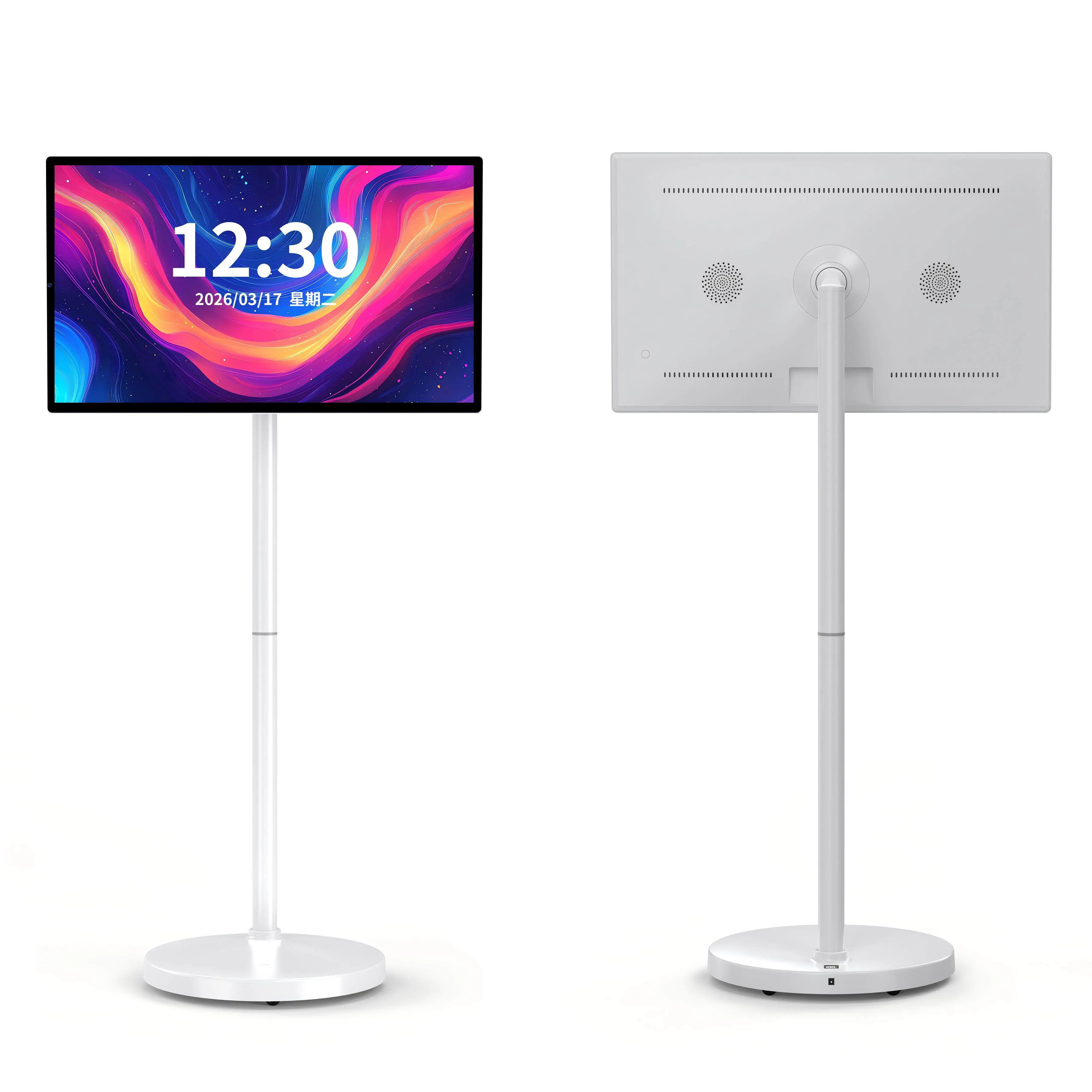
Mobile stand — rooms that share the panel, or layouts that change by session. Confirm locking castors, base footprint, anti-tip stability at full extension, stand height and tilt range, and cable routing.
Floor pedestal — a permanent floor position without wall drilling. Confirm base footprint, floor load, stability and service access.
For any freestanding configuration, the site survey is part of the product. Agree the assembled height and whole-unit weight, castor diameter and locking behaviour, base footprint, floor flatness and load-bearing capacity, ventilation clearance, and the doorway and lift dimensions already recorded for the reference room. Where the stand and the frame are both finished in a custom colour, approve them together on the same sample so the whole assembly matches.
8. Replacing a Projector: What Retires and What Stays
A large share of 65-inch programmes are projector replacements, and the cleanest orders name the change explicitly rather than treating it as a like-for-like screen swap.
Retires — the projector and its lamp and filter replacements, the projection screen, the separate whiteboard, the separate speaker set, the standalone casting receiver, and the dimmed-room routine that came with them.
Stays — the room's wall, mains outlet, wired network point, existing content library and, where applicable, the room PC or laptop fleet used by presenters.
Is added — one 65-inch panel, a wall bracket or mobile stand, the optional Windows OPS module where legacy software requires it, a pen or stylus set, and a defined software image with administrator accounts.
Write the three lists into the RFQ. They settle the scope with the integrator, prevent an old projector being left on the ceiling "just in case", and make the benefits concrete for the buyer: no shadow across the screen, no darkened room, no lamp stock, no separate audio chain, and annotated sessions that can be saved and shared. Where a room also needs a physical chalk surface, that is a different form and a separate line on the order.
9. Frame Colour: Black, White and Brand Interiors
Many briefs specify a 65inch black freestanding interactive flat panel, while others ask for a 65inch white freestanding interactive flat panel. Both are the same 65-inch platform with a different frame finish. A standard black frame suits most classrooms and corporate rooms because it disappears behind the content; a white frame is often chosen for clinics, bright offices, laboratories, hospitality interiors and retail-style training spaces where a lighter enclosure sits more naturally in the room. Custom colours are available where the display must follow a branded interior.
Put the finish on the specification sheet with a colour reference and a signed sample, and state whether the stand, the nameplate and any accessory housing must match. Confirm the surface treatment for cleaning, since a public-space panel is wiped down daily. Locking the finish once prevents a second batch arriving in a slightly different shade — a small detail that is very visible when twenty units sit in one building. Frame colour, stand finish and mounting method should all be approved on the same golden sample, together with the reference-room drawing.
10. Touch Writing, Annotation and Glass
Four capabilities define the interactive part of the panel. Touchscreen writing lets a teacher or presenter write, draw and edit directly on the screen. Annotation over content keeps a video, slide or web page visible while notes are added on top. Multi-user interaction lets several people work at the glass at once during group problem-solving. Session saving keeps the annotated result for people who were absent or for a later class.
Turn those into acceptance items: pen, finger and eraser behaviour, stroke response at the panel edges, colour and line-width options, palm rejection, calibration stability after a power cycle, and the number of simultaneous writers. Anti-glare glass with zero gap bonding matters here as much as it does for viewing — a natural writing feel with minimal parallax is what makes a long lesson comfortable. Then run them on the pilot unit with a real lesson rather than a single demonstration stroke. "The panel supports writing" is a capability; "a teacher can save and share a full annotated lesson" is the acceptance criterion.
11. Wireless Projection, Split Screen and Multi-Screen Interaction
The panel supports split screen, wireless projection and multi-screen interaction. In a classroom that means a worked equation can stay visible while a video plays beside it; in a meeting, an agenda can sit next to a remote participant's screen; in a training estate, one instructor device can be mirrored to several displays. For a multi-building programme, it also means one lesson or meeting layout can be approved once and reused in every standard room.
Put the layout into the specification: zone ratios, which sources can appear in each zone, supported casting protocols from iOS, Android, Windows and macOS devices, behaviour when a device disconnects, and whether the panel keeps playing local content if the network drops. List every file format and interface language by name so the delivered image matches the content workflow and the presenter's laptop.
12. System, Software and Device Management
The Android platform hosts teaching apps, whiteboard tools, multimedia resources and wireless projection on the same unit, and an optional Windows OPS module covers rooms that still depend on legacy Windows software. That openness is what allows one hardware configuration to serve maths, languages, team meetings and staff training without a separate player in each room.
For a district or multi-site company, put the software scope into the specification: exact OS build, pre-installed teaching and whiteboard applications, third-party installation policy, interface language, boot screen, RAM and storage, network join and guest-casting policy, device-management compatibility, administrator accounts, timed power, playback logs, and how saved sessions are stored and shared. Confirm at RFQ stage whether the OPS module is required — that is a configuration decision, not something to assume from a form-factor description. List every application by name so the delivered image matches the operator's workflow.
13. Teaching, Meeting and Training Workflows
A useful way to specify the panel is to write down two sessions that must run end to end. In a maths class, the teacher opens a teaching app, works on a virtual whiteboard, pauses a video to explain a point, splits the class into groups who write equations and change graphs at the glass, reviews each solution on screen, and saves all notes for absent students. In a team meeting, three participants cast in turn, the agenda stays visible beside a financial video window, decisions are annotated live, and the marked-up session is exported to the attendees.
Those two scenarios test writing, multimedia, casting, group interaction, saving and review in one pass. Add a third check for a multi-site estate: the same software image, the same zone layout and the same administrator structure must load on every unit. Outcomes describe why the purchase is made; the named software image and content formats describe what is actually delivered.
14. Branding and OEM / ODM / CKD / SKD
Four cooperation modes are available for volume programmes, and each one suits a different type of buyer:
OEM — your brand, boot screen, nameplate, UI language, carton artwork and manual language on a standard platform.
ODM — a jointly defined specification, enclosure finish, software image and feature set for a product line of your own.
CKD — complete knocked-down supply for markets that require local assembly, with the kit, documentation and test procedure agreed in advance.
SKD — semi knocked-down supply where part of the assembly is completed at the factory and the remainder locally.
Supply logo artwork as production files and state the target volume in the RFQ, since custom imaging, finishes and software builds normally tie to a minimum quantity. Factory visits are welcome at any time before order release, which is a practical way for a distributor to approve the assembly line, the aging test and the export packing in one trip. Keep the customisation bounded: branding, software and declared options are flexible, while the panel, glass stack, VESA pattern and environmental class belong on the fixed specification sheet.
15. Building the RFQ
A complete enquiry removes two or three quotation rounds. Send all of the following in one message:
Configuration — 65" 4K interactive flat panel, with the selected version identified.
Room and session — teaching, team meeting, collaboration or training, with the workflows to be accepted.
Reference room drawing — room dimensions, distance to the back row, smallest readable text, light sources, side seating angle, wall substrate, power and network positions, service clearance, doorway, lift and corridor dimensions.
Projector replacement scope — the retire, stay and add lists from Section 8.
Mounting — wall bracket, mobile stand or floor pedestal, with VESA pattern, bracket rating, base footprint, castor locking and anti-tip stability.
Display — 3840 × 2160, BOE A+ anti-glare zero gap bonding glass, indoor brightness class, 16.7M colour, wide off-axis viewing.
Touch — required sensing technology, point count, simultaneous writers, stylus and pen accessories.
System — OS build, optional Windows OPS module, RAM / storage, named apps, third-party policy, UI language, boot screen.
Collaboration — split-screen zones, wireless projection protocols, multi-screen interaction, session-saving format.
Finish — standard black, white or a custom frame colour, with a colour reference for the frame, stand and nameplate.
Quantity and sites — units per room, number of rooms and buildings, and whether the order mixes sizes.
Branding and packaging — logo, boot screen, nameplate, carton artwork, manual language and per-site marking.
Destination — country / port, mains voltage and plug type, preferred Incoterm, currency and payment terms.
Documentation — certificate set, warranty scope and spare-parts requirement for the tender.
Timing — required delivery date and whether a pilot unit is needed before the production run.
Enquiries are answered within 12 hours by email, product and price questions within 24 hours, and 7*24 online service is available. Monthly stock of 3,000–5,000 units is a supply-capability statement; confirm the actual date and minimum quantity for the specific customisation in writing when the quotation is issued.
16. Pilot Approval and the Golden Sample
For a custom software image, custom finish or multi-room order, approve one fully assembled pilot unit before the production run — panel, glass, bracket or stand, frame finish, touch configuration and software together, not as six separate approvals. Install it in the reference room from Section 6 and run the two sessions from Section 13 on it: open the teaching app, write and annotate, pause a video, split the screen, cast from a teacher laptop and a meeting laptop, save and share the notes, and run a group activity with simultaneous writers.
Add the physical checks that a standard-room roll-out needs: pass the assembled panel and stand through the narrowest doorway, into the lift and along the corridor recorded on the drawing; roll it across the real floor, lock the castors, and push the stand gently at full extension to confirm anti-tip stability. Then check 4K text legibility from the back row, anti-glare behaviour under the room's real window light, edge touch accuracy, wireless projection stability, the OS build and pre-installed apps, boot screen and logo, the black or white frame colour against the signed sample, stand finish, bracket fit, service access, and export carton artwork.
The signed unit becomes the golden sample referenced by the QC checklist and by every later batch. Where a programme mixes a wall-mounted room, a mobile-stand room, a large-hall size or a second frame colour, approve each as its own sample and its own purchase line. One named person on the buyer side should sign the approval — that single discipline prevents most specification drift between pilot and production.
17. Production, Certification, Packaging and Project Timeline
Products are strictly tested by QC before delivery, and the company also sells its own brand in China's domestic market, so quality control is a factory-level routine rather than a project extra. The company adheres to ISO 9001 standards, owns a production factory with a complete supply chain, and maintains 3,000–5,000 units in stock every month. For custom batches, the approved specification sheet is the only reference: no panel substitution, no glass or touch-route change, no OS or software image change, and no frame finish or mounting change without written confirmation. Request the QC checklist and device serial list together with the shipment documents rather than after the container arrives.
For government, education and healthcare tenders, the paperwork is part of the product. The company has been engaged in the business display industry for more than ten years, maintains independent product R&D institutions, and holds a certificate set covering 3C certification, energy-saving certificate, test report, national high-tech enterprise certificate, CNAS quality certification, CE, FCC, RoHS, ISO 9001 quality management, ISO environmental management and the product implementation standard certificate. It is also a designated brand in the domestic government procurement list and holds invention patents, utility model patents, design patents, intellectual property rights and copyrights. Request current certificates for the exact configuration ordered: certificate numbers, validity dates and the legal entity name should match the proforma invoice. Confirm warranty duration, spare-parts scope and the language of the user manual before the purchase order is issued.
A 65-inch glass panel normally ships as a display plus a bracket or stand, in a reinforced export carton or a wooden crate for less-than-container loads. Confirm carton dimensions, foam protection, whether a stand ships assembled or flat-packed, and any drop-test or humidity requirements for long routes. Freight is calculated from packing size and gross weight, not from the screen diagonal. Keep the packing list, commercial invoice, certificate pack and mounting guide as one document set, with every carton labelled to the same serial number.
Commissioning follows a fixed sequence: unbox inspection against the QC checklist, bracket assembly on a load-bearing wall or stand assembly on a level floor, viewing-height and anti-tip check against the reference-room drawing, power-on, network join, wireless projection from a real laptop, split-screen and whiteboard test, session-saving test, edge touch calibration, and administrator handover. Teacher and presenter training is a deliverable, not a courtesy — record the final device list, serial numbers, OS build, touch configuration, mounting method, frame colour and admin credentials in the asset register before the integrator leaves.
| Stage | Owner | Output document |
|---|---|---|
| 1. Session & reference room | School / integrator | Room drawing, back-row distance, smallest readable text |
| 2. Size & form lock | Both parties | 65" 4K IFP, form and version in writing |
| 3. Projector replacement scope | Both parties | Retire, stay and add lists |
| 4. Specification lock | Both parties | Signed sheet with display, glass, touch, OS, software and finish lines |
| 5. RFQ & quotation | Qunmao | Quotation with Incoterm, MOQ, certificate set and lead time |
| 6. Pilot approval | Both parties | Golden sample installed in the reference room, with a full session test |
| 7. Production / QC | Qunmao | QC checklist and device serial list |
| 8. Documentation | Qunmao | Certificate pack, invoice and carton labels |
| 9. Freight & receiving | Forwarder / buyer | Signed receiving report per room |
| 10. Commissioning & training | Integrator | Staff sign-off and asset register entry |
| 11. After-sales & repeat orders | Both parties | 24-hour support record, standardised reorder specification |
Lead times vary with customisation scope, quantity and destination. What belongs in the contract is the sequence and the acceptance document for each stage, not a generic number of days.
Questions receive a reply within 24 hours with solutions provided immediately; quick email response is within 12 hours, and 7*24 online service is available. For expansion, standardise on one size, one version, one OS build, one software image, one finish and one golden sample. Then a second phase in another building is a quantity change, not a new project.
18. Frequently Asked Questions
Q. Are "65inch freestanding interactive flat panel", "65inch black freestanding interactive flat panel" and "65inch white freestanding interactive flat panel" different products?
A. No. They describe one 65-inch 4K platform with three optional details: the size written without a space, the mounting method, and the frame finish. A wall bracket, a mobile stand or a floor pedestal, and a black, white or custom frame, are configuration lines on the same purchase order — not separate products.
Q. Is 65 inches the right size for our rooms?
A. It is the reference size for standard classrooms, seminar rooms, team rooms and training rooms where the group sits at a comfortable distance from the screen. The range spans 55 to 110 inches: 55 inch for compact rooms, 65 inch for standard rooms, 75 inch for larger group rooms, and 86–110 inch for lecture halls and flagship spaces. Record the distance to the back row and the smallest text size that must remain readable, then keep one size per purchase line.
Q. Wall mount, mobile stand or floor pedestal — how do we choose?
A. A wall bracket suits a dedicated room with a load-bearing wall and a known viewing height. A mobile stand suits rooms that share the panel or layouts that change by session. A floor pedestal suits a permanent floor position without wall drilling. Confirm the VESA pattern, bracket load rating, castor locking, base footprint, anti-tip stability and the doorway, lift and corridor dimensions recorded on the reference-room drawing.
Q. Is it a true 4K display?
A. Yes. The panel is 3840 × 2160 UHD with 4K video and image decoding and playback, so a single high-resolution asset library can serve the whole estate. Combined with a BOE A+ grade panel, anti-glare glass with zero gap bonding, 16.7M colour, an indoor brightness class and wide off-axis viewing, small text and diagrams stay readable across a standard room. The exact brightness value is confirmed per version on the approved specification sheet.
Q. How many people can write at once, and which touch technology is used?
A. Infrared or capacitive multi-touch is available, and the point count is confirmed for the selected version on the approved specification sheet. State the required number of simultaneous writers, stylus behaviour, palm rejection and calibration stability at RFQ stage, then test them on the pilot unit with a real group activity, including strokes at the panel edges. Anti-glare zero gap bonding glass keeps the writing feel natural during a long lesson.
Q. Which operating system and software does it run?
A. An Android platform with teaching apps, whiteboard tools, multimedia resources and wireless projection, plus an optional Windows OPS module for rooms that depend on legacy Windows software. Confirm the exact OS build, pre-installed apps, third-party installation policy, RAM, storage, interface language, boot screen, administrator accounts and session-saving policy on the approved sheet.
Q. Can we get a black frame, a white frame, or a custom colour on the frame and stand?
A. Yes. A standard black frame suits most classrooms and corporate rooms, a white frame is often chosen for clinics, bright offices and hospitality interiors, and a custom colour is available for branded spaces. Put the colour reference on the specification sheet, approve it on the signed sample together with the stand and nameplate, and confirm the surface treatment for daily cleaning. Locking the finish once prevents shade differences across a multi-room roll-out.
Q. We are replacing projectors. What changes in the room?
A. The projector, projection screen, separate whiteboard, separate speakers, standalone casting receiver and lamp and filter stock retire. The wall, mains outlet, wired network point, existing content library and presenter laptops stay. One 65-inch panel, a bracket or stand, an optional OPS module, a pen set and a defined software image are added. No shadow across the screen, no darkened room, no lamp stock — and annotated sessions can be saved and shared.
Q. Is it suitable for outdoor or direct-sun positions?
A. The 65-inch interactive flat panel is an indoor education and business product with an indoor brightness class. For a street-facing or direct-sun position, request the dedicated outdoor high-brightness display line with its own enclosure and thermal specification. State the environment in the RFQ so the correct line is quoted.
Q. What cooperation modes, supply capacity and after-sales support are available?
A. OEM, ODM, CKD and SKD are all available, covering branding, a jointly defined specification, complete knocked-down kits and semi knocked-down supply for local assembly. Monthly stock is 3,000–5,000 units, products are strictly QC-tested before delivery, and the factory operates under ISO 9001 with a complete in-house supply chain. Questions receive a reply within 24 hours with solutions provided immediately, quick email response is within 12 hours, and 7*24 online service is available. Standardise on one version, one OS build, one software image, one finish and one golden sample, then reuse the approved specification sheet as the reorder reference.
19. Start Your Project
Send the session and reference-room drawing, the size and form, the projector replacement scope, the mounting method, the touch and system requirements, the frame finish, the quantity and the destination in one message, and the process above starts with a specification that can be quoted, sampled and repeated. For standard classrooms, seminar rooms, team meetings and training rooms, the 65" 4K interactive flat panel for education and business is the reference configuration; where a large hall, a chalk-writing surface, a vertical advertising kiosk or an outdoor position is required, the same project team will quote the matching unit from the range. One approved reference room is what turns a single pilot installation into an estate-wide standard.