English
 Español
 Português
 Français
 Русский язык
 Italiano
 Deutsch
 Nederlands
 لعربية
 한국어
 Japanese
 ภาษาไทย
 Türkçe
 Tiếng Việt
 Bahasa Indonesia
 Hindi
 kazakh
 Uzbek
 Thai
 Farsi





A row of certification logos on a supplier website is not the same thing as compliant documentation for the batch you are buying. For overseas buyers sourcing LCD video walls from China, the real work starts before the purchase order — verifying that certificates match the exact model being quoted, confirming whether the supplier is a factory or a trader, and reading warranty terms for the clauses that decide who pays when something fails. This guide gives procurement managers and system integrators a framework for that verification, using a 46-inch 1.7mm LCD video wall product line as a working example of what to check against.
Certifications are documents to verify, not logos to count
The first mistake in supplier vetting is treating CE, FCC, and RoHS as a checklist of badges. What matters is whether the documentation covers the specific model you are ordering, and whether the document type is what your market actually requires.
CE is a self-declaration, not third-party certification. The CE mark for the EU market rests on the manufacturer's own declaration of conformity with the applicable harmonized standards. The document that matters is the Declaration of Conformity, and it must name the specific model. Ask for the DoC and the corresponding test reports — not a decorative certificate image.
FCC Part 15 governs radio frequency emissions, and commercial equipment typically falls under Class A. Confirm that the FCC documentation the supplier provides covers the model you are purchasing, rather than a general claim that "the factory is FCC certified."
RoHS covers materials, not performance or lifespan. Request a RoHS declaration or material test report, and check that it addresses the phthalate restrictions under Directive (EU) 2015/863.
North American commercial projects often require UL or ETL listing, which is third-party safety certification and a different category from CE. US retailers and insurers generally accept only an NRTL listing mark; CE does not substitute for it. If the project is destined for the US or Canada, confirm the NRTL status before quoting.
A practical verification step: place the model numbers on the supplier's certification documents side by side with the model number on your quotation. A mismatch between document and model is a common cause of customs holds and insurance claim rejections. When cross-checking a quotation against product documentation, the 46-inch 1.7mm LCD video wall specifications show how model, panel size, and bezel parameters should line up on a real specification sheet.
Factory or trader: three signals you can actually verify
The factory-versus-trader question is usually answered with a claim rather than evidence. These three signals are harder to fake and can be checked during the RFQ stage.
Signal one: can they produce a model-specific drawing? A factory can issue a dimensioned drawing, material specification, and mounting interface parameters for the exact model being quoted. Traders typically forward a generic PDF from their upstream supplier and decline to produce drawings for a specific model.
Signal two: will they accept inspection? Third-party pre-shipment inspection is a standard risk control. A supplier that refuses inspection, or offers only a "video walkthrough," warrants caution. On a $25,000 order, a $300 pre-shipment inspection is the cheapest risk hedge available.
Signal three: sample policy. A supplier willing to send samples, or at least provide them at a reasonable price, generally has basic confidence in the product. Samples priced at an unreasonable level, or a flat refusal to send one, is a recurring warning sign in this industry.
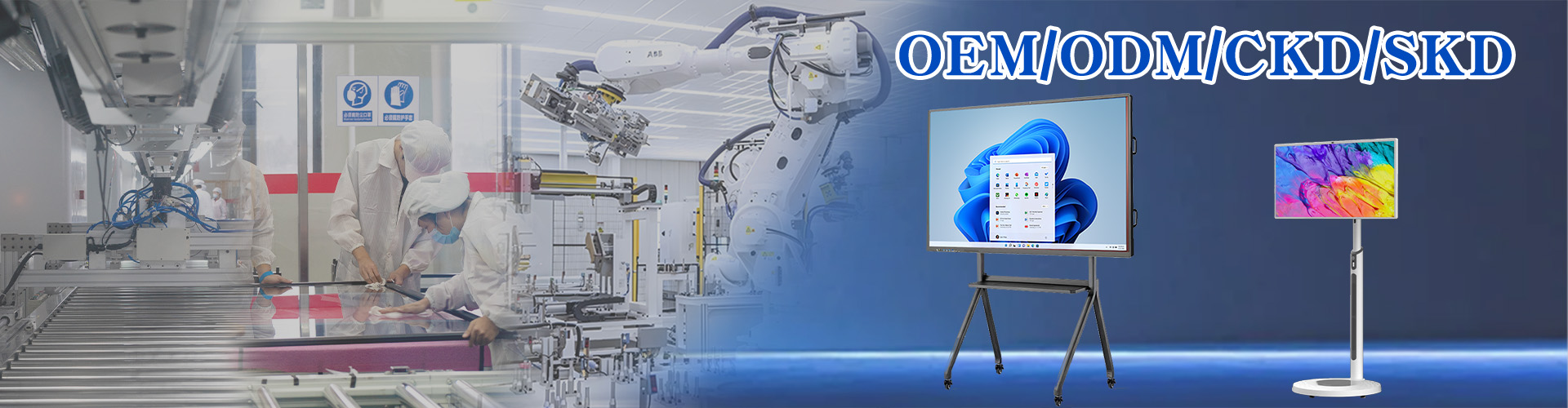
One verification that buyers often overlook: ask for production line photos or video in which the model shown matches the quoted model. Photos alone do not prove ownership, but if the products visible in the images do not correspond to what the supplier claims to manufacture, that discrepancy is worth pursuing.
OEM capability is more than putting your logo on the box
Many suppliers claim OEM support while their actual capability stops at labeling the carton. Real OEM and ODM capability needs to be confirmed item by item.
Customization dimensions include size, bezel color, interface configuration, boot screen, packaging language, and manual language. These should be specified at quotation stage, not negotiated after the order is placed.
Software and firmware-level customization matters if the project requires a preinstalled player application or integration with an existing CMS. Confirm whether the supplier can work at the firmware level, or can only offer a standard Android or Windows configuration.
A useful question to ask: "What was the customization on your last OEM project, and can you share the (redacted) configuration list?" Suppliers with real OEM experience answer specifically. Suppliers whose answer stays at "we can do anything" usually have no OEM track record to describe.
For projects that need specific panel sizes or bezel options, the 46/49/55/65-inch and 0/0.88/1.7/3.5mm bezel options on the 46” ultra narrow bezel video wall specifications illustrate the range of parameters that should be itemized in an OEM quotation — size, bezel, and interface options each need to be written into the quote rather than agreed verbally.
Three places warranty terms hide the real cost
Warranty is not a number of years. The clauses determine who bears the cost when a unit fails, and those clauses deserve more scrutiny than the headline duration.
RMA process and freight responsibility. Many warranty terms state coverage but leave freight to the customer in both directions. A single failed panel can then cost more in round-trip shipping than the panel is worth. Confirm the freight responsibility split before signing.
Who decides repair versus replace. If the clause states the supplier has the right to decide between repair and replacement, the buyer has no leverage. On a project site, replacement usually fits the schedule better, while the supplier may prefer repair to control cost. Push for a contractual commitment to field-replaceable unit priority where the schedule depends on it.
What is excluded. Image retention and burn-in, unevenness from prolonged display of static high-contrast content, and damage from non-approved mounting are commonly excluded. If the project displays surveillance feeds with static UI elements, confirm whether burn-in is covered, or ask for the supplier's anti-burn-in specification. Anti-burn-in technology is a specification item worth requesting explicitly in the RFQ rather than assuming it is included.
Supplier vetting checklist: confirm before you place the order
Use this list for RFQ comparison and supplier shortlisting:
Do the certification documents name the exact model you are purchasing? Are the CE DoC, FCC report, and RoHS declaration all present?
Can the supplier issue a dimensioned drawing and interface list for the quoted model?
Will they accept third-party pre-shipment inspection?
What is the sample policy, and is the sample price reasonable?
Is the OEM customization scope itemized in the quotation — size, interface, packaging, firmware?
Under the warranty, who pays RMA freight, and who decides repair versus replace?
Is burn-in or image retention covered? Is there an anti-burn-in specification?
Does the product specification match the project requirement? See the 46” 1.7mm LCD video wall for control rooms for a reference specification set.
If you are shortlisting China LCD video wall suppliers and need to verify specifications against a real product line, view the full 477 specifications or send your project requirements for a factory capability check.