English
 Español
 Português
 Français
 Русский язык
 Italiano
 Deutsch
 Nederlands
 لعربية
 한국어
 Japanese
 ภาษาไทย
 Türkçe
 Tiếng Việt
 Bahasa Indonesia
 Hindi
 kazakh
 Uzbek
 Thai
 Farsi





Most control room video wall projects go wrong at the first step — not at installation, not at the panel level. Buyers compare spec sheets and prices before measuring the room and asking what will actually be displayed. The result is a wall that is either over-specified or under-performing for the task it was bought to do.
The industry consensus is straightforward: work backwards from viewing distance and content type, then choose the technology. Starting from "LED is newer, so it must be better" is how budgets get wasted. This guide gives surveillance and command center buyers a practical framework for that decision — bezel width, viewing distance, content layout, and 24/7 duty cycle — using a 46-inch 1.7mm LCD wall as the reference point for where that configuration fits.
How big is the control room, and how far do operators sit?
The single most useful number in video wall selection is the closest operator viewing distance. A useful industry rule of thumb puts the decision boundary around 3 meters. Below that distance, LCD panels hold a pixel density advantage: text, charts, and camera labels stay sharp at close range, and the panel's thin profile suits rooms where space is tight. To match that clarity at short distance with LED, pixel pitch has to shrink — and cost rises steeply.
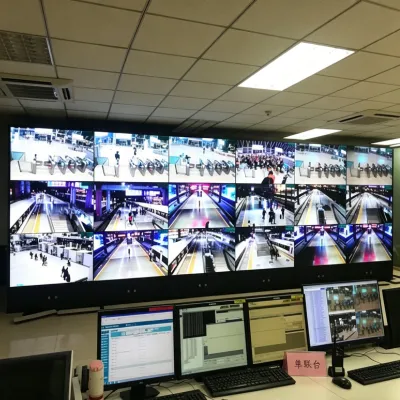
In small-to-mid control rooms, a 46-inch panel is a sensible building block. It is large enough to carry a readable camera feed or dashboard, but not so large that an operator sitting close has to physically turn their head to scan a 2×2 or 3×2 layout. Matching panel size to room geometry matters more than chasing the largest available screen.
For projects evaluating a 46-inch narrow-bezel wall, the 46-inch 1.7mm LCD video wall for surveillance is a useful reference configuration: panel size and bezel width are aligned with the short-viewing-distance, multi-source workflow described above.
Is a 1.7mm bezel good enough? It depends on what is on screen
Current ultra-narrow LCD bezels range from roughly 0.88mm to 3.5mm. A 1.7mm bezel sits in the middle-narrow band — not the most extreme specification available, and not an outdated one either. Whether it is sufficient depends on content layout, not on the number alone.
Independent content per panel: If each screen shows a separate source — one camera per panel, one dashboard per panel — the bezel acts as a natural divider between information streams. At 1.7mm it does not interfere with reading, and in many control rooms a visible separation between sources is an advantage rather than a defect.
One continuous image across the wall: If a GIS map or a single video feed spans multiple panels, the bezel cuts through lines and text. The question then becomes viewing distance: beyond roughly 3 meters, a 1.7mm seam becomes visually less prominent; at close range, it is noticeable and should be evaluated against the content that will actually cross the seam.
The typical surveillance center workflow — multiple camera feeds and dashboards displayed simultaneously — is exactly the scenario where a 1.7mm bezel does not create a usability problem. The specification is not a compromise in that context; it matches the task.
For 24/7 operation, panel grade matters more than bezel width
A frequently overlooked point in procurement: two products can both be labeled "LCD video wall" while using very different panel grades. Consumer-grade panels are designed around 8–10 hours of daily use. Industrial-grade panels are built for continuous operation, with MTBF figures in the region of 60,000 hours — roughly six to seven years of non-stop running. In a control room, that difference is not a detail; it is the difference between a reliable wall and a maintenance liability.
Buyers should confirm three things before signing:
Whether the panel is rated for 7×24 continuous operation, and what MTBF figure the supplier commits to.
How color consistency is maintained as backlights age across panels.
Whether the wall supports front maintenance — replacing a single panel without dismantling the entire wall.
These questions matter more than the difference between 1.7mm and 0.88mm bezels for most control room deployments. If a supplier cannot provide MTBF data and a 7×24 rating, the bezel specification is the least of the project's risks. For the full specification set on a 46-inch narrow-bezel unit, see the 46” ultra narrow bezel video wall specifications.
When LED is genuinely the right choice
An honest selection guide has to state where LCD loses. When viewing distances are consistently beyond 5–6 meters and the wall is used for continuous full-screen imagery, seamless LED begins to outweigh the cost gap: no bezel lines at all, and a visual result that LCD cannot match for that specific use case.
But LED carries its own trade-offs in a control room context. Achieving comparable clarity at short viewing distance requires a smaller pixel pitch, and cost rises sharply as pitch shrinks. LED walls also demand more from control systems and thermal management. For small-to-mid surveillance rooms, LCD still delivers more usable clarity per unit of budget — and the bezel question is manageable when content is laid out as independent sources.
The takeaway is not that one technology wins. It is that the right choice depends on the room and the task, not on which technology is newer.
A selection checklist you can take to your supplier
Before comparing quotes, get clear answers to these five questions:
How far is the closest operator seated? How far is the farthest?
Will each panel display an independent source, or will content span the full wall?
At the closest viewing distance, does the bezel cut through critical information?
Is the panel rated for 7×24 operation, and what is its MTBF?
Does the wall support front maintenance, and how long does a single-panel swap take?
If you are evaluating a 46” narrow-bezel LCD wall for a control room project, view the full specifications or send your room dimensions for a configuration check.