English
 Español
 Português
 Français
 Русский язык
 Italiano
 Deutsch
 Nederlands
 لعربية
 한국어
 Japanese
 ภาษาไทย
 Türkçe
 Tiếng Việt
 Bahasa Indonesia
 Hindi
 kazakh
 Uzbek
 Thai
 Farsi

Interactive Board Price in Zimbabwe: 2027 USD Buying Guide
 2026-11-20
 27



2026-11-20
27
Zimbabwe B2B Sourcing Guide
Interactive Board Price in Zimbabwe: A 2026 USD Guide for Schools & Distributors
If you are a school buyer, education distributor, or tender contractor in Zimbabwe searching for the interactive board price, the number on the box is only the starting point. What actually decides a purchase is the landed cost — board, freight, duty, installation, payment terms, and who fixes it when it breaks. This guide gives you real factory pricing in USD, shows how it compares to local retail, and explains what B2B buyers must confirm before ordering an interactive board for teaching in Zimbabwe.
The short answer: factory-direct smart interactive boards for schools run from USD 400 to USD 1,031 per unit depending on size and quantity, while comparable boards sold through local retail in Zimbabwe are typically listed between USD 1,200 and USD 8,400. Buying direct from the manufacturer is where the 20–30% saving comes from — not from cutting panel quality.
Before comparing brands, it helps to separate two numbers that buyers often confuse: the ex-works factory price (what you pay the manufacturer before shipping) and the local retail price (what a reseller in Harare or Bulawayo charges). The gap between them is the distributer margin, local stock cost, and after-sales overhead. Knowing both lets you judge whether a quote is fair.
The table below is the published factory tier for orders around 300 pieces. Smaller trial quantities are priced separately on request.
| Screen Size | Unit Price (USD, 300 pcs) | Typical Use in Zimbabwe |
|---|---|---|
| 55 inch | $400.00 | Small classrooms, tutorial centres, staff rooms |
| 65 inch | $496.00 | Standard primary & secondary classrooms |
| 75 inch | $587.00 | Larger classrooms, college lecture rooms |
| 86 inch | $731.00 | University halls, corporate training, government tender |
| 98 inch | $1,031.00 | Auditoriums, boardrooms, flagship installations |
All configurations are 4K UHD (3840×2160) with Android OS, available with infrared or capacitive touch, and can be supplied with an optional OPS PC (Intel i3/i5/i7). Pricing moves with size and order quantity — the larger the order, the lower the per-unit cost.
To put the factory numbers in context, interactive boards and interactive flat panels sold through Zimbabwean retail channels are commonly listed in the following ranges:
| Product Type (local market) | Retail Price (USD) |
|---|---|
| Entry interactive whiteboard (e.g. 100-series board) | ~$1,200 |
| Mid-range 65" interactive flat panel (international brand) | $899 – $1,599 |
| 75" interactive flat panel (international brand) | $1,299 – $2,499 |
| 86" interactive flat panel (international brand) | $1,899 – $3,599 |
| Large premium touch interactive display | up to ~$8,400 |
The difference between a $496 factory-direct 65-inch board and a $1,200+ local board of similar specification is exactly the margin buyers can recover by importing direct or through a wholesale partner.
Do not compare board price alone. A low board price with no local spare-parts support, no payment flexibility, and no tender documentation is not cheaper — it is riskier. Always compare the total cost of ownership, covered further down.
Buyers sometimes assume a cheaper board must be a worse board. In B2B sourcing that is usually backwards. The saving comes from structure, not specification:
No middleman. Buying from the factory removes two or three distribution layers, each of which adds 8–15% margin.
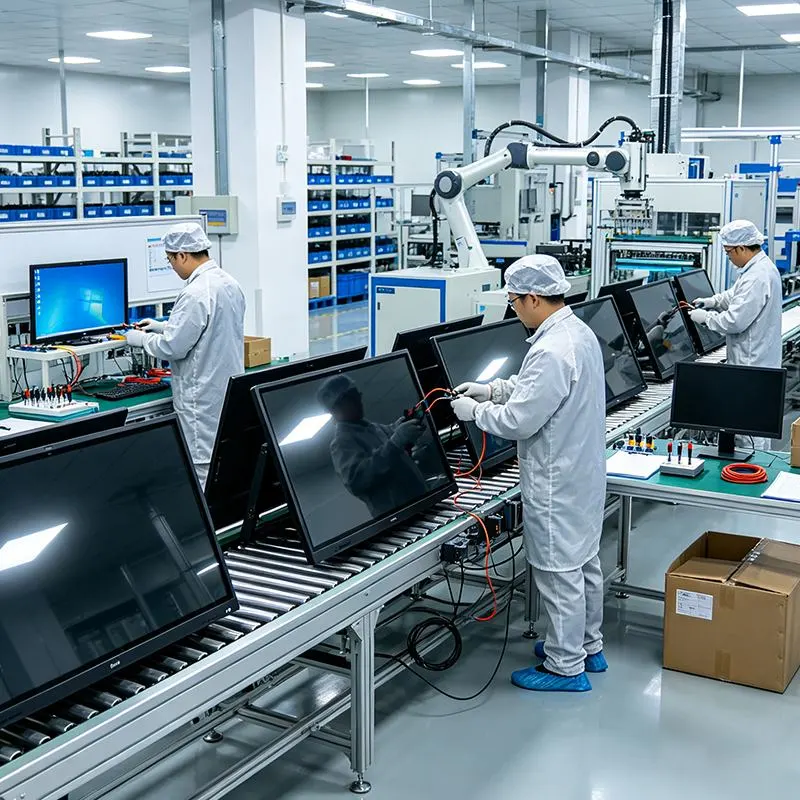
Scale production. A dedicated display factory with optical-bonding and auto-aging lines produces at lower unit cost than a small assembler.
Stock on hand. With 3,000–5,000 units in monthly stock, popular sizes ship without waiting for a production slot.
Platform choice. The standard Android platform keeps cost down while the optional OPS PC module lets buyers add Windows only where it is actually needed.
The panel itself is not downgraded to hit the price. A factory-price smart interactive board still uses a BOE A+ grade 4K panel, anti-glare glass with zero-gap bonding, and a light sensor — the same core components found in boards costing twice as much at retail.
Zimbabwean schools face conditions that a board built only for a climate-controlled office will not survive: unstable power, dust, and limited local repair. The specification has to answer those realities.
Panel
BOE A+ grade 4K UHD
Brightness
350–400 cd/m², 178° viewing
Glass
Anti-glare + zero-gap bonding
Response
6 ms, 16.7M colours
Eye care
Light sensor auto-dim
Panel life
60,000 hrs
System
Android, optional OPS PC (i3/i5/i7)
Touch
Infrared or capacitive multi-touch
Where voltage fluctuates or supply is intermittent, boards should be specified with wide-voltage tolerance and surge protection so they do not fail on a bad line. The sealed, dust-resistant front and reinforced casing matter in classrooms that are not air-conditioned. Confirm these against your site before ordering — they are part of the specification, not optional extras.
CE FCC RoHS ISO9001 ISO14001 3C CNAS
Full certification and test documentation is supplied with every order, which is what allows a low factory price to pass school and government tender approval.
One of the biggest friction points for Zimbabwean buyers is foreign currency availability. B2B orders can be structured to reduce that pressure:
L/C at sight — the standard instrument for cross-border education tenders.
30% deposit / 70% before shipment — the common installment split for repeat wholesale partners.
Trial quantity first — a small sample order lets a distributor verify quality before committing to a full container.
Confirming payment terms at quotation stage avoids the single most common cause of delayed school rollouts.
A board is only as good as the support behind it. For buyers worried about who repairs a fault thousands of kilometres from the factory, the practical answers are:
Regional spare-parts stock — critical components can be staged in a Southern African hub for 2–5 day delivery rather than shipping from China each time.
Warranty — multi-year coverage on panel and electronics, confirmed in writing.
Local agent coordination — where a distributor or installer is already in country, they handle first-line diagnosis.
Response time — email and inquiry replies within 12–24 hours, with a remote-diagnosis step before any part is dispatched.
These points should be written into the purchase agreement, not assumed.
School and government purchases in Zimbabwe typically require a documentation pack, not just a product. Alongside the board, buyers receive CE, FCC, RoHS and ISO certificates, 3C and CNAS quality records, test reports, and full technical specifications. This is what turns a low factory price into an approvable price for a public tender or a donor-funded school project. Buyers bidding on institutional contracts should request the complete pack before submission.
Price gets the board in the door; features keep it useful. The platforms commonly requested by schools include:
Multilingual voice input and transcription covering 120+ languages, with support for local languages used in Zimbabwean classrooms.
On-board lesson preparation, annotation, screen recording and split-screen comparison.
Question-bank and quiz games that turn a lesson into an interactive activity.
Wireless screen sharing from teacher phones and laptops, plus multi-screen interaction.
These are software capabilities layered on the same 4K interactive smart board, and they are what separate a teaching board from a plain display. For OEM/ODM programs, the interface, boot animation and preloaded apps can all be customised to the buyer's brand.
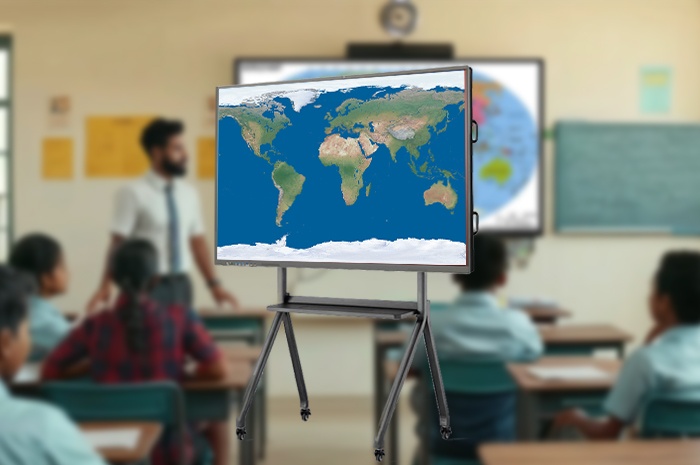
Primary and secondary schools — 55" and 65" boards at $400–$496 for standard classrooms.
Colleges and universities — 75" and 86" boards for lecture halls and training rooms.
Education distributors and wholesalers — container-level pricing with bulk discounts and private-label options.
Government and donor-funded tenders — full certification and documentation for compliant bidding.
Size and quantity confirmed against the factory price tier (55"–98")
Wide-voltage / surge protection and dust sealing confirmed for local power conditions
Payment terms agreed: L/C, 30/70 split, or trial quantity
Spare-parts location, warranty and response time confirmed in writing
Certification and documentation pack requested for tender approval
Software and language requirements (incl. local languages) confirmed
Lead time confirmed against the school term or project deadline
What is the interactive board price in Zimbabwe for a school?
Factory-direct boards range from USD 400 (55") to USD 1,031 (98") at the 300-piece tier. Local retail of comparable boards is typically USD 1,200–8,400. Final landed cost depends on size, quantity, freight and duty.
Will the board work with unstable power or load shedding?
Boards can be specified with wide-voltage tolerance and surge protection for fluctuating supply. For sites with frequent outages, pair the board with a UPS or inverter. Confirm the exact power specification before ordering.
Can I pay by L/C or in installments?
Yes. L/C at sight is standard for education tenders, and a 30% deposit / 70% before shipment split is available for wholesale partners. A small trial order is also possible before a full container.
How fast can spare parts reach Zimbabwe?
Critical spares can be staged in a Southern African regional hub for 2–5 day delivery, avoiding a full shipment from China each time. Warranty and response terms are confirmed in writing.
Will these boards pass a government or school tender?
Boards are supplied with CE, FCC, RoHS, ISO9001/14001, 3C and CNAS documentation plus test reports, which meets the documentation requirements of most institutional tenders. Provide the pack at bid stage.
Can I order a small trial quantity first?
Yes. A distributor can place a small sample order to verify panel quality, software and local performance before committing to a full container at the lower price tier.
Send your required size, quantity, power and payment conditions, and delivery deadline — we will confirm the configuration, landed cost, lead time and wholesale pricing within 12–24 hours.


 Floor 6, Building A, No. 3, North District, Shangxue Science and Technology City, Xinxue Community, Bantian Street, Longgang District, Shenzhen City
 info@szqunmao.com
 +86 13148726043
 +86 13148726043