English
 Español
 Português
 Français
 Русский язык
 Italiano
 Deutsch
 Nederlands
 لعربية
 한국어
 Japanese
 ภาษาไทย
 Türkçe
 Tiếng Việt
 Bahasa Indonesia
 Hindi
 kazakh
 Uzbek
 Thai
 Farsi





Written for distributors, AV integrators, school buyers, corporate IT managers and OEM partners: Touch is the feature that separates an interactive smart board from a plain display, yet it is the specification buyers understand least. For bulk orders, the choice between infrared (IR) and capacitive touch decides cost, durability, multi-user performance and how premium the board feels in daily use. This guide compares the two technologies point by point, explains which one fits large-format smart board deployments, and gives B2B buyers a clear checklist for specifying touch before an order goes to production.
Why Touch Technology Matters More at Bulk Scale
On a single demo unit almost any touch screen feels responsive. Across a 200-school or 50-boardroom rollout, small differences in touch accuracy, calibration drift, parallax and durability multiply into hundreds of support calls. Getting the touch specification right the first time is the cheapest support decision a buyer makes. Whether the product is called a smart board, an interactive smart board, a touch screen smart board or an interactive touch monitor, the underlying touch choice comes down to IR versus capacitive.
How Infrared Touch Works
Infrared touch places an invisible grid of IR emitters and sensors around the screen bezel. When a finger, stylus or any opaque object breaks the light beams, the controller calculates the contact point. Because the sensing hardware sits in the frame rather than on the glass, IR scales cleanly to very large sizes, supports many simultaneous contact points, tolerates a stylus or a gloved finger, and keeps the glass surface itself simple to manufacture and replace. This is why most 86″ to 110″ interactive smart boards use infrared multi-touch.
How Capacitive Touch Works
Projected capacitive touch bonds a transparent conductive layer to the glass. It senses the electrical properties of the human body, giving a phone-like, highly responsive feel with excellent multi-touch. The limitation is cost and manufacturability at large formats: producing a flawless 98″ capacitive panel is expensive, the conductive layer adds complexity, and the surface responds best to a bare finger rather than a stylus or gloved hand. For most education and conference deployments, capacitive is hard to justify at large sizes.
IR vs Capacitive: The Comparison
| Criteria | Infrared (IR) Touch | Capacitive Touch |
|---|---|---|
| Scalability to 98″–110″ | Excellent — sensing sits in the bezel | Difficult and costly at large sizes |
| Simultaneous touch points | 20–40 points, easy to scale | Good, but cost rises with size |
| Stylus / glove support | Works with any opaque object | Best with bare finger only |
| Durability | Glass is simple; frame is serviceable | Conductive layer adds fragility |
| Cost at large format | Lower — better bulk value | Significantly higher |
| Feel | Natural with low touch height | Phone-like, very smooth |
The 98-inch interactive smart board uses 40-point infrared multi-touch with a 1mm touch height. Write with a finger or a stylus and the board recognises both at once — zero lag, zero ghost touches — which is exactly the behaviour large classrooms and boardrooms need from an interactive smart board.
Buyer tip: touch-point count is not the whole story. A 1mm touch height and zero-gap bonded anti-glare glass do more for perceived quality than doubling the point count. Always test writing accuracy and parallax on a sample before committing to volume.
Touch Points: What 20, 40 and Beyond Actually Mean
Touch-point count determines how many people can write or gesture at the same time. Ten points cover a single presenter using two-handed gestures. Twenty to forty points support several users writing simultaneously, which is essential for group work in classrooms and brainstorming in meeting rooms. For B2B buyers, 40-point multi-touch is the current commercial benchmark for a large-format interactive smart board, and it is the specification to hold suppliers to when comparing quotes.
Touch Height, Parallax and Glass
Three specifications decide whether writing feels natural. Touch height is how far above the glass the board activates — around 1mm means the pen barely touches. Parallax is the gap between the pen tip and the on-screen cursor; air-gap assembly creates visible offset, while zero-gap bonding eliminates it so touch and image share one plane. Anti-glare etching keeps the surface readable under fluorescent or office lighting. Together these matter more than any headline number, and they should be specified explicitly in any bulk order.
Panel and Response Time Behind the Touch
Touch quality depends on the panel responding just as fast. A 6ms response time, a BOE A+ grade 4K panel, 500 cd/m² brightness and a 178° viewing angle ensure that what you write appears instantly and stays legible from every seat. Android 14.0 on an octa-core CPU keeps annotation, casting and split-screen multitasking smooth, with an optional OPS PC (Intel i3/i5/i7) for Windows environments. A 60,000-hour LCD life protects total cost of ownership across years of daily use.
Which Technology for Which Deployment
Large classrooms and lecture halls (98″–110″): IR multi-touch — scalable, durable, stylus-friendly.
Corporate boardrooms (86″–98″): IR multi-touch — best bulk value and reliable multi-user writing.
Small rooms with a phone-like feel priority: capacitive can be considered at smaller sizes where cost is manageable.
Specialist quotation environments: IR tolerates any stylus or pointer, which suits technical and industrial settings.
For the overwhelming majority of B2B interactive smart board orders at 86″ and above, infrared multi-touch is the recommended specification.
Bulk Ordering, MOQ, Lead Time and Stock
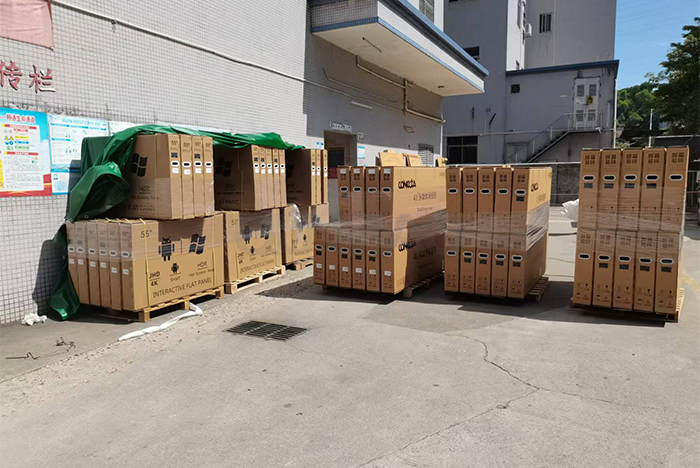
B2B buyers need supply reliability as much as the right touch spec. Minimum order is one unit for a sample and 10 units for production, with express production of 7–10 days at MOQ 5 for urgent projects. Standard lead time runs 15–25 days, and the factory holds 3,000–5,000 units in monthly stock. Shipping covers sea freight (FCL/LCL), air freight for samples and DDP door-to-door delivery, with replies within 12 hours. Requesting a sample unit to test touch accuracy under your own lighting and writing conditions is the single best pre-order step.
Factory since 2009230,000㎡ base85%+ export50+ countriesCE / FCC / RoHS / ISO9001
Certifications and Compliance
Wholesale interactive smart boards headed for EU or US distribution should carry CE, FCC, RoHS and ISO9001. Certified units clear customs and compliance checks smoothly and are ready for distributor programs in those markets. Verifying test reports before ordering protects both importer and end customer, and it is especially important when private-label branding is involved.
OEM and ODM: Specifying Touch Under Your Brand
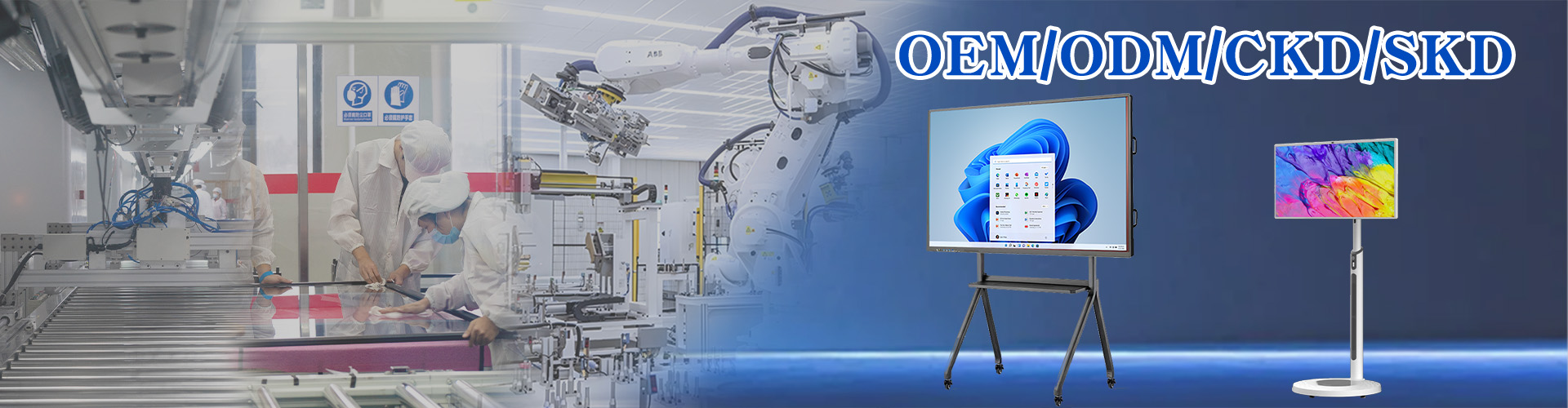
Distributors and brand owners can specify touch configuration, panel grade and software as part of an OEM/ODM program, adding custom logos, boot screens and pre-installed branded software. Customized units retain full CE, FCC, RoHS and ISO9001 certification. Confirming IR versus capacitive, touch-point count and glass type at the quote stage keeps production on scope and avoids costly mid-run changes.
IR or capacitive touch for a large interactive smart board?
For 86″ to 110″ sizes, infrared multi-touch is usually the better choice: it scales to large formats, supports 20–40 simultaneous points and is highly durable. Capacitive feels phone-like but costs significantly more at these sizes.
How many touch points does a good smart board need?
20–40 point multi-touch is the commercial standard. It lets several users write at once, which is essential for classroom and workshop use.
Does touch height really matter?
Yes. A ~1mm touch height means the pen barely has to touch the glass, so writing feels natural. Combined with zero-gap bonding it removes parallax between pen tip and cursor.
Can I use a stylus or do I need my finger?
IR touch works with a finger, stylus or any opaque object. Capacitive responds best to a bare finger, which is another reason IR suits education and boardroom use.
Can I get a sample to test touch before a bulk order?
Yes. MOQ is 1 unit for a sample, with 7–10 day express production available. Test accuracy and parallax under your own conditions before committing to volume.
Are customized boards still certified?
Yes. OEM/ODM units keep full CE, FCC, RoHS and ISO9001 certification, so private-label buyers get differentiation without losing compliance.
Specify the Right Touch
Compare IR and capacitive options, order a sample and get wholesale pricing with a 12-hour reply.