English
 Español
 Português
 Français
 Русский язык
 Italiano
 Deutsch
 Nederlands
 لعربية
 한국어
 Japanese
 ภาษาไทย
 Türkçe
 Tiếng Việt
 Bahasa Indonesia
 Hindi
 kazakh
 Uzbek
 Thai
 Farsi

Elevator Advertising Displays: Engineering Case Studies for Residential & Commercial Rollouts
 2026-11-18
 36




2026-11-18
36
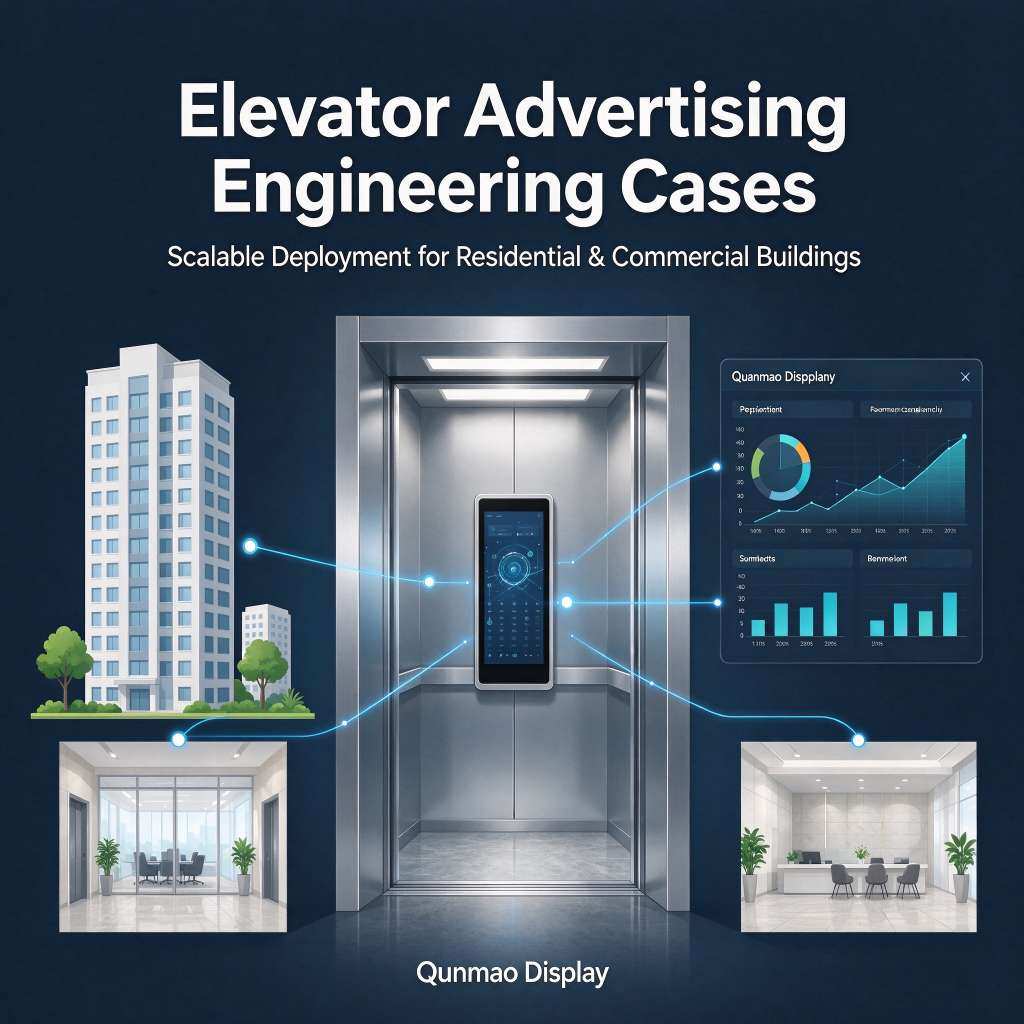
In overseas projects, the real barrier for elevator advertising displays is rarely whether the screen lights up. What batch rollout projects actually expose comes down to three things: whether the unit fits inside the cab, where the power comes from, and what guarantees consistency across a batch installation. Specification sheets do not solve these problems—engineering methods do. The following content uses elevator advertising display case studies as a thread to break down point planning, equipment constraints, installation delivery, and operational variables across two types of building media projects—residential communities and office buildings—for overseas elevator advertising project operators and contractors.
Overseas elevator advertising projects rarely fail at the procurement stage. They fail at four engineering checkpoints: site survey, power access, mounting, and acceptance. An elevator cab is a tightly constrained space. Safety fixtures cannot be obstructed, wall materials dictate mounting methods, overhead cable routing space is limited, and continuous elevator vibration places long-term demands on fasteners. When any one of these checkpoints goes wrong during batch replication, rework costs scale linearly with the number of buildings.
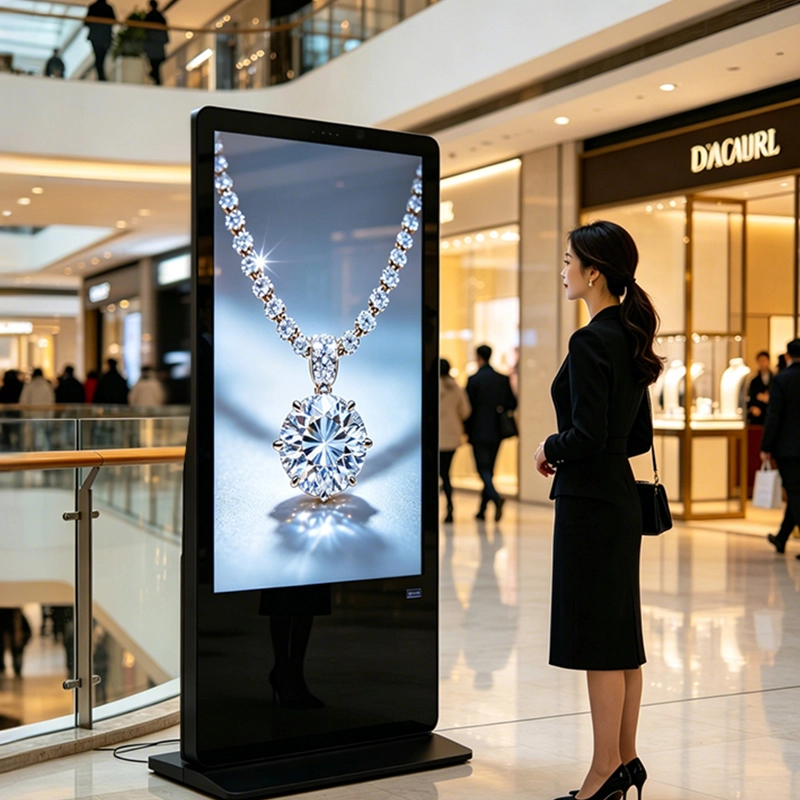
Qunmao Display's product line serves as a useful anchor for this discussion: the 32-inch frameless wall-mount series (QM-3215GPW) and the 43-inch double-sided floor-standing series (QM-43EG8) cover three core scenarios—elevator cabs, waiting lobbies, and main lobbies. Both units offer wide-voltage input and remote playback control[reference:0][reference:1]. But equipment is only one variable. What elevator advertising display case studies truly need to unpack is the fit between equipment and engineering constraints.
Consider a reference scale of 15–25 high-rise residential buildings, 2–4 elevators per building, and 1,500–4,000 total households. The core tension in residential projects is balancing batch cost against long-term durability: the number of points is large, per-point budgets are limited, yet equipment must withstand high-frequency elevator use, potential misuse, and property management's sensitivity to preserving the cab's original appearance.
Point tiering should follow the logic of "cab screens drive reach frequency, waiting-lobby screens capture attention duration, and main-lobby screens carry branding and announcements." Cab screens should prioritize 21.5–32 inch frameless wall-mount form factors with tightly controlled installation depth. Waiting-lobby screens should be primarily 32–43 inches with brightness no lower than 450 cd/m² to handle ambient light in public areas. Main-lobby screens can use 43–55 inch double-sided floor-standing units, serving both internal announcements and external advertising from a single device—reducing point count while maintaining per-point output.
No Obstruction of Safety Fixtures
The car operating panel, emergency call, floor indicator, and ventilation openings must remain unobstructed by screens or brackets in any playback state. Under the EN 81-20/50 framework, visibility of emergency call confirmation and overload warnings takes priority over media content[reference:2].
Wall Clearance and Installation Depth
The protrusion distance between the screen surface and the cab wall must be controlled. Industry installation norms typically require ≥50 mm clearance from other cab fixtures; recessed installation depth should be <50 mm to avoid interfering with passenger movement and normal door closure[reference:3][reference:4].
Mounting and Load Safety Factor
Brackets and anchor points must be rated at ≥3× the screen weight as a safety factor. Fasteners should feature anti-loosening design to withstand long-term vibration from high-frequency elevator operation[reference:5].
Power Access and Cable Routing
Confirm whether a usable power source exists at the cab roof access panel or machine room. Cable fixation spacing should be ≤200 mm, connections should be insulated, and routing must not intrude into the elevator's existing cable channels[reference:6]. The QM-3215GPW supports AC 100–240V wide-voltage input, but "the device accepts wide voltage" does not mean "power is available on site." Power access points must be confirmed unit by unit during the survey phase[reference:7].
A successful single-building installation does not guarantee controllable batch rollout. When replicating to the second and third buildings in a residential project, three factors determine engineering consistency: mounting hole deviation (hole spacing deviation should be controlled within ±1 mm), uniform fastening methods (the same wall material corresponds to the same fastening solution), and unit-by-unit acceptance documentation (point maps, wiring records, and playback/network test results signed off per unit). The installation SOP and acceptance checklist themselves are the deliverables that prove compliance to property management and elevator maintenance contractors[reference:8].
The revenue model for residential projects is determined by sellable point count, rate card pricing, sales fill rate, property revenue share, O&M costs, and collection cycle. Equipment configuration can influence two of these: O&M costs (remote scheduling, timed power on/off, and batch playback control reduce manual inspection and content-change frequency) and effective playback duration (cab screens guarantee baseline exposure frequency, while lobby screens provide a premium position for high-value announcements and brand content). Only when all three screen types are managed under a single playback control system do O&M variables shift from "uncontrollable" to "measurable."
The Middle East market offers a directly comparable building media case study: Dubai-based operator Elevision has deployed over 1,700 elevator screens across commercial and residential buildings, running a 4-minute loop with approximately 1.5 exposures per unique viewer per day[reference:9]. Its partnership with the Dubai World Trade Centre (DWTC) covers assets including One Central, Sheikh Rashid Tower, and Convention Tower, with a single deployment of 72 elevator screens + 83 large-format/lobby screens, plus 15 screens installed in the Expo Village Residences lobby on the residential side[reference:10]. The European market shows a similar path: Schindler and HYGH operate over 650 elevator displays in residential and office buildings across Germany[reference:11].
The above is publicly available industry project information, intended to illustrate reference coordinates for commercial elevator screen networks in terms of point structure, deployment scale, and operational cadence. It does not constitute any commitment to specific customers or revenue outcomes.
| Selection Dimension | Residential Project Focus | Office/Commercial Building Focus |
|---|---|---|
| Appearance and building image | Durable, vandal-resistant, easy to maintain | Frameless/ultra-slim design matching lobby and elevator hall finishes |
| Screen brightness | Ambient cab lighting is sufficient | Lobbies and elevator halls must handle strong ambient light from glass curtain walls and public lighting; 450–700 cd/m² range provides more headroom |
| Point form factor | Primarily cab screens; lobby screens for announcements | Elevator hall screens and double-sided lobby screens serve brand zones and premium ad positions |
| Playback control hierarchy | Single community/multi-building unified management | Cross-building, cross-city management requiring group permissions and remote distribution |
| Customization needs | Batch cost priority | Appearance, system UI, boot screen aligned with operator brand system |
The QM-43EG8 double-sided floor-standing series offers selectable brightness at 450 / 700 cd/m², with front and rear panels supporting either synchronized or independent display—suited for office lobbies running "external brand advertising + internal building information" in parallel[reference:12]. If operators present themselves to property managers and advertisers under their own brand, OEM customization (bezel, system UI, packaging markings) allows the device to become a recognizable hardware entry point within their service system, rather than an undifferentiated screen.
The common prerequisite across the Dubai and Germany cases is that network and playback control precede screen scale-up. Elevision's technical approach includes wireless transmission solutions to maintain continuous elevator screen connectivity without interfering with building data networks[reference:13]. For operators planning to expand from one building to multiple buildings, three things need to be locked in during the first batch installation: consistency of device model and configuration (avoiding playback compatibility issues caused by hardware differences across batches), consistency of installation methods (the same cab material corresponds to the same fastening solution), and standardization of point records (building numbers, elevator numbers, screen numbers, and playback system groups mapped one-to-one). Replication capability is not a supplier's promise to "support batch orders"—it is the operator having an executable standardized delivery package in their own hands.
The revenue logic for commercial buildings differs from residential: residential looks at households covered × frequency, while office buildings look at building quality × tenant quality × content sales capability. Brand zones in elevator halls and lobbies can raise per-point rate card pricing, while cab screens guarantee baseline exposure volume. The value operators offer advertisers should not stop at "point count" but extend to playback records, device online rates, and scheduling execution data—data that comes from the playback control system, not the screen itself. Qunmao devices support remote publishing, split-screen, timed power on/off, and playback schedule management, with the goal of making this data deliverable operational evidence[reference:14].
The shared conclusion from both case studies: the replicability of batch rollout projects depends not on screen count but on the documentation and standards left behind after the first installation. We recommend packaging the following five items as a "replicable unit" that can be called upon directly when entering each new building or new city, rather than reinventing the process each time.
Point RecordsBuilding number, elevator number, screen number, installation location photos, wall material records.
Installation SOPPower access method, cable routing path, fastening solution, fastener torque, wall clearance—versioned by cab material.
Acceptance ChecklistPer-unit network connectivity, playback, remote reboot, and alarm test results signed off; hole deviation and cable fixation checks.
Playback Mapping TableScreen groups, permission levels, schedule templates, and content zoning rules mapped one-to-one with new points.
Spare Parts BaselineReserve critical spares such as power supplies and mainboards at a ratio of point count; define fault response paths.
Qunmao's support during the batch phase concentrates on manufacturing and delivery: batch production by project, aging tests, packaging protection, installation drawings, and remote technical guidance. Engineering capability is not a promise that "problems will never occur"—it is ensuring that the installation actions and acceptance standards for every new building remain consistent with the first.
| Prerequisite | Why It Can't Wait Until Goods Arrive On Site | How to Confirm |
|---|---|---|
| Elevator management/maintenance approval | Installation methods may affect annual inspection conclusions or cab original appearance determinations | Provide bracket方案 and wall clearance drawings; obtain written confirmation |
| On-site power access conditions | Wide-voltage device support does not equal an available power outlet in the cab; added load may involve circuit capacity | Record power access point location, voltage, frequency, and plug type per unit |
| Destination country certifications and markings | CE/FCC/RoHS are common baselines, but Middle East markets may also involve local requirements such as SASO; certification scope is subject to order and importing country regulations | Lock the certification list at the quoting stage to avoid补做 during customs clearance or bidding |
| Network and playback strategy | Network conditions in elevator shafts and cabs vary widely; offline playback capability determines the lower bound of content updates | Confirm Wi-Fi/wired/4G options and offline playback strategy |
| Content and data compliance | Multilingual requirements, advertising review, religious and cultural constraints, and cloud server location may affect system configuration | Pre-sort destination country content rules and data storage requirements |
Saudi Arabia's voltage and plug specifications differ from Europe—220V/60Hz with BS plugs is a common configuration, and some areas also have 127V systems[reference:15]. These differences will not appear on generic product pages, but they directly determine whether on-site rework is needed.
That phrase is a common industry search combination and does not refer to Qunmao's brand or product naming. Qunmao Display is a commercial display equipment manufacturer offering elevator advertising displays, building digital media equipment, and OEM/ODM customization. Specific models and solutions are subject to Qunmao's product line.
The key lies in the installation method, not the screen itself. Not obstructing safety fixtures, controlled wall clearance, adequate fastening safety factors, and cables not intruding into existing channels are the prerequisites for obtaining approval from elevator management and maintenance contractors. We recommend completing confirmation with the first unit before batch installation and writing the confirmed results into the installation SOP.
Both the QM-3215GPW and QM-43EG8 support AC 100–240V / 50–60Hz wide-voltage input[reference:16][reference:17]. Certification requirements are assessed by destination country and order. CE/FCC/RoHS can be discussed as a baseline; Middle East markets require separate confirmation of local requirements. Final certification scope is subject to contract and importing country regulations.
Yes, sample testing and small batch trial orders are supported. We recommend validating three things during the sample phase: whether the cab mounting method is accepted by local elevator management, whether the playback control system matches the operations team's actual workflow, and whether the offline playback strategy covers local network conditions.
Yes, it supports multi-device grouping, content scheduling, timed power on/off, remote reboot, and playback logs. For cross-region replication, we recommend establishing mapping rules between screen numbers and playback groups during the first batch installation, so that subsequent new points are managed under the same rules.
Warranty policy is determined by contract and product model. For batch projects, we recommend reserving critical spares such as power supplies and mainboards at a ratio of point count, and including the spare parts list and fault response path in the project delivery documentation—rather than coordinating after a fault occurs.
Ready to launch an elevator advertising project in a residential community or office building?
Submit your target country/city, building type, elevator count, and desired point scenarios to receive an equipment selection list, engineering configuration recommendations, and a sample testing plan. Qunmao Display supports OEM/ODM customization covering dimensions, structure, system UI, and brand markings.
Phone/WhatsApp: +86 13148726043


 Floor 6, Building A, No. 3, North District, Shangxue Science and Technology City, Xinxue Community, Bantian Street, Longgang District, Shenzhen City
 info@szqunmao.com
 +86 13148726043
 +86 13148726043