English
 Español
 Português
 Français
 Русский язык
 Italiano
 Deutsch
 Nederlands
 لعربية
 한국어
 Japanese
 ภาษาไทย
 Türkçe
 Tiếng Việt
 Bahasa Indonesia
 Hindi
 kazakh
 Uzbek
 Thai
 Farsi

Elevator Advertising Display FAQ: A Procurement, Deployment and Maintenance Guide for Overseas Media Companies
 2026-11-18
 32



2026-11-18
32
For Overseas Media Companies · Procurement & Operations
Seven high-frequency questions on electromagnetic interference, cabin noise, remote disconnection, screen reflection, batch management, warranty terms and standby power consumption — with two project case reviews and a procurement checklist that separates verifiable device requirements from contractual terms.
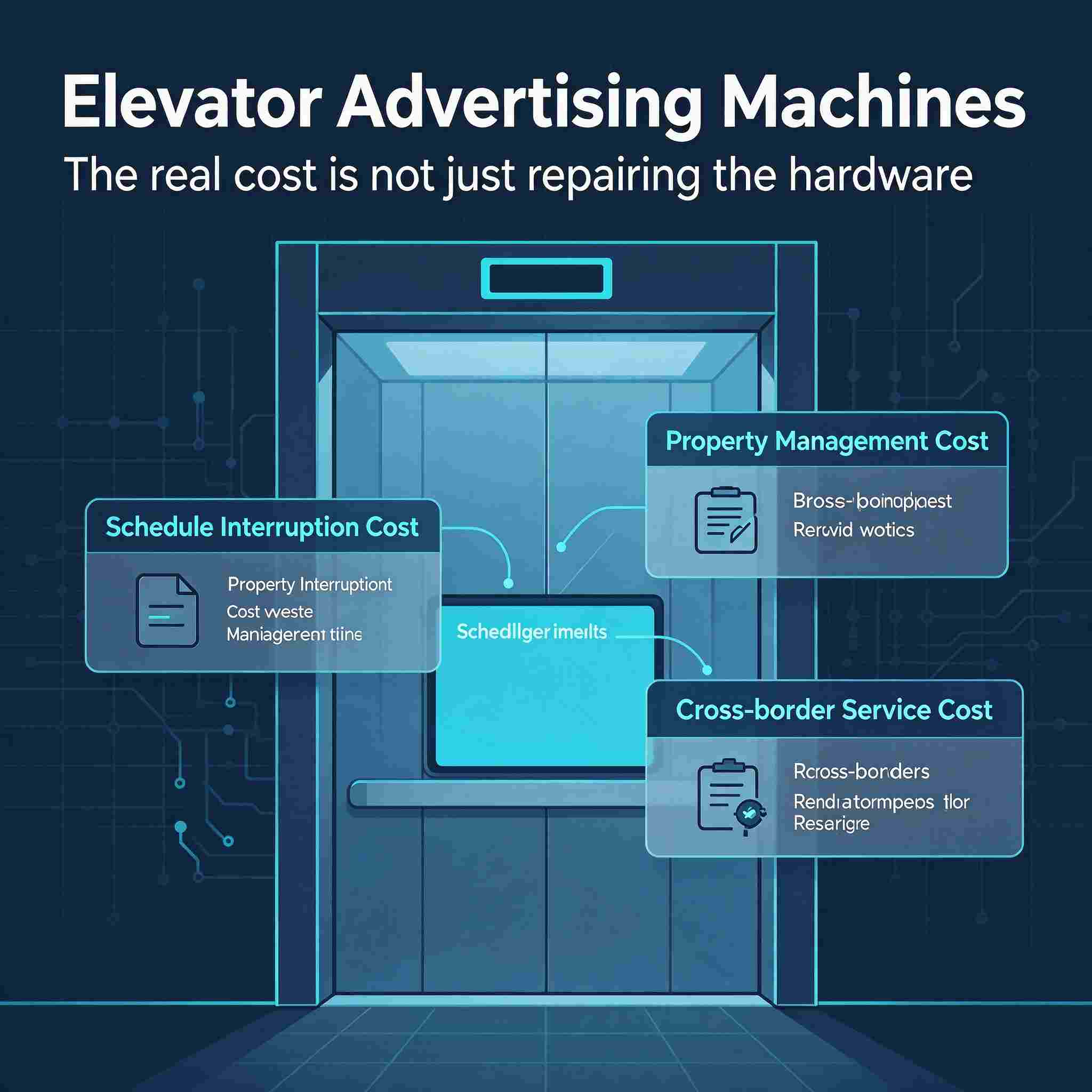
Most buyers focus on unit price during the quotation stage. But the expensive part of elevator advertising display FAQ issues happens after delivery. When a screen fails inside an elevator cabin, the direct repair cost is often a small fraction of the total loss. The rest is spread across advertiser relationships, property management communication and cross-border after-sales processes — costs that never appear on a quotation sheet.
Campaign interruption cost: When a device misses its scheduled playback, the media company cannot provide a complete proof-of-play record to the advertiser. The dispute is rarely about how long the screen was down — it is about whether you can prove what was not played. That points directly to local log retention on the device.
Property relationship cost: Noise, heat or power anomalies trigger complaints. At best, the property manager asks for a temporary shutdown. At worst, it affects renewals for other screen locations in the same building. An elevator cabin is a confined public space with low background noise — tolerance for device noise is far lower than in a normal indoor environment.
Cross-border after-sales cost: Spare parts shipped from China, customs clearance and local labor — if any step is not clearly defined in the contract, you end up with equipment on the way and an empty screen location. Warranty length alone does not solve this. Executable spare-parts and response terms do.
Many media equipment operations disputes start not because a device is broken, but because responsibility is unclear: device-side issues get blamed on the CMS platform, and platform issues get blamed on the device. As a hardware supplier, Qunmao is responsible for model specifications, device-side stability, certification documents, delivery and warranty terms. Grouping, scheduling, account permissions and advertising delivery strategy belong to the customer’s own or third-party CMS platform. Writing this boundary into the procurement contract is far more effective than arguing later about whose fault it is.
| Decision dimension | Buying a commercial monitor | Buying an elevator advertising display |
|---|---|---|
| Starting point | Size, resolution, unit price | Whether failure interrupts scheduled playback |
| Failure scope | One unit fails, repair one unit | Same batch or same building may share a configuration issue |
| Supplier responsibility cycle | Largely ends at shipment | Continues through spare parts, response SLA and remote diagnostics |
| Certification expectation | A certificate is enough | Certificate must match the specific model and target market |
The procurement decision for elevator advertising displays is essentially about using verifiable device-side conditions and executable contract terms to bring disconnection, complaints and after-sales disputes down to a manageable level.
The seven questions below come from the most common concerns raised by overseas media companies during elevator advertising display procurement and daily operations. Each is structured as: operational consequence, root cause, what to verify on the device side, and procurement action. The focus is on materials you can request from a supplier and requirements you can write into a contract — not marketing language.
Symptoms include repeated playback interruptions during a campaign, screen flicker or unexpected reboots. The media company often has no explanation for the advertiser beyond “equipment failure.” A more hidden risk is that interference triggers a property manager or elevator service provider to require a shutdown and rectification, affecting all screen locations in the building.
Conducted coupling: Elevator motors and variable-frequency drives generate disturbances on the power line that enter the device through its power supply.
Radiated coupling: The cabin and hoistway are metal structures. Wireless signal attenuation and reflection vary greatly — different buildings, elevator brands and antenna positions produce completely different results. Absolute statements are misleading.
Common-mode interference: When the grounding path is not clean, interference enters the mainboard through the ground line, appearing as random crashes or reboots.
Whether the EMC test report matches the exact model to be purchased and covers radiated disturbance, conducted disturbance, electrostatic discharge, electrical fast transient/burst and surge, with test levels stated.
Whether the power input has filtering, whether the metal enclosure has a defined grounding point, and whether the antenna can be externally mounted or extended.
Whether the device supports wired-first networking with Wi-Fi and 4G redundancy, rather than relying on a single link.
Request EMC documents that match the model and confirm in writing which standards apply to the target market. Note that CE, FCC and RoHS address product compliance; they do not replace property or elevator service provider installation approval, and should not be described as an “elevator installation permit.”
An elevator cabin is small and has low background noise, so any continuous sound source is noticed by passengers. Once a complaint is filed, property management usually requires a shutdown, forcing the media company to choose between keeping the location and resolving the noise issue.
Fan noise: Bearing noise plus airflow noise through narrow ducts.
Switching power supply whine: Often appears at light load or standby, caused by magnetostriction in magnetic components, especially noticeable in quiet cabins at night.
Backlight driver whine: If the PWM dimming frequency falls within the audible range, a continuous high-frequency tone appears at low brightness.
Structural resonance: Insufficient rigidity in the enclosure and mounting bracket amplifies internal vibration into audible noise.
Whether the design is fanless or uses low-speed fans. A fanless design also reduces dust ingress and mechanical wear points.
Whether measured noise data is provided for the specific model in typical playback and standby states, with test distance and background noise stated.
Whether the dimming method and dimming frequency are specified, and whether the power supply is potted or vibration-isolated.
Whether the mounting structure includes damping pads or bracket isolation.
Do not accept “low noise” as an adjective. Require the datasheet or test summary to state the test conditions. At incoming inspection, the buyer may arrange an on-site listening test according to project needs, but this is an internal verification step and should not be interpreted as a supplier on-site service commitment.
Failed schedule changes, unnoticed offline devices and interrupted batch upgrades all surface as “the advertiser says the ad did not run.” In media equipment operations, the most time-consuming part is not the repair — it is determining who should handle this particular disconnection.
Physical layer: weak signal in the hoistway or cabin, or poor antenna placement.
Network layer: DHCP lease, DNS resolution or gateway policy anomalies.
Application layer: CMS authentication failure, heartbeat timeout, or unsynchronized API changes.
Device layer: system crash, storage full, or inability to roll back after an interrupted upgrade.
Whether offline cached playback is supported: content continues during network loss, playback logs are retained locally, and synchronization resumes automatically.
Whether a hardware watchdog, scheduled reboot and power-loss memory are present, and whether the device can self-recover after an anomaly.
Whether OTA supports staged rollout and block verification, and whether a failure triggers an alert or a rollback.
Whether online status, playback logs and fault codes are exposed as fields or interfaces that the platform can read.
Define device-side responsibility and platform-side responsibility in the contract. If the customer already has an advertising platform, the integration scope must be specified as a capability list — not a vague “can integrate.” Device-side capabilities are documented by the hardware supplier; platform functions are confirmed by the CMS provider.
Cabin lighting, mirrored stainless steel and glass reflections combine to distort the advertising image at certain angles. Advertisers question the value of the location during acceptance, and such issues often surface only after batch installation.
Panel surface treatment determines reflection characteristics; high-haze anti-glare treatment diffuses reflected light spots.
Mounting height and tilt determine the primary viewing angle. Portrait installation inside a cabin must be reassessed against passenger standing positions.
Cabin illuminance varies widely. Fixed high brightness can cause glare and halo in darker environments.
Whether an anti-glare surface treatment option is available, with haze and surface reflectance specified.
Whether ambient-light dimming is supported to adjust brightness with cabin lighting.
Whether brightness, contrast and viewing angle in the datasheet include test conditions.
Request the model datasheet and panel parameter documentation. Mounting height, tilt and surrounding materials should be confirmed by the buyer based on the actual site. The hardware supplier provides configuration recommendations but does not replace the buyer’s on-site optical evaluation.
Hundreds or thousands of screens spread across cities and buildings cannot be managed by manually swapping content or troubleshooting one unit at a time. A more serious issue is permission chaos: regional operators, property managers and advertisers all access the same backend, and actions cannot be traced.
Without batch configuration delivery and staged upgrades on the device side, a single full rollout can cause widespread interruption.
If devices do not report status and logs, the platform only sees “offline” and cannot determine the root cause.
Without grouping, permissions and alerting on the platform side, fault detection depends on manual inspection.
Whether batch configuration delivery and staged OTA are supported, and whether upgrade failures generate alerts.
Whether the device automatically returns to playback after power restoration, and whether configuration and schedules are retained.
Whether customer-specified applications can be pre-installed or required interfaces opened, subject to the actual model and customization scope.
Before batch deployment, the buyer should organize a small-batch validation covering content delivery, network recovery, staged upgrade and report export. The hardware supplier provides device-side configuration documentation and a delivery plan at quotation stage; platform-side validation and operational trials are organized by the customer.
In cross-border projects, responsibility definition, spare-parts shipping and local service capability often affect project profitability more than the device price itself. A long warranty period means little if the start date, coverage and advance replacement conditions are not clearly defined — execution will still stall.
Start date: Shipment date, arrival date or acceptance date — the three definitions correspond to very different actual coverage periods.
Coverage: Whether the whole unit and core components are treated the same, and whether screen, mainboard and power supply are specified separately.
Advance replacement: Under what conditions a spare part can be shipped first, how the old part is returned, and who bears freight.
Spare-parts ratio: Whether a certain percentage of spares can be shipped with a batch order, and how the ratio and categories are determined.
Response time: The response time for remote diagnosis, how repair turnaround is calculated, and whether it can be written into an SLA.
Write the five items above into the purchase contract one by one. Industry warranty commonly falls in the 1–3 year range, but the elevator advertising display warranty policy should be based on the supplier’s actual contract and product page — not replaced by an industry average.
Property managers are sensitive to electricity costs, and abnormal power consumption can trigger disputes. Heat accumulation from long-term operation also accelerates backlight and power supply aging, indirectly increasing after-sales frequency.
The backlight usually accounts for the majority of total power; brightness strategy directly determines consumption.
The mainboard and network module still draw baseline power in standby, depending on standby strategy design.
Power conversion efficiency affects heat generation; a low-efficiency power supply is more likely to cause heat buildup in a closed cabin.
Whether operating power, standby power and typical playback power are provided as separate figures with test conditions.
Whether scheduled on/off, ambient-light dimming and time-based policies are supported and configurable to building schedules.
Whether the power figures correspond to the exact model to be purchased, not a generic series value.
Require the quotation to list model power parameters and scheduling configuration. Annual electricity cost estimates should be calculated by the buyer using local tariffs and actual operating hours; the hardware supplier provides parameters and configuration recommendations.
The following two scenarios are based on typical reviews of overseas building media projects. The focus is not on numbers, but on the diagnosis path and responsibility split for elevator advertising display faults — both can be adapted to similar project evaluations.
The customer deployed several hundred cabin screens across residential and office locations in multiple cities. In the early operating period, the backend showed a relatively high offline ratio, and the first assumption was unstable hardware quality. After unit-by-unit inspection, only a minority of offline cases were caused by actual hardware failure. Most were weak hoistway signal, DNS resolution anomalies, and failure to self-recover after an interrupted upgrade.
Device-side adjustments included: enabling offline cached playback so content continued and logs were retained locally during network loss; configuring adjustable heartbeat intervals and automatic reconnection; enabling hardware watchdog and scheduled reboot; switching OTA to staged delivery with failure alerts. The platform side adjusted authentication and alert rules at the same time.
After the changes, the operations team could distinguish network issues from device issues using fault codes, and unnecessary repairs and misjudgments dropped noticeably. The lesson: for fleet-wide disconnection, observability comes before hardware replacement.
The customer received noise complaints from property management at premium hotel and office locations, concentrated during nighttime low-brightness playback. Analysis identified two sources: some batches used fan cooling, and the airflow noise was noticeable in quiet cabins; and at low brightness the PWM dimming frequency fell within the audible range, producing a continuous high-frequency tone.
Later batches moved to a fanless passive cooling design, the power supply was potted, and the dimming frequency was adjusted outside the audible range. Damping pads were added at the mounting point to reduce structural resonance. At the same time, the customer wrote the warranty start date, advance replacement conditions and spare-parts ratio into the contract, bringing the risk of empty screen locations caused by cross-border repair turnaround under contractual management.
The key takeaway: noise issues and after-sales issues often appear together. Device-side acoustic design determines whether complaints occur; contract terms determine whether losses can be controlled once they do. Both must be confirmed at procurement stage.
Under the CE framework, LVD, EMC and RoHS typically apply, and products with wireless functions also need RED attention. North America uses FCC, the UK uses UKCA, and Korea, Japan, Saudi Arabia and other markets have local requirements. At procurement, confirm three things: whether the certificate matches the exact model and voltage configuration, whether it covers the included wireless module, and whether it matches the target sales region. Elevator scenarios also involve flame retardancy, electrical safety and structural fixing — these cannot be replaced by CE or FCC, nor by property-side installation approval.
Wide voltage input, target-country plug, multilingual UI and time zone settings — if not confirmed at quotation stage, these become delays and missing accessories on installation day. Whether PoE is suitable depends on project power conditions; do not assume “PoE support” is automatically better. These items should be listed one by one in the configuration sheet of the complete hardware solution.
Enclosure size, logo, boot screen, packaging and localized manuals are all negotiable, but the inquiry stage must clarify MOQ, sampling lead time, ownership of tooling and software costs, IP boundaries, and responsibility for issues arising from customized parts. Hardware customization and platform customization are two different things; the latter usually falls outside a hardware supplier’s delivery scope.
MOQ, sample lead time, mass production lead time, packaging protection,随货 spare parts and incoming acceptance criteria should form executable contract terms, including batch functional sampling, packaging protection requirements and the trigger conditions for after-sales response SLA. On-site installation and final acceptance are organized by the buyer; the hardware supplier provides the delivery plan and supporting documentation.
Does the EMC test report match the exact model to be purchased, with test levels and target-market standards clearly stated?
Measured noise data for the model in typical playback and standby states, including test distance and background noise conditions.
Device-side documentation for offline playback, local log retention and automatic synchronization after network recovery.
A list of fields or interfaces for online status, playback logs and fault codes that the platform can read.
Whether OTA supports staged rollout and failure alerts, and how recovery works after an interrupted upgrade.
Measured operating and standby power figures for the exact model, plus scheduling and dimming configuration.
Warranty start date, coverage, advance replacement conditions, spare-parts ratio and response SLA.
The mapping between certification documents, target market and exact model, including verification method.
Batch sampling method, packaging protection standard and随货 spare-parts arrangement for bulk delivery.
Contract wording that defines the boundary between device-side responsibility and CMS platform responsibility.
What factors affect the service life of an elevator advertising display?
Mainly continuous operating hours, brightness settings, cabin temperature and cooling conditions, and the working environment of the power supply and backlight driver. High temperature, high brightness and frequent power cycling accelerate aging; reasonable scheduling and brightness strategy help extend service life.
Can the device retain playback logs for ads played during a network outage?
This depends on whether the device has local storage and log retention. At procurement, confirm whether logs are recorded locally during outages, how long they are retained, and whether they are automatically uploaded after network recovery. This is the basis for providing proof-of-play to advertisers.
We already have an advertising platform. To what extent can a hardware supplier cooperate?
A hardware supplier can typically provide device-side status fields, log interfaces and necessary application pre-installation support, subject to the exact model and customization agreement. Platform-side grouping, scheduling, permissions and delivery strategy are handled by the customer’s own or third-party CMS.
Wi-Fi and 4G signals are weak inside the elevator. What redundancy options exist on the device side?
Common approaches include wired-first networking, Wi-Fi plus 4G dual-link redundancy, external or extended antennas, offline playback and automatic reconnection. The specific configuration depends on site conditions; at procurement, confirm the supported link types and switching logic.
Who bears the cost and lead time for target-market certification?
This usually depends on order volume and whether existing reports cover the model. If the model already has target-market certification, documents can be provided directly. If new certification is required, cost and lead time should be clarified at quotation stage and written into commercial terms.
How do we confirm MOQ, lead time and spare-parts policy?
Provide target quantity, deployment timeline and spare-parts requirements at inquiry stage, and the supplier will propose MOQ, sample and mass production lead times accordingly. The spare-parts ratio and advance replacement conditions should be written into the contract as separate clauses to avoid renegotiation during after-sales.
Coming back to the elevator advertising display FAQ itself, the answer is not about how high the specifications are. It is about whether three things are verifiable: whether the device can run stably under the target building’s conditions, whether the device side has self-recovery and staged-upgrade capability as a safety net, and whether warranty and after-sales terms are executable in the contract. Separating device-side responsibility from platform-side responsibility, matching certification to the exact model, and documenting noise and power with measured data will affect long-term operating costs of overseas projects more than comparing any single specification.
Tell us your target market, order quantity, installation scenario (inside cabin or outside hall, portrait or landscape) and delivery timeline. We will provide a complete proposal covering model configuration, certification notes, lead time and warranty terms.
Request a Quotation View Product Details Call / WhatsApp +86 13148726043
Phone / WhatsApp: +86 13148726043


 Floor 6, Building A, No. 3, North District, Shangxue Science and Technology City, Xinxue Community, Bantian Street, Longgang District, Shenzhen City
 info@szqunmao.com
 +86 13148726043
 +86 13148726043