English
 Español
 Português
 Français
 Русский язык
 Italiano
 Deutsch
 Nederlands
 لعربية
 한국어
 Japanese
 ภาษาไทย
 Türkçe
 Tiếng Việt
 Bahasa Indonesia
 Hindi
 kazakh
 Uzbek
 Thai
 Farsi

Digital Signage in Supermarkets: Wholesale & OEM Sourcing Guide
 2026-11-12
 32



2026-11-12
32
Sourcing digital signage in supermarkets is a different procurement problem from buying general advertising screens. A supermarket runs long opening hours, has lighting that changes across the store, needs screens in several positions rather than one, and usually wants content updated across all of them from a central system. For a distributor, integrator, or retail chain buyer, that changes what to specify and what to confirm with the digital signage in supermarkets wholesale factory before placing a batch order.
A general advertising screen is usually specified by size and resolution. A supermarket screen is specified by how long it runs, where it is mounted, and whether it can be managed remotely. Four requirements separate the two:
Continuous operation. Screens stay on through opening hours, so the panel and components need to be rated for 24/7 commercial use.
Multiple positions. A single store needs screens above shelves, in aisles, at the entrance, and near checkout — often in different sizes.
Central content control. Chains and distributors want to update promotions across sites from one CMS, not by touching each screen.
Batch supply consistency. A rollout order needs the same model delivered consistently, not a one-off unit.
That is why the sourcing question is not “which screen is cheapest” but “which model can be delivered in the right sizes, mounted in the right places, and managed the same way across the project.”
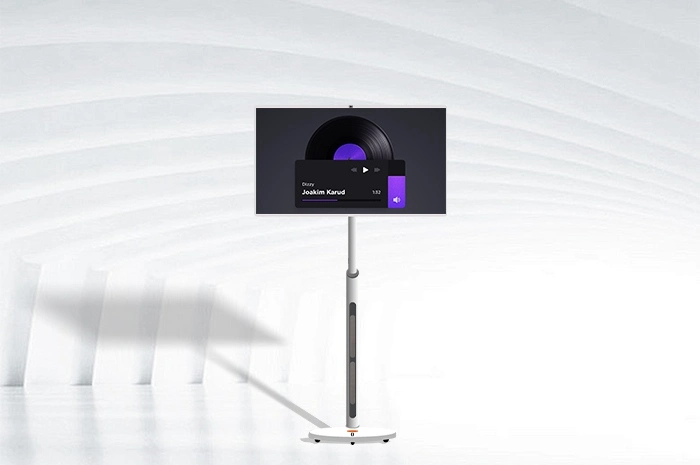
The 27-inch model listed on the product page supports wall-mounted, embedding, and hanging installation, with a universal bracket for horizontal or vertical orientation. That flexibility maps to how supermarkets actually deploy screens:
Wall-mounted or hanging, usually in smaller sizes. The 27-inch model is a common choice here because shelf space above is limited. Content is typically price, promotion, and product information.
Wall-mounted or embedded. These positions need to stay readable under store lighting, which is where brightness matters. The 27-inch model lists ≥350cd/m², and the same series covers sizes up to 55 inches for larger positions.
Wall-mounted, with content focused on promotions, queue information, and store messaging. Vertical orientation is common here, and the universal bracket supports it.
For a multi-position rollout: map the store layout first and assign a size and mount type to each position. A supermarket project usually needs a mix of 27-inch and larger screens, not a single size across the whole store.
| Specification | 27-inch model (product page) | Why it matters in a supermarket |
|---|---|---|
| Size range | 27-inch standard; 352 series covers 10.1–55 inch, 972 series 32–98 inch | Shelf positions need small screens; entrance and aisle positions need larger ones |
| Resolution | 1920×1080 | Promotional text and prices stay readable |
| Brightness | ≥350cd/m² | Readable under store lighting |
| Operation | 24/7 commercial-grade design | Screens stay on through opening hours |
| System | Android 9.0–16.0, built-in WiFi, local/remote updates, third-party CMS support | Central content management across sites |
| Installation | Wall-mounted, embedding, hanging; horizontal/vertical | Different positions in the same store |
| Packing / weight | 725×640×120mm, gross weight 8KG | Freight and on-site handling planning |
Specifications above are taken from the 27-inch supermarket LCD advertising screen product page at the time of writing. Confirm current parameters and options with the supplier before finalizing an order.
For a digital signage in supermarkets wholesale order, the confirmation list is different from a single-unit purchase:
Size mix. Confirm which sizes the project needs and whether they come from the same series, so the CMS and mounting approach stay consistent.
System and CMS compatibility. The 27-inch model runs Android 9.0–16.0 and supports third-party CMS software; confirm the CMS your project uses is supported before quoting.
Supply volume. The product page FAQ cites 3,000–5,000 units in stock per month; use this as a starting point for lead-time negotiation on larger rollouts.
Packing and freight. Use the packing size (725×640×120mm) and gross weight (8KG) for container and pallet planning, not the product dimensions alone.
Certifications. CE, FCC, ROHS, ISO9001, and 3C are listed; request current certificates for the exact configuration you are ordering.
Confirm the CMS before the order, not after. A supermarket rollout often depends on a chain’s existing content management system. If the screen configuration does not support that CMS, the problem surfaces at installation — after production and shipping.
For chains and distributors, the relevant route is a factory oem digital signage in supermarkets order. The product page lists logo customization, hardware specification customization, pre-installed CMS software, boot animation customization, and open system authorization that allows root permission and custom software development. The OEM and ODM services page covers the broader process.
In practice, the items to raise at quotation stage are:
Logo placement and boot animation — confirm what is included and what is charged separately.
Hardware configuration (RAM and storage) for the CMS or app the project runs.
Pre-installed CMS software and whether the project needs a specific version.
Packaging and carton marking for distribution orders.
Customized items affect lead time. Confirm the production lead time for the customized configuration before committing to a project delivery date, rather than assuming it matches the standard model’s stock availability.
Qunmao Display was established in 2009 with a 230,000m² production base in Shenzhen and exports more than 85% of its output to over 50 countries. For a china digital signage in supermarkets wholesalers order, confirm the following in writing:
Current certificates for the ordered configuration (CE, FCC, ROHS, ISO9001, 3C).
Monthly supply capacity and lead time for the specific size mix.
Spare-parts policy, warranty terms, and response time (listed as within 24 hours).
Export packaging and carton marking requirements.
Quoting a project on screen size alone, without confirming the mount type and CMS compatibility.
Treating the 27-inch model as the whole solution instead of planning a size mix across store positions.
Selecting a non-commercial panel for a position that runs all day.
Confirming OEM logo and CMS preload after the order instead of at quotation stage.
Calculating freight from product dimensions rather than packing size and gross weight.
Relying on product-page certification text instead of requesting current certificates.
Store layout mapped with a size and mount type for each position
Size mix confirmed (27-inch standard, larger sizes from the same series)
CMS compatibility confirmed before quoting
Packing size (725×640×120mm) and gross weight (8KG) used for freight planning
Monthly supply volume and lead time confirmed
OEM logo, hardware configuration, and CMS preload requirements defined
Current certificates requested for the ordered configuration
Spare-parts policy and warranty confirmed in writing
Sourcing supermarket signage for a chain or distribution order?
Send your store layout, position-by-position size requirements, CMS details, and OEM needs — we will confirm the configuration, packing plan, lead time, and wholesale pricing.


 Floor 6, Building A, No. 3, North District, Shangxue Science and Technology City, Xinxue Community, Bantian Street, Longgang District, Shenzhen City
 info@szqunmao.com
 +86 13148726043
 +86 13148726043