English
 Español
 Português
 Français
 Русский язык
 Italiano
 Deutsch
 Nederlands
 لعربية
 한국어
한국어 Japanese
 ภาษาไทย
 Türkçe
 Tiếng Việt
 Bahasa Indonesia
 Hindi
Hindi kazakh
 Uzbek
Uzbek Thai
Thai Farsi
Farsi
Touch Screen Ordering Kiosk Self-Order Kiosk for QSR Retail 2026
 2026-04-27
 699
699



2026-04-27
699
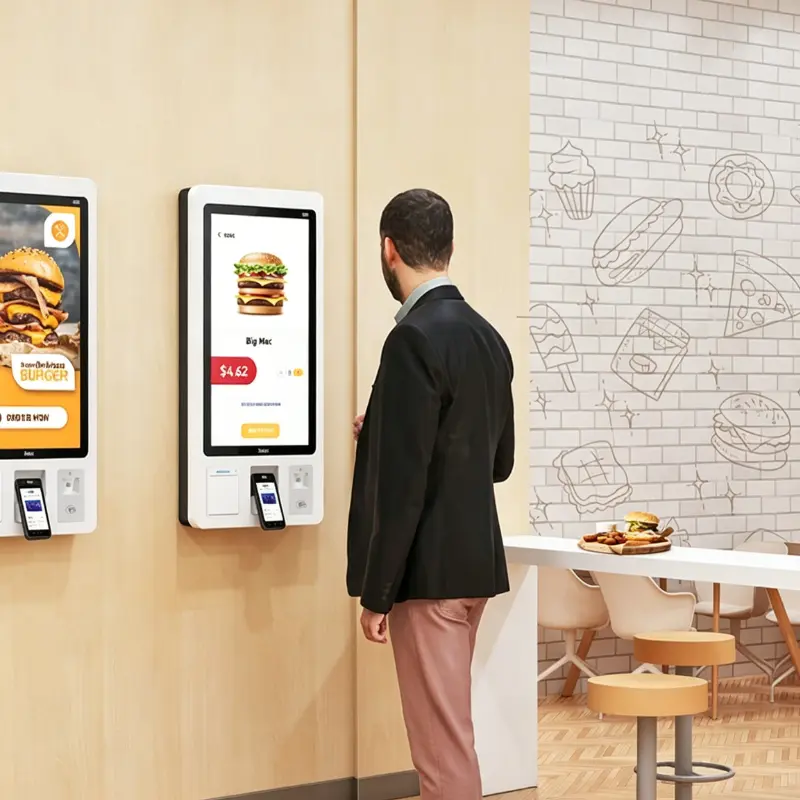
In 2026, most failed self-service catering upgrade projects stem from one single mistake: B2B buyers purchase generic touch screen order kiosk devices without matching store traffic density, indoor brightness, customer group age range, and peak order volume. Unlike standard payment terminals, touchscreen ordering kiosk devices face frequent fast tapping, repeated sliding, and high-frequency operation for 12–18 hours daily, which requires customized industrial-grade touch and panel standards rather than ordinary commercial screens. Blind specification matching causes 27% of store kiosks to suffer touch lag, screen reflection, and system crash during peak dining hours, directly reducing customer order completion rate and damaging store revenue.
Different catering and retail scenarios require completely different hardware configurations. Small cafes and snack shops with daily traffic below 500 customers adapt to 15.6–18.5 inch touch screen order kiosk with 300-nit standard brightness and 10-point capacitive touch. Standard fast-food restaurants and chain beverage stores with 800–2000 daily customers must deploy 21.5–24 inch touch screen ordering kiosk with 350–400 nit Grade-A anti-glare panels and 20-point high-precision touch technology. Large shopping mall food courts and busy airport catering outlets need 27-inch plus high-brightness models to resist strong ambient light and ensure zero reflection display.
All qualified touchscreen ordering kiosk devices for commercial catering pass CE-LVD, RoHS, and FCC industrial certification, with a stable MTBF of 50,000 working hours. This industrial index guarantees continuous stable operation for more than 5 years in high-frequency commercial scenarios, solving the core pain point of frequent replacement and high maintenance costs for low-quality civilian-grade ordering terminals.
2026 global chain catering renovation projects no longer adopt scattered hardware assembly methods. Integrated touch screen ordering kiosk turnkey solutions have become the standard configuration for large-scale QSR and retail chain upgrades. The essential reason is that integrated solutions unify hardware standards, operating systems, software ecosystems, and after-sales systems, avoiding compatibility failures and data disconnection caused by mixed-brand matching.
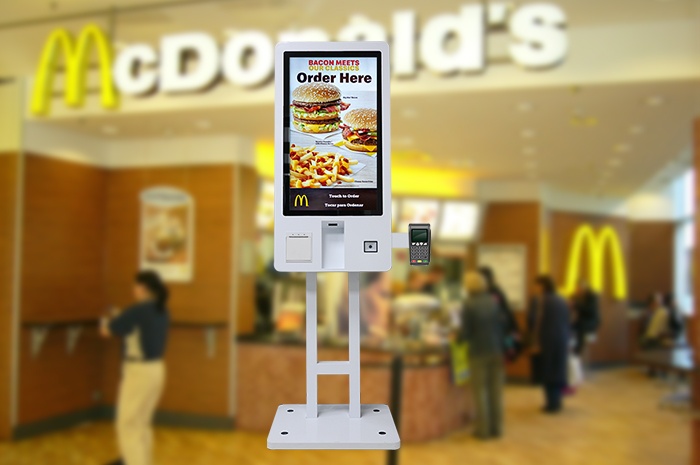
A complete touchscreen ordering kiosk system integrates touch display, QR code scanning, receipt printing, card payment, NFC wireless payment, and background order synchronization functions. It realizes one-stop self-service ordering, automatic order pushing to the kitchen, and real-time data statistics. Compared with manual ordering, standardized kiosk ordering reduces average single-store labor demand by 2–3 people, cuts manual error rate from 8% to 0.3%, and increases peak order processing capacity by 55%.
The supporting cloud centralized management system allows brand operators to remotely modify menu information, adjust product prices, push promotional activities, and count sales data for all offline touch screen order kiosk devices across the country. It completely solves the management pain point of slow information synchronization and inconsistent marketing activities for chain stores, helping brands achieve standardized and digital intelligent operations.
| Kiosk Size | Screen Brightness | Touch Type | Best Application Scenarios | Core Industrial Advantages |
|---|---|---|---|---|
| 15.6–18.5 Inch | 300 Nit | 10-point Capacitive Touch | Cafes, dessert shops, small beverage stores | Compact structure, low power consumption, cost-effective, 50000hrs MTBF, CE-LVD certified |
| 21.5–24 Inch | 350–400 Nit | 20-point Capacitive Touch | Standard QSR, fast food chains, milk tea chains | Grade-A anti-glare panel, fast response, multi-payment integration, IP54 dustproof |
| 27–32 Inch | 400–500 Nit | 20-point High-precision Touch | Shopping mall food courts, airport catering, large restaurants | Super anti-reflection, large display, advertising playback, high traffic adaptability |
All sizes in the table adopt Grade-A original industrial panels without dead pixels or color cast, fully adapting to long-term commercial continuous operation. The 0.1s ultra-low touch response speed ensures that customers complete ordering quickly during peak queues, effectively improving store turnover efficiency. Every touch screen order kiosk undergoes 72-hour continuous aging testing before delivery to ensure batch stability of large-scale chain projects.
B2B buyers need to clarify system selection logic before bulk procurement, because Android and Windows versions of touchscreen ordering kiosk apply to completely different business expansion needs.
Android 11/12/13/14/16 system is the mainstream cost-effective choice for chain catering in 2026. It features fast boot speed within 12 seconds, stable operation, low failure rate, and simple later maintenance. It perfectly matches standard ordering functions such as menu display, self-service selection, payment settlement, and receipt printing. Android-based touch screen ordering kiosk reduces comprehensive equipment cost by 20%–28% compared with Windows models, which is very suitable for standardized large-scale deployment of hundreds of chain stores.
Windows 10/11 IoT system is suitable for complex commercial scenarios that require docking with catering ERP systems, membership systems, and multi-dimensional data analysis platforms. Windows touch screen order kiosk supports deeper software secondary development, multi-task parallel operation, and more stable data synchronization, meeting the intelligent management needs of large catering groups and high-end brand stores.
In terms of customization, all touchscreen ordering kiosk supports brand LOGO customization, shell color customization, interface UI customization, and functional module combination customization. Manufacturers can adjust hardware configurations according to buyer’s local payment habits, language versions, and brand operation rules to achieve zero-docking barrier project delivery.
Most B2B buyers only focus on the upfront unit price but ignore the huge hidden costs of after-sales maintenance, system updates, and equipment replacement. Cooperating with head manufacturers with more than 15 years of intelligent terminal production experience can reduce the total ownership cost of touch screen ordering kiosk projects by 30% within 5 years.
First, manufacturers have stable Grade-A panel supply chain advantages, ensuring that every batch of touch screen order kiosk maintains consistent display effect and touch accuracy, avoiding frequent screen replacement losses caused by inferior panels. Second, mature mass production capacity can complete the delivery of more than 300 units of bulk orders within 30 working days, fully matching the rapid expansion cycle of global chain brands.
In addition, professional manufacturers provide lifelong free system firmware upgrades and software function optimization for touchscreen ordering kiosk. Unlike trading companies that cannot provide later iteration services, factory direct supply ensures that the equipment can always adapt to updated catering operation modes and new payment methods, extending the equipment service life from 3 years to more than 6 years.
Completed in August 2025, a large Southeast Asian milk tea chain store upgrade project deployed 186 sets of 21.5-inch touch screen ordering kiosk to solve the pain points of long queuing time, insufficient manual cashiers, and low order accuracy.
The project adopted standard Android industrial models, equipped with 400-nit Grade-A anti-glare panels, 20-point capacitive touch, built-in thermal printer, and multi-channel payment module. The system supports local Southeast Asian language switching and local mainstream payment channel docking, fully adapting to regional consumption habits.
After the equipment went online, the store average ordering time was shortened from 90 seconds to 35 seconds, the manual cashier pressure was reduced by 53%, the customer queuing complaint rate dropped to zero, and the store daily order volume increased by 29%. The stable operation rate of touchscreen ordering kiosk reached 99.87% within six months, verifying the high stability and high return value of industrial-grade ordering terminals in chain commercial scenarios.
Transparent pricing logic helps B2B buyers control project budgets accurately. The price fluctuation of touch screen ordering kiosk mainly comes from three variables.
First, procurement quantity. Orders above 100 units enjoy batch discount, and bulk orders above 300 units can obtain factory ex-factory price and free standard customization service. Second, hardware configuration differences: high-brightness anti-glare screen, Windows system, extended payment module, and customized shell will increase the cost appropriately. Third, delivery method and cycle: sea freight bulk shipment has the lowest logistics cost, while urgent air freight will generate additional expediting fees.
Q1: Does the touchscreen ordering kiosk support multi-language and regional local payment adaptation?
All devices support one-click switching of English, Arabic, Spanish and other multilingual interfaces, and can be customized to dock local mainstream payment methods in different regions, fully meeting global cross-border project deployment needs.
Q2: What is the after-sales guarantee for bulk kiosk orders?
We provide 2-year full hardware warranty and lifelong free software upgrade and technical support. 7×24-hour remote troubleshooting ensures no long-term shutdown impact on store business.
Q3: Can the manufacturer provide long-term spare parts supply?
We guarantee 8 years of complete spare parts supply for all touch screen order kiosk models, including touch screens, mainboards, printers and power modules, completely solving the later maintenance risk of chain projects.
If you are a chain brand operator, catering project integrator, or bulk procurement buyer, standardized hardware matching can no longer meet high-quality project delivery requirements. Contact our professional team now to get the exclusive 2026 Touch Screen Ordering Kiosk Project Specification Proposal, including scenario configuration suggestions, detailed parameter sheets, bulk quotation breakdown, and real overseas project cases, helping you complete low-TCO and high-stability smart catering project deployment.


 Floor 6, Building A, No. 3, North District, Shangxue Science and Technology City, Xinxue Community, Bantian Street, Longgang District, Shenzhen City
 info@szqunmao.com
 +86 15920011166
 +86 15920011166