English
 Español
 Português
 Français
 Русский язык
 Italiano
 Deutsch
 Nederlands
 لعربية
 한국어
한국어 Japanese
 ภาษาไทย
 Türkçe
 Tiếng Việt
 Bahasa Indonesia
 Hindi
Hindi kazakh
 Uzbek
Uzbek Thai
Thai Farsi
Farsi



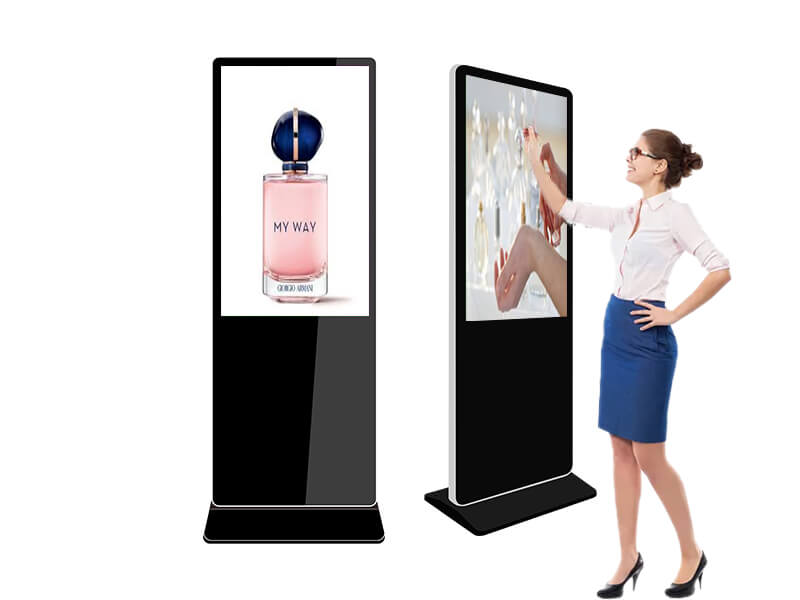
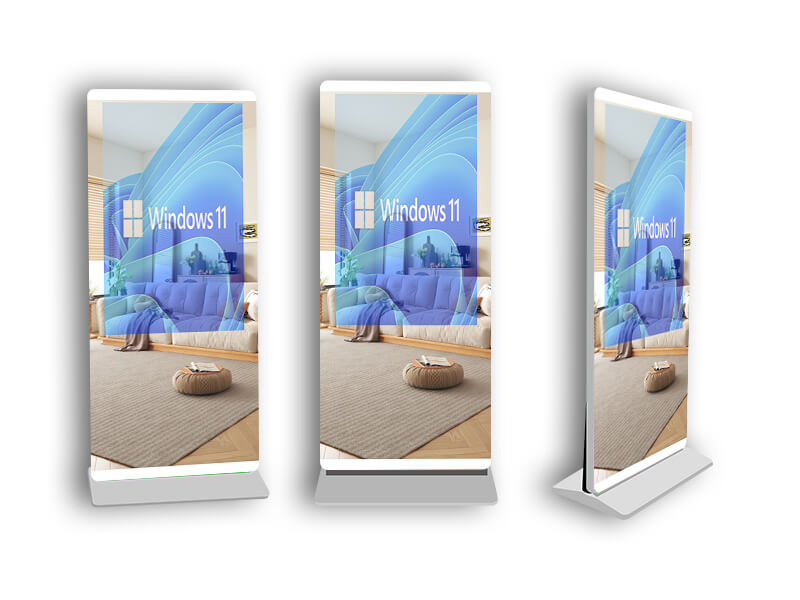
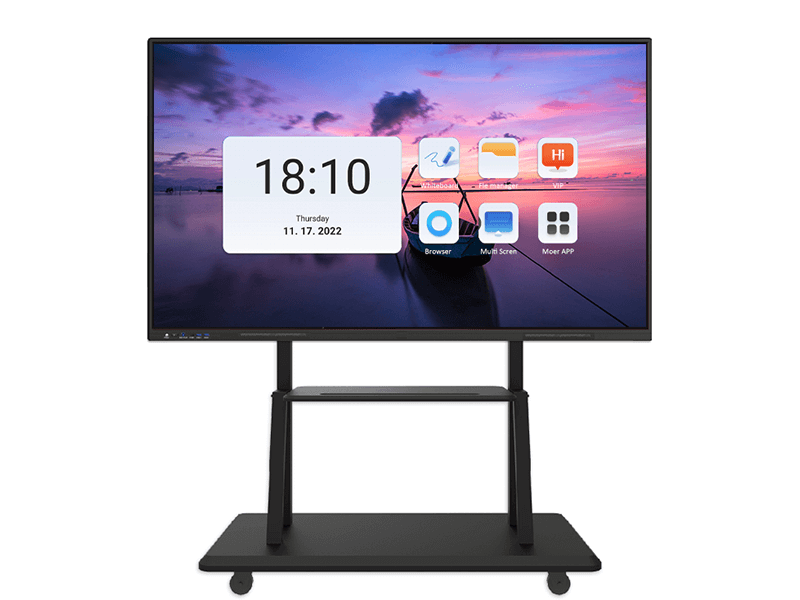
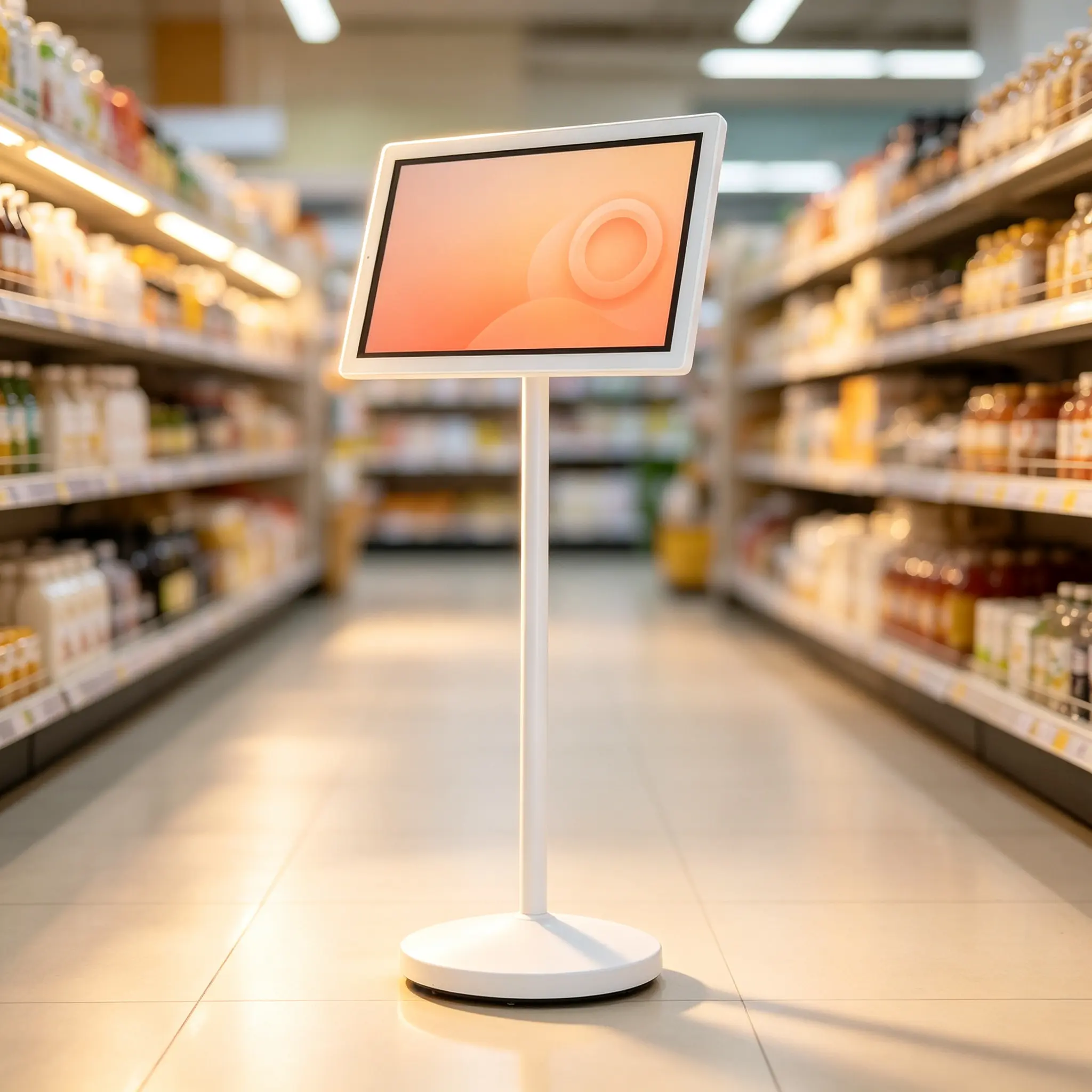
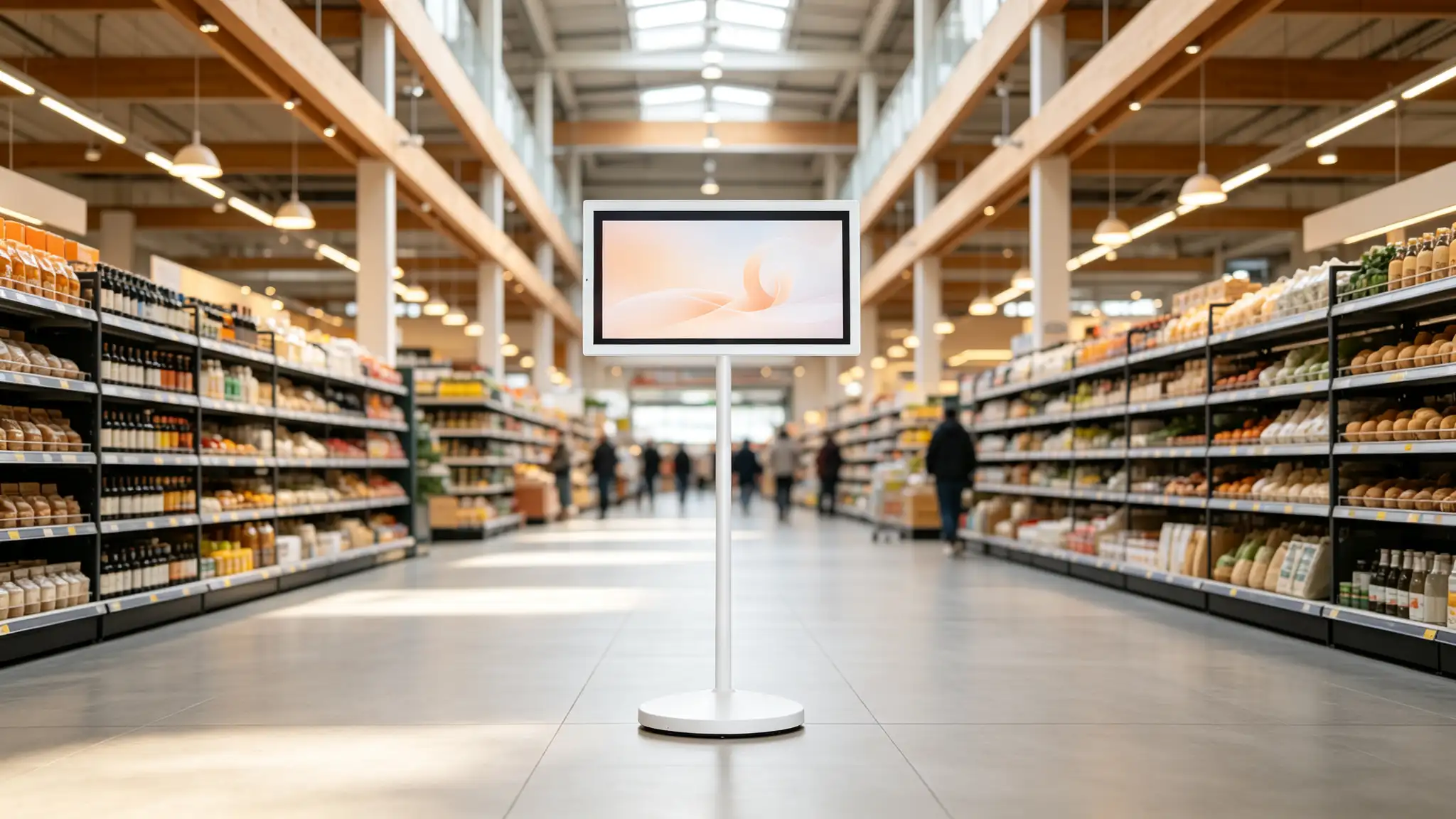
Portable Smart TV for Supermarkets
A movable, battery-powered Android touchscreen display on wheels for promotions, aisle engagement, checkout queue guidance, member campaigns and staff training.
21.5–32" touchscreen options Built-in battery Rolling stand with lockable casters Android smart display platform Portrait & landscape rotation Wireless casting & HDMI Optional camera, microphone & speakers CMS / MDM-ready options OEM/ODM branding available
Request a Supermarket Display Quote Download Specifications
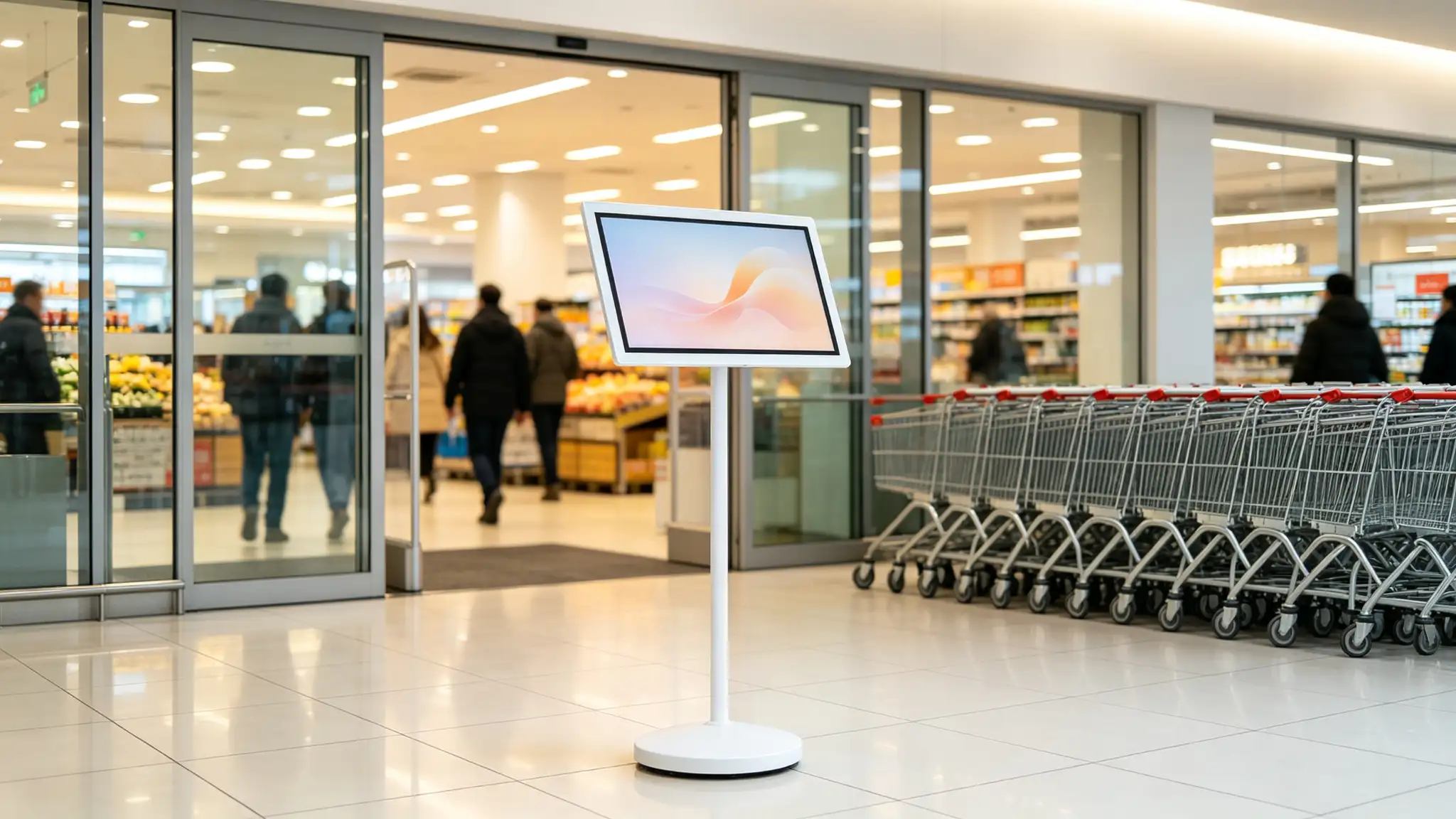
Why Supermarkets Need a Movable Smart Display
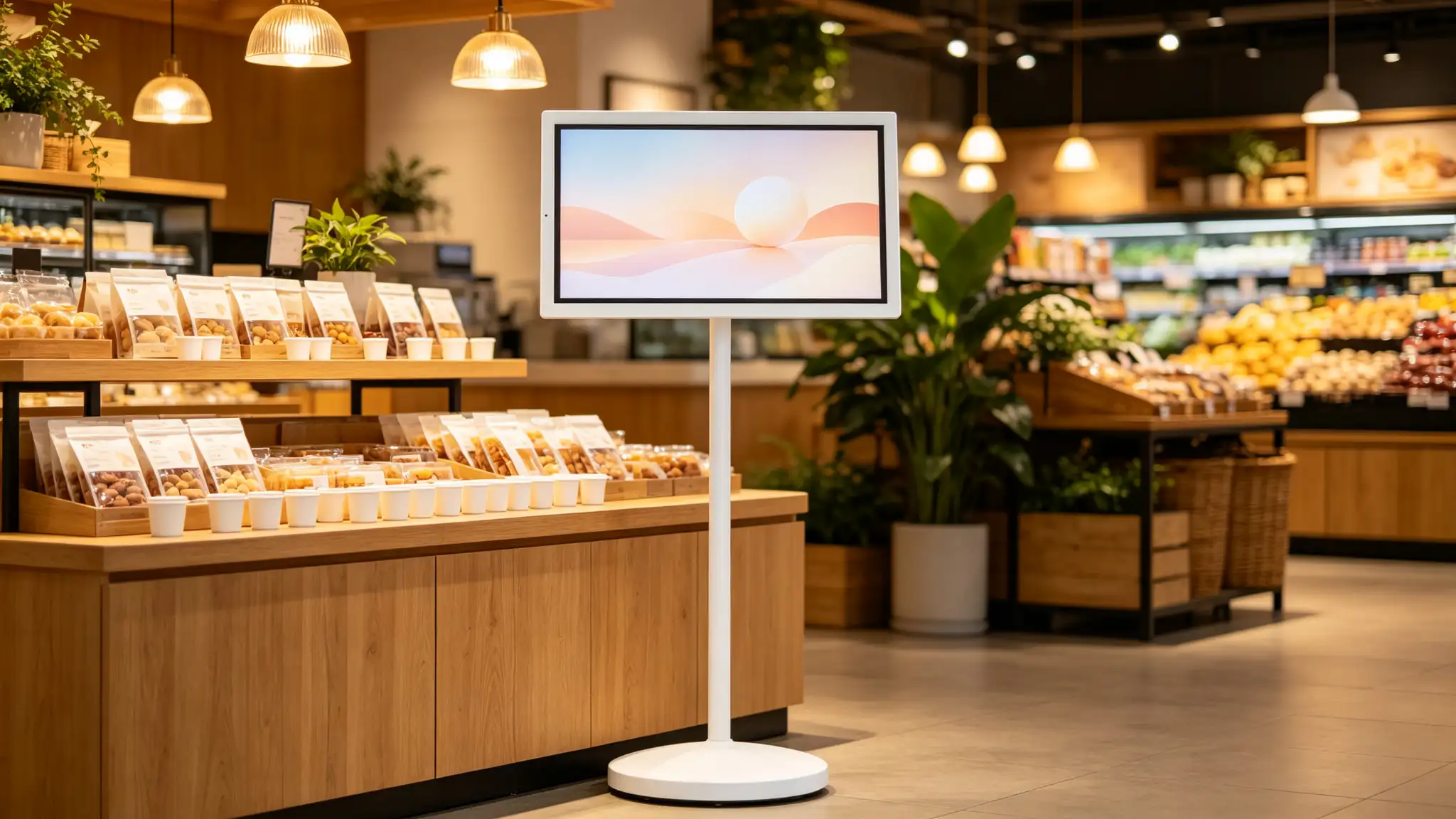
Supermarket promotions, traffic flow and store layouts change every day. Fixed digital signage works well for permanent locations, but it cannot quickly respond to temporary promotions, seasonal campaigns, tasting stations, member days, checkout peaks or pop-up events. A portable smart TV on wheels lets one screen serve different purposes in different zones at different times.
Flexible Promotion Coverage
One device can cover the entrance, main aisles, end caps, checkout area, tasting zone, member corner and staff training room.
Reduce Printed Materials
Replace paper posters, roll-up banners, temporary signs and manual announcements with dynamic digital content.
Support Member Campaigns
Display member QR codes, digital coupons, points campaigns and app download links at high-traffic points.
Multi-Store Content Control
With a compatible CMS or MDM option, headquarters can manage content across multiple supermarket locations.
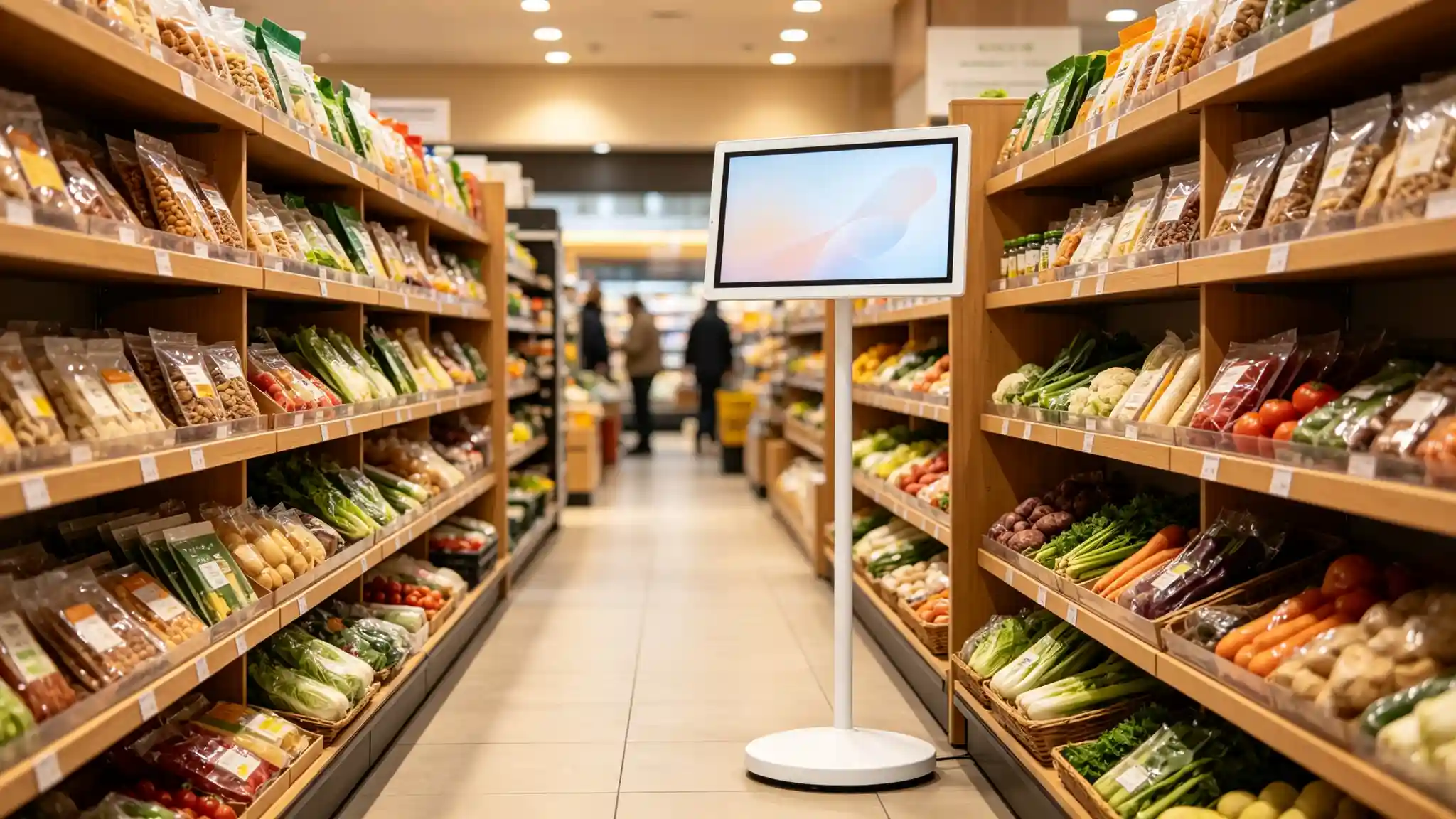
Typical Supermarket Applications
Entrance & Promotion Area
Today’s promotions, weekly specials, member registration QR code, digital coupon, opening hours, store map and seasonal campaign videos.
Main Aisle & End Cap
New product launches, category promotions, brand videos, product comparisons, recipe inspiration, bundle offers and QR codes for product details.
Fresh Food & Produce Area
Origin stories, freshness tips, cooking videos, recipe suggestions, seasonal produce, storage guidance and traceability QR codes.
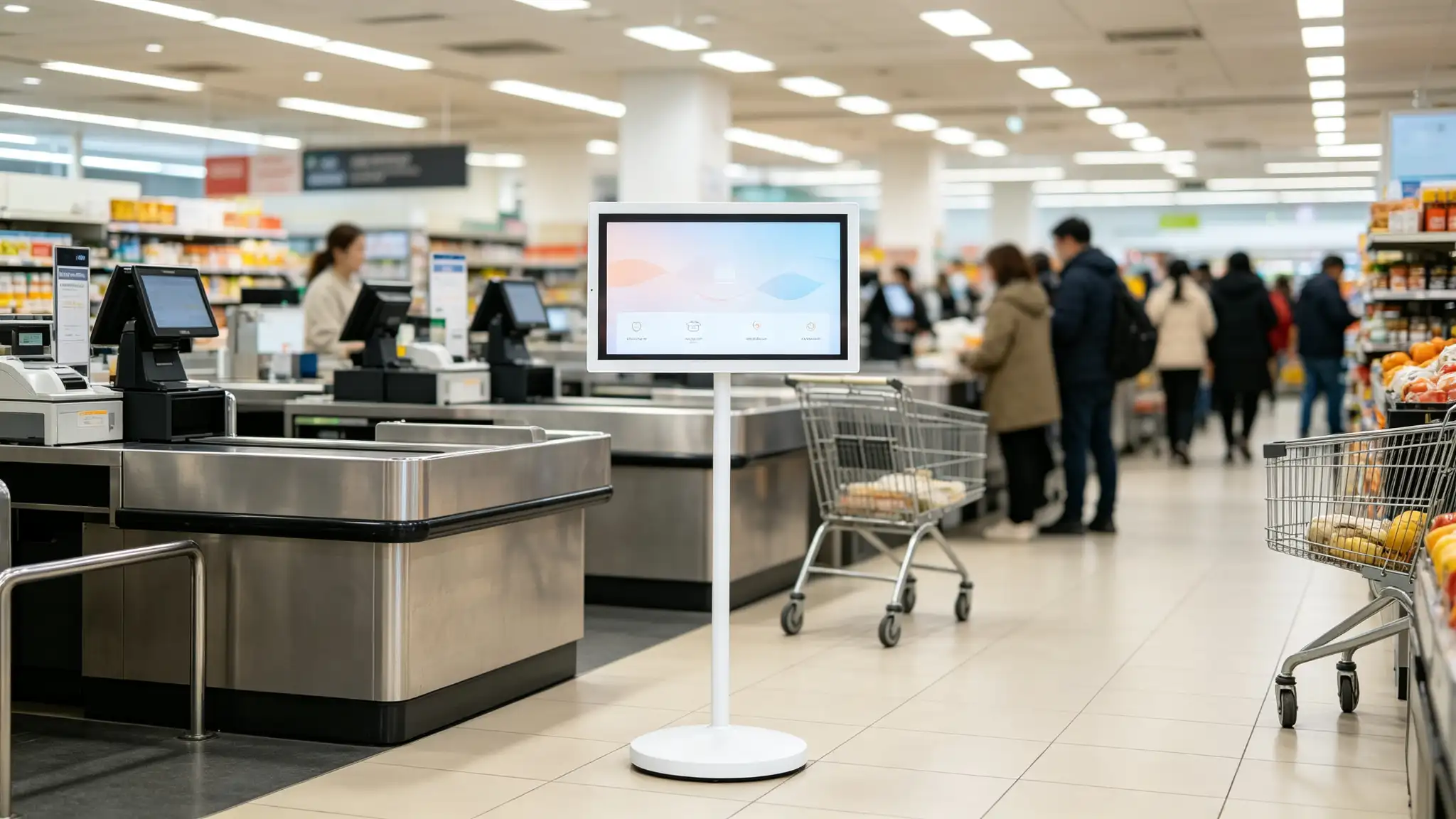
Checkout & Queue Area
Queue guidance, member points, digital coupons, payment QR codes, add-on recommendations, review QR codes and pickup instructions.
Tasting & Experience Zone
Product stories, tasting schedules, ingredient highlights, brand videos, QR coupon redemption, recipe pairings and event registration.
Member Campaign & Loyalty Zone
Member day offers, points campaigns, digital coupons, birthday offers, app downloads, referral programs and event check-ins.
Online Order Pickup Point
Pickup guidance, order status, locker instructions, delivery platform QR codes and customer service information.
Staff Training & Back Office
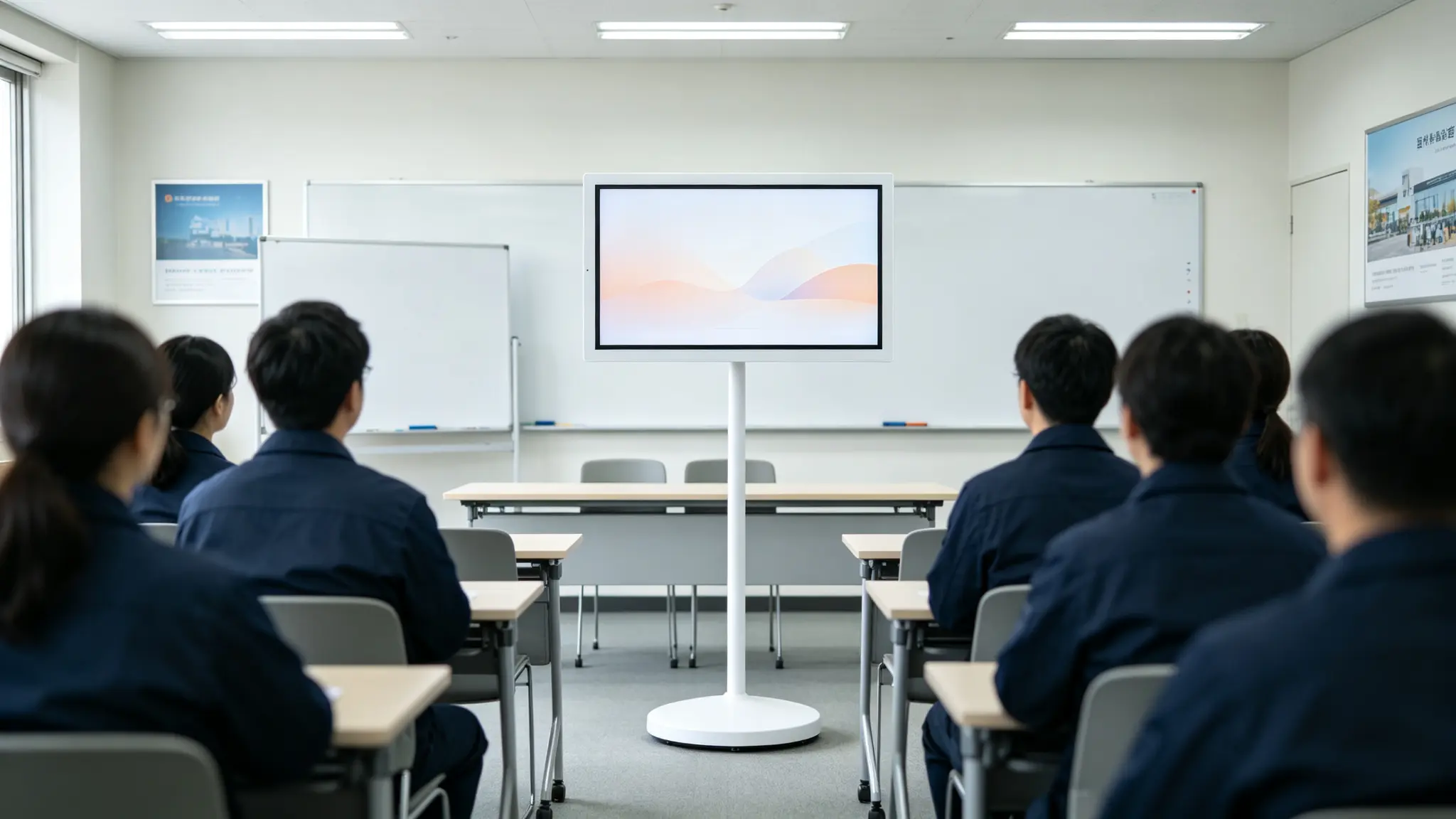
New product training, promotion briefings, food safety reminders, cleaning procedures, shift announcements and remote training sessions.
Pop-up & Mall Atrium Campaign
Brand campaigns, new store openings, holiday events, QR registration, social media campaigns and live streaming or video playback.
Core Features for Supermarket Operations
Display & Touch
21.5 / 24 / 27 / 32 inch options
Full HD / 2K / 4K by model
10-point capacitive touch optional
Non-touch version for playback only
Portrait and landscape rotation
Tilt and height adjustment
Anti-glare or protective glass options
Indoor brightness options for supermarket lighting
Mobility & Battery
Rolling floor stand with quiet casters
Lockable wheels and anti-tip base
Built-in lithium battery for mobile use
Plug-in operation for long sessions
Battery runtime depends on brightness, volume, video load, network, touch use and battery capacity
Runtime should be stated under defined test conditions
System & Connectivity
Android smart system
Wi-Fi, Bluetooth, HDMI, USB, USB-C
LAN if supported
Wireless casting
Google Play or pre-installed app ecosystem depends on model and region
Kiosk mode option, scheduled content playback, auto-start after power restoration
Audio, Video & Interaction
Optional front-facing or detachable camera
Built-in microphone and dual speakers
Video calls, remote training, product videos
Whiteboard and presentation, light office use
Content & Device Management
Local content playback, USB update if supported
App-based management, CMS compatibility, MDM compatibility
Remote content update, store grouping, daypart scheduling
Device status monitoring, user-permission management
CMS, MDM, POS integration and remote management capabilities depend on the selected Android system, application platform and project software solution. These should be described as optional integration capabilities.
Why Choose a Portable Smart TV on Wheels Instead of Fixed Signage?
| Item | Portable Smart TV on Wheels | Fixed Digital Signage | TV + Cart | Tablet |
|---|---|---|---|---|
| Mobility | High, can move across the store | None | Medium, no battery | High, but small screen |
| Battery | Built-in lithium battery | Usually none | Usually none | Yes |
| Touch | Optional | Some support | Usually none | Yes |
| System | Android smart system | Dedicated system | Standard TV system | Mobile system |
| Commercial Stand | Integrated floor stand | Fixed installation | Cart stand | None |
| Content Management | Local / casting / CMS optional | CMS | Limited | Limited |
| Best For | Multi-zone temporary promotions | Permanent wall locations | Temporary playback | Desktop display |
Plan the Display Around Supermarket Traffic and Content Workflow
Traffic Flow & Placement
Entrance: attract shoppers, member registration, event preview
Main aisle: category promotions, new product recommendations
End cap: brand campaigns, bundle offers
Checkout: queue guidance, member points, payment QR code
Tasting area: product story, tasting schedule
Pickup point: order status, pickup instructions
Staff area: training, shifts, food safety reminders
Content Scheduling
Breakfast, lunch and dinner time slots
Weekdays vs. weekends
Holidays and member days
New product launches and clearance promotions
Different stores, regions and store formats
Multi-language content
Emergency notices and temporary replacements
Charging & Storage
Daily charging location, backup battery plan
Storage space, doorway width, floor surface
Wheel locks and anti-slip, cable safety, child safety
Cleaning & Food Area Notes
Follow manufacturer’s cleaning instructions
Use soft cloth and approved screen cleaner
Avoid direct water spray, harsh chemicals and excess moisture
Fresh food areas need moisture and condensation evaluation
Do not assume the device is waterproof or suitable for direct washing
Privacy & Camera Use
Public-area camera use requires privacy notices
Do not enable facial recognition by default
Do not assume footfall analytics without a compliant software solution
Data collection, storage and processing must follow local regulations
Loss Prevention & Safety
Wheel locks, anti-theft options, movement permissions
Fixed placement in high-risk areas, anti-tip design
Power safety, device numbering and inspection
Procurement Checklist for Supermarket Buyers
Questions Before Ordering
Is the main goal promotion, membership, queue guidance, tasting or training?
Which zones need a screen during peak hours?
Does the device need to move every day?
Are doorway width, aisle clearance and storage space sufficient?
Is battery use required, or will the display remain plugged in?
Will customers touch the screen?
Is a CMS, local playback or wireless casting needed?
Must the screen run an existing retail app or content platform?
Is a camera needed, and how will privacy be managed?
Single store or multi-store deployment?
What local power, wireless and certification requirements apply?
How will screens, batteries, stands and accessories be serviced?
Total Cost of Ownership Considerations
Screen and stand configuration
Battery capacity and replacement policy
Lithium battery shipping classification
CMS / MDM software fees
Content production cost
Multi-store deployment labour
Charging and storage process
Warranty and spare parts
Screen protection, cleaning procedures
Local certification and plug adaptation
Camera / privacy compliance where relevant
Certifications & Shipping
UN38.3, MSDS, IEC 62133
CE, FCC, UKCA, PSE, KC, RCM
RoHS, REACH
Wi-Fi / Bluetooth certification
GDPR / CCPA where relevant
Because battery-powered smart displays may include lithium battery systems, shipping documentation, packaging method, transport restrictions and destination-market requirements should be confirmed before mass delivery.
After-Sales & Spare Parts
Replaceable power adapter
Battery-service planning
Spare remote control
Screen-protection recommendations
Spare caster or stand components
Remote software support
Batch deployment documentation
Store-level quick-start instructions
Multi-unit spare-parts strategy

Customize a Portable Smart TV for Your Supermarket Brand
Hardware Customization
Screen size, touch / non-touch, resolution
Battery capacity, charging method
Stand height, rotation and tilt mechanism
Caster type, wheel-lock option, base design
Camera module, speaker and microphone
HDMI, USB, USB-C interface selection
Housing material and colour, front-glass treatment, cable management
Software & Brand Customization
Logo printing, brand colour matching
Custom boot animation, Android launcher
Kiosk mode, pre-installed retail application
CMS compatibility, multi-language interface
Regional content settings, branded remote control
Packaging and user manual, power adapter and plug configuration
Suitable B2B Buyers
Supermarket chains, convenience store groups, warehouse clubs
Retail technology integrators, digital signage providers
POS and SaaS providers, AV integrators
Retail equipment distributors, franchise operators
Commercial display distributors
Configure a Portable Smart TV for Your Supermarket Network
Whether you need a flexible promotion screen for one supermarket, a member-engagement display for a checkout area or a portable smart-screen programme for a multi-store retail group, we can help configure the screen, stand, battery, Android platform and branding around your operating workflow.
Request a Quote Discuss Multi-Store Deployment Ask About OEM/ODM
Frequently Asked Questions
1. Is this product a portable smart TV or a supermarket digital signage display?
It can be used as both, depending on the configuration and software. In supermarket projects, it is best positioned as a portable smart TV or movable smart display that can play promotions, product videos, member campaigns, queue guidance and training content.
2. Can it be moved between the supermarket entrance, aisles and checkout area?
Yes, a rolling stand is designed for flexible indoor repositioning. Before deployment, confirm floor type, doorway width, aisle clearance, wheel-lock requirement, total device weight and storage location.
3. Does it need to remain connected to power?
A battery-equipped version can support temporary cable-free use. Actual battery runtime depends on brightness, audio, video playback, touch use, network activity, camera use and battery capacity. For long sessions, the unit can be used with a power connection if the selected model supports this mode.
4. Can it display supermarket promotions and product videos?
Yes. It can display promotion images, product videos, brand content, QR codes, member campaigns, queue guidance and pickup instructions. Content can be managed locally, by casting or through a compatible CMS, depending on the selected configuration.
5. Can customers use it to place orders or pay?
A touchscreen version can support menu browsing and interactive information. However, a full ordering or payment workflow requires compatible software, POS integration, payment processing and security compliance. If those elements are not included, the device should be described as an interactive display rather than a self-checkout kiosk.
6. Can it connect to a supermarket POS or CMS?
POS or CMS integration depends on the operating system, customer application, API availability and selected peripherals. Please provide the POS or CMS platform, required data flow and integration method for technical evaluation.
7. Can we install our own retail application?
Yes. A customer application can be pre-installed or deployed according to the agreed Android system configuration. Compatibility with touchscreen, camera, casting, peripheral access and remote management should be confirmed before production.
8. Is a camera suitable for supermarket public areas?
A camera can support video calls, remote training or in-store communication, but public-area camera use should be evaluated for privacy notices, consent requirements, data handling and local regulations. Camera-based analytics should not be assumed without a defined, compliant software solution.
9. Can it be used in fresh food or cold chain areas?
It may be used in selected indoor areas, but fresh food, cold chain and wet areas require careful evaluation of moisture, condensation, cleaning procedures, power safety and protection level. Do not assume the device is waterproof or suitable for direct washing unless the model specification confirms it.
10. How should the display be cleaned in a supermarket?
Follow the manufacturer’s cleaning instructions. Use a soft cloth and approved screen cleaner. Avoid direct water spray, harsh chemicals, abrasive materials and excess moisture around ports, cables and the battery compartment.
11. What certifications are required for battery shipping?
Common requirements may include UN38.3, MSDS, IEC 62133 and destination-market electrical and wireless certifications. Requirements vary by country and transport method. Confirm all documents before mass delivery.
12. Can the screen rotate between portrait and landscape?
A rotating-stand configuration may support portrait and landscape use. Confirm the actual rotation mechanism, supported angle and application UI requirements before finalizing the project.
13. Can it be deployed across multiple supermarket stores?
Yes, multi-store deployment can be supported with a suitable CMS or MDM configuration. Content grouping, daypart scheduling, remote updates and device monitoring should be confirmed as optional project capabilities.
14. What information is required for a quotation?
Please provide the intended supermarket application, preferred screen size, quantity, touchscreen requirement, battery requirement, camera and audio requirement, Android application or CMS requirement, connectivity requirement, branding needs, destination market and target delivery schedule.
15. Is the device suitable for outdoor use?
Standard models are typically designed for indoor use. Outdoor, semi-outdoor or direct sunlight environments require confirmation of brightness, protection level, temperature range, power safety and warranty conditions.