English
 Español
 Português
 Français
 Русский язык
 Italiano
 Deutsch
 Nederlands
 لعربية
 한국어
한국어 Japanese
 ภาษาไทย
 Türkçe
 Tiếng Việt
 Bahasa Indonesia
 Hindi
Hindi kazakh
 Uzbek
Uzbek Thai
Thai Farsi
Farsi
Qtenboard MG520.U Mainboard For Premium Conference Interactive Flat Panel
 2026-08-17
 331
331



2026-08-17
331
Core Hardware For Premium Conference Interactive Flat‑Panel Terminals
Smart office hardware keeps rolling out across enterprise sites. You build interactive flat‑panel devices for meeting rooms, lecture halls and exhibition spaces. One weak component can ruin the whole user experience. Many finished panels suffer from frozen screens, dropped video frames, or unstable peripheral connections. Those issues trace straight back to the mainboard underneath.
Qtenboard MG520.U is purpose‑built for high‑end conference interactive flat panels. It sits on the proven MTK G520 main control platform. Engineers ran multiple rounds of real‑scene tuning before releasing official V1.1 firmware. The hardware first launched January 2026. Full datasheets and real‑unit photos became available in March 2026. You deploy this board inside government meeting rooms, enterprise conference spaces, smart exhibition halls and multi‑function lecture halls. It handles heavy daily commercial workloads you cannot test with consumer‑grade circuit boards.
You can drop cheap generic mainboards into your product bill of materials. You will see complaints from end‑users within months. Slow touch response, random reboots under long‑hour playback, limited port options stop teams from using extra microphones or sensors. MG520.U solves these real‑world pain points for hardware manufacturers and solution integrators.
This board runs on heterogeneous multi‑core architecture. Two ARM Cortex‑A78 high‑performance cores pair with six ARM Cortex‑A55 efficiency cores. The G57 MC2 GPU takes charge of graphic rendering, video output and interface drawing. You run multiple jobs at one time. Video decoding runs alongside whiteboard software and background network services. The system does not stall when you open several business applications.
Standard memory configuration uses 8GB DDR4. You upgrade up to 16GB DDR4 for heavier multi‑app workloads.
Base flash storage reads 128GB eMMC. Max hardware upgrade reaches 512GB. Store large courseware packages, local meeting software and cached video resources directly on‑board.
Deeply customized Android 16.0 builds on kernel version 6.1. System developers adjusted touch‑input stack, casting modules and peripheral driver layers. Actual testing cuts frame drop occurrences during screen‑casting sessions.
Native hardware support for 4K@60Hz dual‑screen display. 4K@60fps hardware video decoding works for mainstream video formats. You deliver sharp moving pictures for remote video meetings, courseware playback and split‑screen content demonstration.
Many competing boards lock memory and flash size. You cannot expand later even if your client raises project requirements. MG520.U keeps expandable hardware slots. You adjust hardware specs according to project bids without switching to an entirely different mainboard model. This shortens your hardware validation cycle for different customer orders.
Commercial conference terminals connect to dozens of external pieces. You hook up microphones, sensors, speakers, secondary displays and central‑control equipment. Limited port selection forces you to add extra adapter boards. Adapters raise assembly cost and introduce extra points of failure on production lines.
MG520.U carries a full physical port array right on the mainboard. You get RS232 serial port, fiber output, dual RJ45 network ports, TF card slot, multi‑group USB ports, HDMI, DP and VGA interfaces. You pick wireless communication modules for your target market. Two mainstream combinations exist: Wi‑Fi 6 plus Bluetooth 5.2, or Wi‑Fi 7 plus Bluetooth 5.4. You place custom orders for your exact project needs.
Hardware interface reserved for 8‑channel PDM array microphones. Pick up voices across large meeting rooms without extra signal conversion boards.
Reserved signal paths for NFC modules, ambient light sensors and human‑detection sensors. Add access control or auto‑brightness features to your finished devices.
Audio output supports 2.0‑channel or 2.2‑channel speaker sets with subwoofer connection. Sound output stays stable for large‑space broadcast scenarios.
You cut auxiliary board count inside your finished interactive panels. Fewer internal cables speed up assembly work and lower defect rates on mass‑production lines.
Conference equipment often runs many hours each day. Exhibition‑hall devices can stay powered 7 days each week. Voltage surges, unstable input power or improper power‑on timing damage consumer‑oriented boards quickly. You face high after‑sales repair rates if you select hardware not built for long‑cycle commercial use.
MG520.U supports multi‑voltage power input including 5V, 5V standby, 12V and 18V. Every circuit channel adds strict voltage‑current limiting rules. Standardized power‑on sequence protects chips from voltage spike harm. Standby power consumption sits below 0.3W when wake‑up functions stay disabled. That number brings real power savings for devices that keep long‑term standby status.
USB 2.0 ports limit maximum output current to 500mA. This rule avoids peripheral‑triggered short‑circuit risks on the whole board.
Component selection follows commercial‑grade standards. Key circuit parts pass repeated load testing before mass‑production release.
End‑user sites cover office buildings, humid coastal exhibition halls, dry northern lecture rooms and temperature‑variable public spaces. Temperature and humidity swing widely from one installation spot to another. Your finished hardware must hold steady under these variable real‑world conditions.
Operating temperature window runs 0℃ to 40℃. Storage temperature spans ‑20℃ to 85℃. Working humidity accepts 10%‑85% non‑condensing environment. Storage humidity covers 10%‑90% non‑condensing. All environmental validation tests follow national standard GB/T 2423. Connectors use standardized pin definitions. Your production team finishes assembly, debugging and maintenance steps faster. Production cost and after‑sales service cost drop for batch‑volume projects.
Important Static‑Protection Reminder: This mainboard counts as electrostatic‑sensitive hardware. Operators must complete anti‑static protection steps during installation work. Never plug‑or‑unplug cables while the board stays powered on. The mainboard supports mainstream audio‑video formats AAC, DTS, H.264, H.265 and AV1. You take full responsibility for finishing relevant patent authorization work for interface and multimedia functions when you sell finished end‑products.
| Comparison Item | Qtenboard MG520.U | Generic Mid‑range Conference Mainboard |
|---|---|---|
| CPU Configuration | 2×Cortex‑A78 + 6×Cortex‑A55 Octa‑core | Quad‑core or hexa‑core mixed architecture |
| Memory & Storage Expand | RAM:8GB‑16GB; ROM:128GB‑512GB | Fixed memory, limited flash upgrade options |
| System Version | Custom Android 16.0, kernel 6.1 | Android 13 / 14, generic BSP |
| Display Output | 4K@60Hz dual‑screen output | Single‑screen 4K output mostly |
| Network Ports | Dual RJ45 gigabit network port | Single RJ45 port on most models |
| Wireless Module Options | Wi‑Fi6+BT5.2 / Wi‑Fi7+BT5.4 optional | Fixed Wi‑Fi5 + BT5.0 |
| PDM Microphone Support | 8‑channel PDM array microphone hardware reserved | Limited 2‑channel microphone input |
| Standby Power Consumption | <0.3W (without wake‑up trigger) | 0.8W‑1.2W typical value |
| Operating Temperature | 0℃ ~ 40℃ commercial grade | 5℃ ~35℃ narrow temperature window |
| Serial & Special Interface | RS232, fiber output, multi‑sensor reserved pins | Few industrial‑control reserved interfaces |
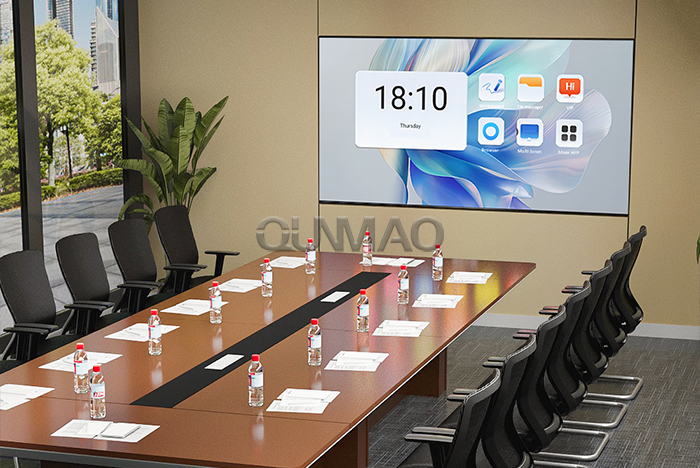
Enterprise Government Meeting Rooms: Drive interactive flat panels for daily team meetings, cross‑branch remote video sessions. Stable multi‑task performance prevents crashes during long‑time video‑conference work.
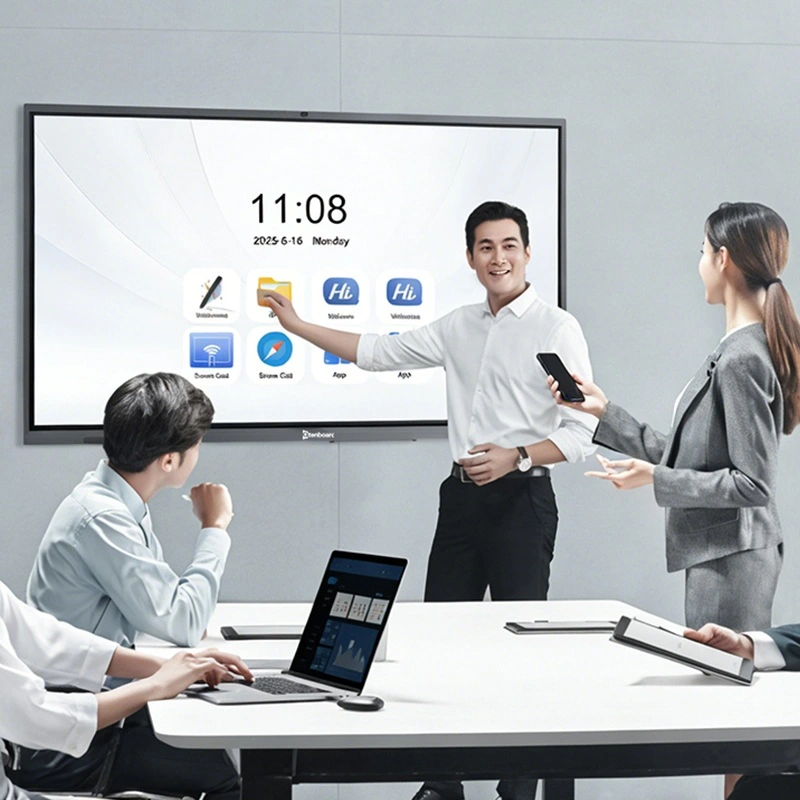
Multi‑function Lecture & Training Halls: Connect array microphones and large speaker systems. Run courseware playback, on‑screen annotation and multi‑person writing functions. Expand storage to hold large local teaching resource packages.
Smart Exhibition Halls & Public Lobbies: Support 7×24 cyclic video playback. Low standby power cuts long‑term energy use. Link with central‑control hardware through RS232 serial ports for unified device management.
Custom Commercial Interactive Terminals: Reserve hardware paths for NFC, light sensors and human‑detection modules. You build differentiated finished products for special‑purpose commercial projects.
Q1: Can I switch RAM and flash size after buying the mainboard?
Hardware chips are soldered onto the circuit board. You cannot modify memory or flash after manufacturing. You pick your target RAM and ROM combination before order placement. Two mainstream choices exist: 8GB+128GB for standard projects and 16GB+512GB for heavy‑load terminals.
Q2: Does MG520.U support Windows operating system?
This mainboard builds on MTK G520 platform. It only runs customized Android 16.0. It cannot boot Windows. If your end‑customer requires Windows‑based devices, you need to select OPS x86 compute modules for your interactive flat‑panel products.
Q3: What wireless module combinations can I select?
Two official options are available. One is Wi‑Fi6 plus Bluetooth5.2. The second is Wi‑Fi7 plus Bluetooth5.4. You specify your selection when you place purchase orders. You cannot swap wireless modules on finished boards without hardware rework.
Q4: Can I use 8‑channel PDM microphones directly out‑of‑box?
The board reserves hardware signal paths for 8‑channel PDM array microphones. You still need to finish driver configuration and audio‑parameter tuning in firmware development phase. Raw hardware connection does not bring full audio functions automatically.
Q5: What risks appear if you ignore anti‑static operation during installation?
Electrostatic discharge can damage mainboard chips without visible burn marks. Partial circuit damage causes random crash, unstable peripheral identification or intermittent touch‑screen failure. Those faults are hard to reproduce in lab testing. Always use anti‑static wrist straps and anti‑static work benches during assembly.
Q6: Is dual‑RJ45 network port functional for two independent local networks?
Yes. Two gigabit RJ45 ports work independently. You connect one port to internal enterprise LAN and connect the second port to public internet. This fits government‑level network‑isolation project requirements you often meet in tender projects.
Q7: What test standards apply for environmental validation?
All temperature and humidity testing follows GB/T 2423 national standard. Real‑world installation still needs ventilation inside finished equipment housing. Do not seal the mainboard inside zero‑ventilation narrow spaces.
Q8: Who takes charge of multimedia format patent authorization?
The mainboard supports hardware decoding for AAC, DTS, H.264, H.265 and AV1. You, as product integrator or manufacturer, handle all relevant patent authorization work before selling finished end‑products to market.
Define real‑world workload of finished devices. Pick 8GB or 16GB RAM according to multi‑app running demands.
Confirm wireless module variant before order submission, choose between Wi‑Fi6+BT5.2 or Wi‑Fi7+BT5.4.
Sort out peripheral device list: array microphones, NFC, light sensors, sub‑woofer speakers. Verify all needed interfaces exist on MG520.U.
Clarify network requirements. Dual‑RJ45 ports solve physical network‑isolation needs for government and enterprise tender projects.
Reserve firmware development cycle. Custom driver tuning is required for PDM microphone and sensor accessories.
Add anti‑static operation rules into your production‑line work instructions. Prevent hidden electrostatic‑damage faults.
Your interactive flat‑panel product lives or dies by its mainboard. You spend money on high‑quality screens and touch layers. A low‑grade compute board will waste that investment. MG520.U delivers expandable interfaces, industrial‑grade electrical protection and wide environmental tolerance. It serves as a solid core hardware solution for smart conference and commercial‑display manufacturing partners.


 Floor 6, Building A, No. 3, North District, Shangxue Science and Technology City, Xinxue Community, Bantian Street, Longgang District, Shenzhen City
 info@szqunmao.com
 +86 15920011166
 +86 15920011166