English
 Español
 Português
 Français
 Русский язык
 Italiano
 Deutsch
 Nederlands
 لعربية
 한국어
 Japanese
 ภาษาไทย
 Türkçe
 Tiếng Việt
 Bahasa Indonesia
 Hindi
 kazakh
 Uzbek
 Thai
 Farsi

OEM Digital Signage for Supermarkets: Customization & Lead Time
 2026-11-12
 5



2026-11-12
5
For a supermarket chain or retail distributor, ordering OEM digital signage for supermarkets is not the same as buying a standard screen and adding a sticker. A private-label order usually combines branding, hardware configuration, pre-installed CMS software, and packaging changes — and each of those affects how long production takes. This guide breaks down what can actually be customized, which items are standard versus custom, and how to structure lead-time questions so a project delivery date is based on the right assumption.
A single-unit buyer mainly checks whether the screen works. A factory oem digital signage in supermarkets buyer checks four other things: whether the brand can be applied, whether the CMS can be pre-installed, whether packaging can be changed for distribution, and whether the delivery schedule matches a store rollout. In a supermarket project, OEM is less about the logo and more about hardware, software, packaging, and delivery rhythm together.
The product page lists boot animation customization as supported. In practice this covers logo placement, startup screen, and carton marking. Buyers should confirm at quotation stage which of these are included in the standard OEM package and which are charged separately, because “OEM support” on a product page does not automatically mean every branding item is free.
The 27-inch model lists RAM options of 1/2GB, storage options of 8/32GB, and Android 9.0–16.0. Hardware configuration should match the CMS or app the project will run. A higher RAM and storage configuration is a customization item, not a standard stock variant, so it affects both cost and production scheduling.
The product page states pre-installed display software, support for installing third-party software, and open system authorization that allows root permission and custom software development. For supermarket projects, CMS preload is usually the most important OEM item — and the one most likely to affect lead time, because it involves software adaptation and testing rather than just hardware assembly.
The 27-inch model lists a packing size of 725×640×120mm, carton packing, and a gross weight of 8KG. Distribution orders often need changed carton marking, barcodes, or multilingual documentation. Packaging changes affect container planning and require their own production scheduling, so they should be raised together with the OEM request rather than added later.
| Item | Standard | Custom | Lead-time impact |
|---|---|---|---|
| Logo / boot animation | No branding | Customizable | Medium |
| RAM / storage | 1/2GB, 8/32GB | Configured to project | Medium to high |
| CMS preload | Pre-installed display software | Project CMS preload or development | High |
| Packaging | Standard carton | Changed marking / barcode / documentation | Medium |
| System authorization | Standard | Root permission / custom development | High |
The more custom items in an order, the less it makes sense to quote a project date from standard stock availability. The 27-inch model is listed with 3,000–5,000 units in stock per month, but that figure applies to standard configurations, not to a fully customized OEM build.
Lead time in a supermarket OEM order is not one number. It breaks down by item:
Standard model. Stock availability is the main constraint, and the product page cites monthly stock of 3,000–5,000 units.
Branding and boot animation. Requires additional production and flashing time on top of the standard build.
Hardware configuration change. Requires material confirmation and production line scheduling.
CMS preload or custom software development. Requires software adaptation and testing, and is usually the item that extends lead time the most.
Packaging changes. Requires printing and packaging scheduling.
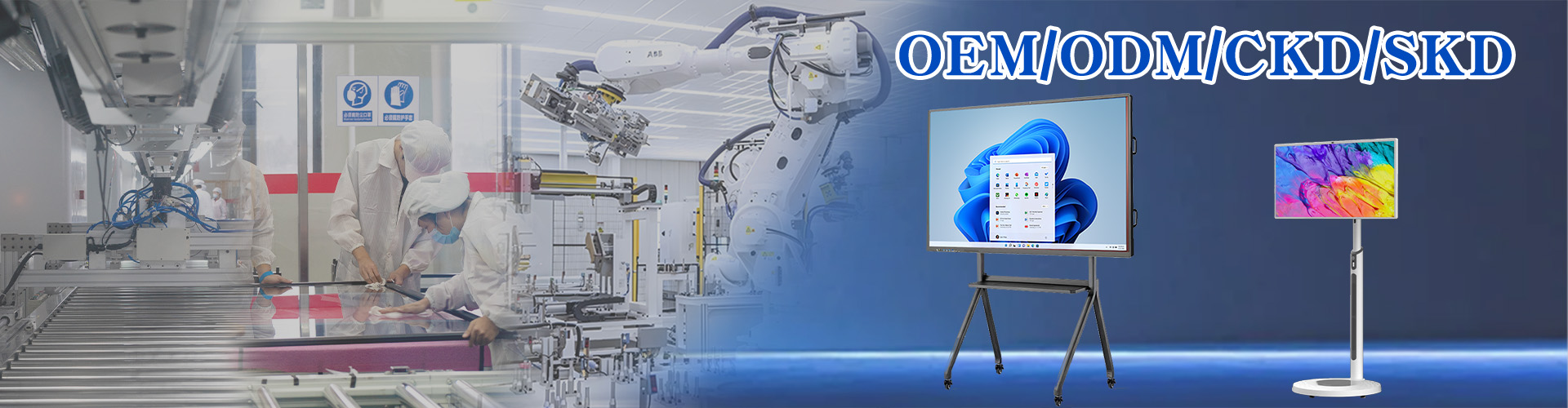
For a project with a fixed opening date, the practical approach is to ask for lead time in three tiers — standard, private-label, and deep customization — rather than a single quoted lead time. The OEM and ODM services page covers the broader process.
Do not commit to a project date using standard-model lead time. A customized OEM build with CMS preload and packaging changes follows a different production path. Confirm the lead time for the specific configuration being ordered, in writing, before signing a project schedule.
MOQ. Confirm the minimum order quantity for the OEM configuration, not just for the standard model.
Itemized pricing and lead time. Ask for branding, boot animation, and packaging changes to be quoted and scheduled separately.
CMS compatibility. Confirm whether the project’s CMS is supported, and whether root permission or custom development is required.
Hardware configuration and certification. A configuration change may affect which certificates apply — confirm this with the supplier rather than assuming the standard certificate covers the customized build.
Spare parts and warranty. Confirm whether the customized configuration carries the same spare-parts and warranty terms as the standard model.
Phased delivery. Supermarket projects often go live store by store — confirm whether partial shipments are possible.
For multi-store rollouts: ask whether the OEM configuration can be produced in batches matched to store opening dates, rather than one large production run. This affects both inventory holding and cash flow.
Treating OEM as “logo only” and ignoring the lead-time impact of CMS preload and hardware configuration.
Committing to a project date using the standard model’s lead time.
Not confirming CMS version compatibility until after production.
Raising packaging changes late, after container planning has been done.
Assuming the standard certificate covers a customized hardware configuration.
Ignoring phased delivery needs, which leads to excess inventory and cash-flow pressure.
MOQ for the OEM configuration confirmed
Branding, boot animation, and packaging quoted and scheduled separately
Hardware configuration (RAM / storage) defined against the CMS requirement
CMS preload and root permission confirmed with the supplier
Certification status confirmed for the customized configuration
Lead time confirmed in three tiers: standard, private-label, deep customization
Phased delivery option confirmed for multi-store rollouts
Spare-parts and warranty terms confirmed in writing
Planning an OEM supermarket signage order?
Send your brand requirements, CMS details, hardware configuration, packaging needs, and store rollout schedule — we will confirm what can be customized, the lead time for each tier, and OEM/wholesale pricing.


 Floor 6, Building A, No. 3, North District, Shangxue Science and Technology City, Xinxue Community, Bantian Street, Longgang District, Shenzhen City
 info@szqunmao.com
 +86 13148726043
 +86 13148726043